
Digital businesses now operate without borders, but customer verification has not kept pace with this global reach. A single onboarding flow may need to process passports from 190+ countries, match names across multiple languages, and comply with different AML and data protection rules at the same time. According to Juniper Research, identity fraud losses are expected to exceed 50 billion dollars globally by 2026, driven largely by cross-border digital onboarding gaps. This makes global KYC and international identity verification essential for secure growth.
Global KYC is the structured framework used to identify, verify, screen, and assess customers across multiple jurisdictions. It combines international identity verification with AML screening, customer due diligence, and risk assessment to ensure businesses can confidently onboard users anywhere in the world. Importantly, global identity verification is only one part of the wider KYC process and does not replace regulatory checks or ongoing monitoring.
This guide explains what global KYC means in practice, how international ID verification works, the core compliance checks involved, and why requirements differ between countries. Binderr Services unifies international identity verification, AML screening, risk assessment, due diligence, and ongoing monitoring in one configurable workflow, enabling seamless cross-border onboarding without disconnected systems.
Binderr Global KYC Software Solution
Binderr provides a unified global KYC solution for businesses that need to verify customers, screen for financial crime risk, and manage due diligence across multiple jurisdictions.
- AI-powered identity document verification
- Coverage across 230+ countries
- Biometric face matching between the customer and their identity document
- Sanctions, PEP, watchlist, and adverse media screening
- Automated customer risk scoring
- Continuous monitoring with alerts for new risks
What Is Global KYC?
Global KYC is the process of identifying, verifying, and assessing customers across multiple countries using international identity verification, AML screening, and customer due diligence to support secure cross-border onboarding. It combines document verification, biometric checks, risk assessment, and ongoing monitoring to ensure businesses can confidently verify users worldwide while meeting different regulatory requirements and managing financial crime risk.
Faster KYC Starts Here with Binderr
Global KYC Requirements in 2026
Global KYC requirements in 2026 are shaped by international AML frameworks, national regulations, and emerging digital identity standards. There is no single global KYC law, so businesses must follow local rules while applying international customer due diligence and risk-based principles.
The 2026 overview below is a reference guide, not legal advice.
FATF Customer Due Diligence Standards
FATF CDD standards are the global baseline for KYC compliance. They require businesses to identify and verify customers using reliable data, understand the relationship purpose, identify beneficial owners, and apply enhanced due diligence for higher-risk cases.
The 2025 update emphasises proportionality, meaning controls should match customer and jurisdiction risk. Low-risk cases may qualify for simplified checks, while high-risk customers require stronger verification. Ongoing monitoring is also essential, making KYC a continuous process rather than a one-time check.
Representative Regulatory Developments
Global KYC in 2026 is shaped by several key regulatory changes. FATF remains the international benchmark, while each country applies its own rules. In the EU, the AML Regulation (effective July 2027) makes 2026 a preparation year for harmonised compliance.
Digital identity is also expanding, with the EU Digital Identity Wallet expected by the end of 2026. In the UK, identity verification for company directors and PSCs is being rolled out in phases. In the US, FinCEN continues refining beneficial ownership rules to reduce repeated checks. Australia is also increasing the use of digital identity and biometrics within a risk-based CDD approach.
What Is Global ID Verification?
Global ID verification is the process of confirming a person’s identity using internationally accepted documents such as passports, national ID cards, and driving licences, regardless of their country of origin. It combines advanced technologies like document authentication, OCR data extraction, NFC chip reading, biometric face matching, and liveness detection to ensure the identity is genuine and belongs to the person presenting it.
Unlike local verification systems, global ID verification is designed to handle multiple languages, document formats, and security standards across jurisdictions, making it essential for international onboarding, cross-border KYC, and remote customer verification in a secure and compliant way.
Verify Identities with Confidence
How Does Global KYC Work?
Global KYC combines international identity verification, cross-border KYC processes, AML screening, and risk-based customer due diligence across multiple jurisdictions.
It enables businesses to onboard global customers through a structured, compliant, and scalable identity verification workflow.
Step 1. Determine the Applicable Jurisdiction and Rules
Global KYC and international identity verification begin by identifying which legal and regulatory frameworks apply. This includes where the business is incorporated, where it is licensed, where the customer is located, and which financial regulator oversees the activity. It is also important to assess whether cross-border KYC restrictions or AML compliance obligations apply across multiple jurisdictions.
In global identity verification, the country shown on an identity document may not match the customer’s actual residence, tax residence, nationality, or transaction location. This makes jurisdiction mapping essential for accurate KYC compliance, AML screening, and risk-based customer due diligence in cross-border onboarding.
Step 2. Collect Customer Information
The next stage of international KYC involves collecting core customer identity data to support verification and AML compliance. This typically includes full legal name, previous names, date of birth, place of birth, nationality, residential address, contact details, occupation, employer, and tax identification number.
Businesses also gather information about the intended product or service, purpose of the relationship, and expected transaction activity. This data supports customer due diligence (CDD), risk assessment, and ongoing monitoring within a global KYC framework.
Step 3. Select the Appropriate Verification Method
Choosing the right identity verification method depends on the customer’s country, available identity documents, and the level of regulatory risk. High-risk customers or jurisdictions may require enhanced KYC checks, stronger AML screening, or additional biometric verification.
Other factors include whether onboarding is remote or in-person, fraud risk levels, accessibility needs, and the required identity assurance level. Selecting the correct global identity verification method ensures compliance while maintaining a smooth customer onboarding experience.
Step 4. Capture the Identity Document
Document capture is a core part of global identity verification and typically involves guided mobile or desktop onboarding. Users are prompted to upload identity documents with real-time image quality checks to reduce errors and improve KYC accuracy.
Advanced systems detect glare, blur, cropping issues, and missing edges while supporting front and back capture. Automatic document classification and secure transmission ensure that identity data is correctly processed for AML compliance and fraud prevention.
Step 5. Extract and Validate Document Data
Once captured, identity documents are processed using optical character recognition (OCR) and machine-readable zone (MRZ) extraction. This allows systems to parse names, dates, document numbers, and expiry information for global KYC verification.
The data is then validated through checksum checks, cross-field consistency analysis, and comparison between visual and machine-readable zones. Transliteration and formatting checks ensure accuracy across different languages and international identity documents, supporting reliable AML screening and customer due diligence.
Step 6. Check Document Authenticity
Document authenticity checks in global KYC and international identity verification ensure that identity documents are genuine and have not been altered or forged. This includes document template matching, layout verification, font analysis, security feature detection, tampering detection, image substitution detection, barcode validation, hologram analysis, NFC chip reading, and digital signature validation.
These checks are essential for fraud prevention and help detect counterfeit passports, national IDs, and driving licences during remote onboarding. By combining document verification with automated identity verification systems, businesses strengthen global KYC compliance and reduce identity fraud risk across international customer onboarding flows.
Step 7. Verify the Person Behind the Document
Verifying the person behind the document uses biometric identity verification techniques such as selfie capture, facial similarity matching, passive liveness, active liveness, presentation-attack detection, injection-attack detection, deepfake detection, and manual review when automated confidence is low. These methods ensure the person presenting the identity document is its legitimate owner.
NIST SP 800-63A-4 (2025) provides a technical framework for identity proofing, including identity assurance levels, evidence collection, privacy controls, and fraud prevention standards. It is widely used as a benchmark in global identity verification and KYC verification systems, but it is not itself a legal KYC requirement.
Step 8. Verify Supporting Information
Supporting information verification strengthens international KYC by confirming additional customer data such as residential address, phone number, email address, tax information, employment, occupation, source of funds, source of wealth, immigration or residency status, and authorised representative status. These checks help build a complete customer profile for compliance and risk assessment.
Depending on jurisdiction and regulatory requirements, this step supports customer due diligence (CDD) and enhanced due diligence (EDD) by validating financial behaviour, identity consistency, and legitimacy of cross-border activity. It is a key part of global identity verification workflows for regulated onboarding.
Step 9. Conduct AML Screening
AML screening checks customers against sanctions lists, politically exposed person (PEP) databases, regulatory watchlists, law enforcement lists, criminal databases where legally permitted, adverse media sources, and internal blocklists. This ensures compliance with global AML regulations and helps identify high-risk individuals or entities.
It is important to distinguish AML screening from identity verification. A verified identity document confirms who the customer is, but it does not confirm whether they present financial crime risk. AML screening is therefore a separate but essential layer in global KYC compliance and risk management.
Screen International Customers from One Workspace
Binderr allows compliance teams to screen both individuals and organisations within the same platform. Users can enter identifying information such as the customer’s name, alias, date of birth, and country to improve screening accuracy and reduce irrelevant matches.
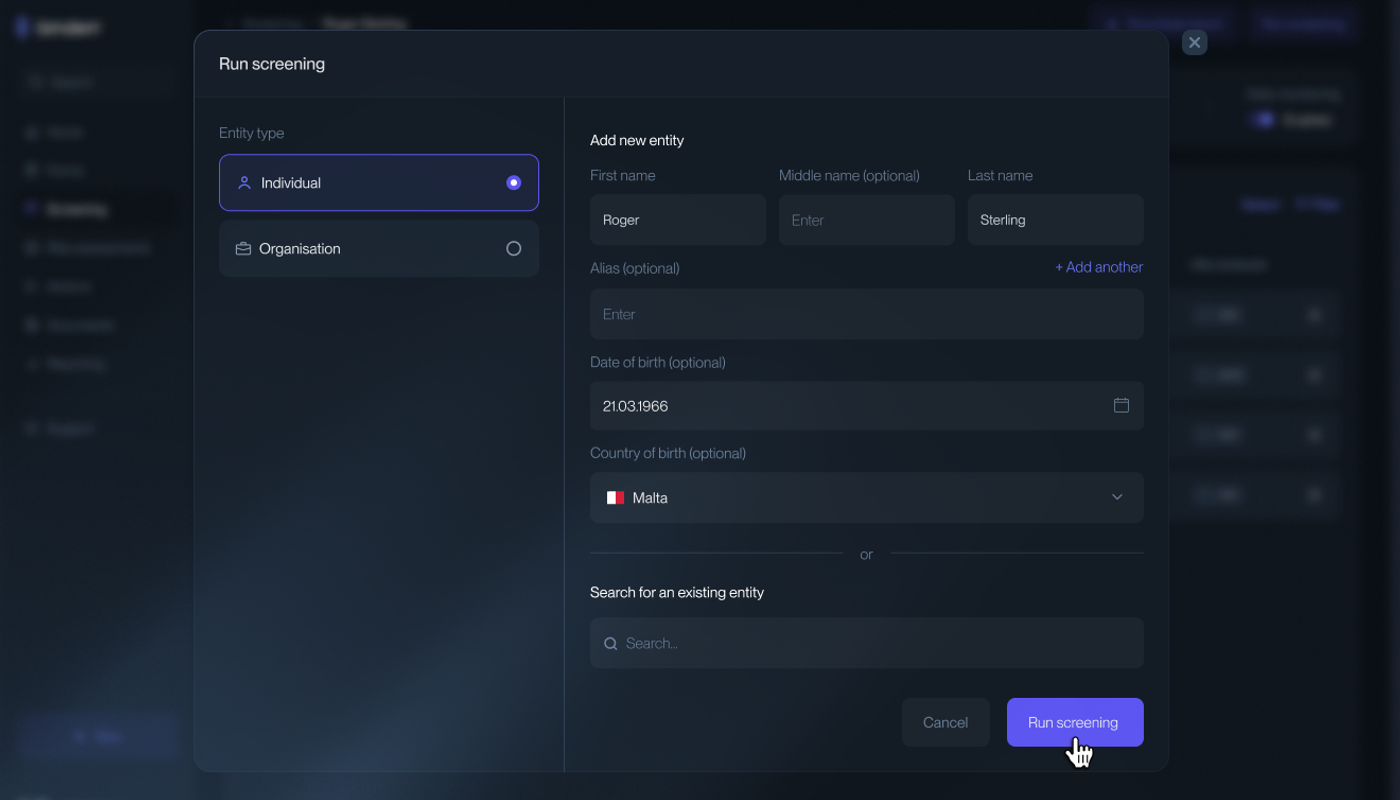
(Binderr enables compliance teams to screen individuals and organisations using names, aliases, dates of birth, and country information.)
Step 10. Calculate the Customer Risk Score
Customer risk scoring evaluates multiple factors including country of residence, nationality, product type, delivery channel, occupation, industry, expected transaction behaviour, sanctions exposure, PEP status, adverse media, fraud indicators, document risk, device and network signals, source of funds, and relationship complexity. These inputs create a dynamic risk profile for each customer.
This risk-based approach is central to modern global KYC and AML compliance frameworks, allowing businesses to tailor onboarding and monitoring intensity. Higher-risk signals may trigger enhanced due diligence (EDD), while lower-risk profiles may qualify for simplified customer due diligence (CDD).
Step 11. Apply CDD or EDD
For standard-risk customers, proportionate customer due diligence (CDD) is applied by completing identity verification, recording evidence, and approving or referring the case based on risk thresholds. This ensures efficient onboarding while maintaining compliance with global KYC requirements.
For higher-risk customers, enhanced due diligence (EDD) is required, including additional document collection, source of funds or wealth verification, senior approval, deeper adverse media checks, tighter transaction controls, and increased ongoing monitoring frequency. This ensures stronger risk mitigation for high-risk international customers.
How Binderr Simplifies the Global KYC Process
Global KYC can involve several separate checks, systems, and manual handovers. Binderr brings these stages into one structured workflow, helping compliance teams move from customer data collection to a documented onboarding decision.
With Binderr Services, compliance teams can:
- Collect customer information through configurable onboarding forms
- Verify passports, national identity cards, driving licences, and other identity documents
- Extract customer data automatically using OCR
- Compare the customer’s selfie with the identity document
- Screen customers against sanctions, PEP, watchlist, and adverse media databases
- Continuously monitor approved customers for risk changes
Which Documents Are Used for International KYC?
In global KYC and international KYC verification, businesses rely on passports, national ID cards, driving licences, and residence permits as primary identity sources. These documents are validated through global ID verification systems that check authenticity, structure, and biometric consistency.
Supporting documents such as utility bills, bank statements, and tax records help strengthen verification and compliance decisions.
Primary Identity Documents
- Passports - Passports are the most widely accepted international identity document. Issued by governments, they include MRZs, biometric data, and sometimes NFC chips, making them a high-confidence form of ID for global KYC.
- National identity cards - Government-issued IDs used mainly for domestic identification. In regions like the EU and parts of Asia, they are widely trusted and include photos, personal data, and security features such as chips or barcodes.
- Driving licences - Common secondary identity documents that include a photo and sometimes address details. Acceptance varies by country as they are not always primary ID.
- Residence permits - Issued to non-citizens legally residing in a country. They confirm identity and residency status and are important for onboarding foreign nationals.
- Refugee documents - Identity documents issued to individuals with refugee or asylum status. They are used when standard IDs are unavailable and often require enhanced verification.
- Government-issued digital identities - Electronic identity credentials issued or recognised by governments, often stored in secure apps or wallets and supported by cryptographic verification.
- Voter identity cards where accepted - Electoral IDs used as proof of identity in some jurisdictions. Acceptance depends on local registration and document security standards.
- Social security or tax identity documents where permitted - Government-issued identifiers used within tax or social systems, typically as supporting evidence alongside primary identity documents.
Supporting Documents
- Bank statements - Used to verify address and financial activity. Issued by regulated banks, they confirm name, address, and transaction history.
- Utility bills - Common proof of address issued by service providers like electricity or water companies. Usually required to be recent.
- Government correspondence - Official letters from public authorities used to verify identity or address, such as tax or benefit notices.
- Tax documents - Tax returns or registration documents used to confirm identity, income, or tax residency, especially in higher-risk cases.
- Tenancy agreements - Rental contracts used to confirm residential address and occupancy when utility bills are unavailable.
- Employment documents - Contracts, letters, or payslips used to verify occupation, income, and support source-of-funds checks.
- Immigration records - Visas or residency documents confirming legal status in a country, important for cross-border KYC.
- Proof of study - Student letters or IDs used to confirm enrolment and temporary residency status.
- Insurance statements - Documents from regulated insurers used as supplementary evidence for identity or address verification.
Global KYC and Data Protection Compliance
Global KYC, international KYC verification, and global ID verification meet data protection compliance to enable secure cross-border identity verification and AML screening while safeguarding customer privacy.
Understand how international KYC frameworks align with GDPR, FATF standards, and modern data governance to protect identity data across multiple jurisdictions.
Data Minimisation - Data minimisation is a core principle of both global KYC compliance and data protection law. Businesses should only collect identity information that is strictly necessary for customer verification, AML screening, and risk assessment. Minimising data reduces exposure to fraud, lowers storage risk, and improves compliance with privacy regulations.
Purpose Limitation - Purpose limitation ensures that customer identity data collected for KYC and AML purposes is not reused for unrelated activities. Identity documents collected for regulatory onboarding should not be repurposed for marketing, profiling, or behavioural tracking without a lawful basis. This principle reinforces trust and ensures that global identity verification processes remain compliant with international privacy standards.
Biometric Data Safeguards - Biometric data such as facial recognition, liveness detection outputs, and biometric templates require enhanced protection due to their sensitivity. Strong safeguards include encryption, template-based storage (rather than raw images where possible), strict access controls, and purpose limitation. Businesses must also ensure biometric systems are resistant to spoofing, deepfakes, and presentation attacks while complying with biometric privacy regulations.
Encryption in Transit and at Rest - All identity data used in global KYC workflows should be protected using strong encryption protocols. Data in transit should be secured using TLS encryption, while data at rest should be encrypted using industry-standard algorithms. This ensures that sensitive identity documents, AML screening results, and customer records remain protected from unauthorised access or interception.
Access Controls - Strict access controls ensure that only authorised personnel and systems can access sensitive KYC and AML data. Role-based access control (RBAC), multi-factor authentication, and least-privilege principles help reduce internal risk and prevent unauthorised data exposure. Access should be continuously monitored and regularly reviewed.
Data Retention - Data retention policies must align with both regulatory requirements and privacy obligations. Financial institutions are often required to retain KYC records for several years after the end of a customer relationship, but data should not be kept longer than necessary. Retention schedules should be clearly defined by jurisdiction, risk level, and customer type.
Cross-Border Transfers - Global KYC systems often involve transferring identity data across multiple jurisdictions. These transfers must comply with international data transfer rules, such as Standard Contractual Clauses (SCCs), adequacy decisions, or local regulatory frameworks. Businesses must ensure that data remains protected regardless of where it is processed or stored.
Vendor and Subprocessor Oversight - Many organisations rely on third-party providers for global KYC, international KYC verification, and global ID verification services such as identity verification, AML screening, and fraud detection. It is essential to conduct due diligence on all vendors and subprocessors, ensuring they meet security, compliance, and privacy standards. Contracts should clearly define data usage, retention, security obligations, and audit rights.
Incident Management - A robust incident management framework is essential for handling data breaches, security incidents, or unauthorised access events. Organisations must have clear procedures for detection, containment, investigation, and notification, including regulatory reporting where required. Rapid response helps minimise risk and maintain compliance.
Audit Logging - Comprehensive audit logs are critical for demonstrating compliance in global KYC processes. Logs should record all key actions, including identity verification steps, AML screening results, data access events, and manual review decisions. These logs support regulatory audits, internal investigations, and dispute resolution.
How to Choose Global KYC Software
Choosing the right global KYC software is the difference between seamless international onboarding and costly compliance friction.
Look for a solution that unifies global KYC, international KYC verification, and global ID verification with AML screening and risk-based compliance workflows to support secure, scalable cross-border customer onboarding.
Global Identity and Document Coverage
A strong global KYC platform should support wide country coverage, enabling onboarding across multiple jurisdictions with ease. It must handle diverse document types such as passports, national ID cards, and driving licences. It should also support different document versions, formats, and security features.
Advanced systems integrate digital identity frameworks and government-backed credentials. They also support NFC-enabled passport and ID verification for cryptographic validation. This ensures truly global identity verification and smooth cross-border KYC compliance.
Identity Verification and Fraud Detection Capabilities
Modern identity verification solutions should combine high-accuracy OCR and data extraction with advanced document authenticity checks to detect tampering or forgeries. Strong systems also include facial recognition and biometric matching.
These are supported by liveness detection and deepfake prevention to stop synthetic identity fraud. Additional layers such as device intelligence, behavioural signals, and IP risk scoring strengthen fraud detection. Address verification tools and structured manual review workflows ensure edge cases are properly assessed within a compliant KYC process.
AML Screening and Monitoring Capabilities
Effective AML compliance requires broad sanctions screening coverage, including global and regional lists. It should also include robust PEP screening and watchlist monitoring.
Platforms must also provide adverse media detection to identify reputational and financial crime risks early. Continuous real-time monitoring, combined with alert management and triage systems, helps compliance teams prioritise risk efficiently. Strong match resolution tools and investigation workflows support accurate decision-making and ongoing AML compliance.
Manage Compliance in One Place
Risk Scoring and Due Diligence Workflows
A modern KYC system should offer flexible custom risk rules and dynamic customer risk scoring that adapts based on behaviour, geography, and transaction patterns. It must support structured customer due diligence (CDD) workflows.
It should also include automated enhanced due diligence (EDD) triggers for high-risk profiles. Additional capabilities like document collection workflows, multi-stage approvals, and escalation paths ensure strong governance. Periodic review scheduling enables continuous compliance and long-term risk management.
Regulatory Configuration and Policy Flexibility
A scalable global KYC platform must allow organisations to configure compliance rules by jurisdiction, product type, and customer segment. This ensures alignment with local regulatory requirements.
It should support variable risk thresholds, enabling different levels of scrutiny based on exposure. Businesses must be able to adjust document requirements, verification steps, and onboarding flows dynamically. They should also define manual review triggers and update compliance policies without engineering effort, ensuring agility in a changing regulatory landscape.
Integration and Deployment Options
Strong KYC platforms provide comprehensive API coverage and documentation for seamless integration into existing systems. They should also support webhooks for real-time updates.
Hosted onboarding flows enable fast deployment, while SDKs, no-code or low-code workflow builders, and case management integrations support both technical and non-technical teams. Reporting tools, data export capabilities, and sandbox environments are also essential for testing, scaling, and maintaining global identity verification systems efficiently.
Security, Privacy, and Data Governance
Enterprise-grade KYC solutions must ensure end-to-end encryption in transit and at rest to protect sensitive identity data. They should implement strict role-based access controls.
Clear data residency and storage policies must align with global privacy laws. Strong retention and deletion frameworks, along with subprocessor governance, ensure GDPR and similar compliance. Platforms should also maintain recognised security certifications, audit readiness, incident response procedures, and full audit logging, ensuring complete traceability and trust in global identity verification operations.
Do Global Identity Verification and AML Screening with Binderr
Verifying an identity document confirms who a customer claims to be. It does not show whether the customer is sanctioned, politically exposed, connected to negative news, or otherwise higher risk.
Binderr combines global identity verification with AML screening so compliance teams can evaluate identity and risk within the same customer profile.
- Verify identity documents from customers worldwide
- Compare customer selfies with document photographs
- Detect spoofing attempts, manipulated media, and deepfakes
- Screen individuals against global sanctions lists
- Identify politically exposed persons and their close associates
- Search regulatory, law enforcement, and financial crime watchlists
How Much Does Global KYC Cost?
Global KYC pricing varies based on verification depth, operating regions, and compliance requirements. While providers often advertise low per-check fees, the true cost usually comes from the full lifecycle, including screening, monitoring, manual review, and ongoing risk management across multiple jurisdictions.
Binderr simplifies global KYC pricing by combining identity verification, AML screening, risk scoring, and monitoring in one platform. It offers transparent self-serve pricing from £0/month, with paid plans starting at £99/month and flexible per-check usage pricing, helping teams avoid large upfront costs or complex enterprise contracts.
Global KYC Pricing Comparison (2026 Overview)
Provider | Starting Price Model | Pricing Transparency |
Binderr | Free plan + from £99/month | High (self-serve + usage-based) |
Onfido | Custom / enterprise pricing | Medium (quote-based) |
Jumio | Enterprise contracts | Low (sales-led) |
Sumsub | Tiered + custom pricing | Medium |
Ondato | Custom pricing | Medium-low |
Binderr: A Complete Global KYC and Compliance Solution
Global KYC does not end when a customer’s identity document is approved. Regulated businesses must combine verification results with AML screening, risk assessment, due diligence, record keeping, and ongoing monitoring.
Binderr provides an end-to-end compliance platform that supports the complete customer lifecycle.
- KYC: Verify individuals using AI-powered document checks, biometric face matching, liveness detection, and fraud controls
- KYB: Verify companies through global registry data, directors, shareholders, UBOs, and ownership structures
- AML screening: Check individuals and businesses against sanctions, PEPs, watchlists, and adverse media
- Dynamic risk assessment: Score customers using identity, business, geographic, product, and screening information
- CDD: Combine KYC, KYB, AML, and risk data into a complete customer risk profile
- EDD: Trigger deeper investigations, additional document requests, source-of-funds checks, and approval workflows
Bottom Line
Global KYC combines international identity verification with country-specific regulatory requirements to create a unified approach to customer onboarding. It brings together AML screening, customer risk assessment, due diligence, and ongoing monitoring, helping businesses verify users across multiple jurisdictions while reducing fraud risk and maintaining compliance.
Rather than a one-size-fits-all process, global KYC is a flexible framework that adapts to different regulations, products, and risk levels. Configurable workflows allow organisations to tailor identity checks and screening intensity to each situation, ensuring efficient onboarding without compromising compliance or user experience.
Binderr Services helps businesses verify customers internationally while connecting identity checks with AML screening, dynamic risk scoring, due diligence, and ongoing monitoring. Create a free account to explore a more unified approach to global compliance.