
KYC due diligence goes beyond basic customer verification. Businesses must verify customers while also understanding who they are, why they are engaging, and how they will use financial services. Identity verification confirms authenticity, but KYC due diligence connects that data with AML screening, customer risk assessment, and ongoing monitoring. Without this broader approach, organisations risk onboarding customers whose behaviour or background may expose them to financial crime.
Digital onboarding has accelerated customer acquisition, but it has also increased exposure to fraud, sanctions breaches, and hidden ownership risks. According to the United Nations Office on Drugs and Crime, up to 5 percent of global GDP is linked to money laundering each year. This highlights why verifying identity alone is not enough. Businesses must assess whether the customer’s purpose, expected activity, and risk profile align with regulatory expectations and internal risk appetite through structured customer due diligence KYC processes.
In this guide, you will learn how to conduct KYC due diligence step by step, including how to verify customer identities, assess risk, perform AML screening, and maintain ongoing monitoring to ensure continuous compliance. For a streamlined and efficient way to manage this entire process, Binderr offers integrated KYC, AML screening, and risk assessment solutions designed to simplify compliance and enhance accuracy across cdd kyc workflows.
Binderr KYC Due Diligence Software
Binderr provides a unified compliance platform that simplifies KYC due diligence from start to finish:
- AI-powered KYC identity verification with document checks and biometric matching
- KYB business verification with global registry access and ownership mapping
- AML screening across sanctions, PEPs, watchlists, and adverse media
- Dynamic risk assessment with automated scoring models
- Ongoing AML monitoring with real-time alerts
- UBO identification and ownership structure visualization
- End-to-end CDD and EDD workflows in one platform
What Is KYC Due Diligence?
KYC due diligence is the risk-based process of identifying and verifying a customer, understanding the relationship, conducting AML screening, assessing risk, and monitoring the customer after onboarding. It goes beyond basic verification by combining identity checks, customer due diligence KYC principles, cdd kyc frameworks, and ongoing monitoring to ensure the customer is legitimate and within the organization’s risk appetite.
Start KYC Verification for Free
Why Is Customer Verification Alone Not Enough?
Customer verification alone is not enough because confirming identity does not reveal financial crime risk. A verified customer may still be a PEP, appear on sanctions lists, or show suspicious behavior. KYC due diligence adds AML screening, risk assessment, and monitoring to evaluate the customer’s legitimacy and ensure compliance. This is why customer due diligence KYC and cdd kyc processes are critical for identifying risks beyond identity verification.
When Should KYC Due Diligence Be Conducted?
Knowing the right moment to initiate KYC due diligence can make the difference between proactive compliance and reactive risk management.
From onboarding to ongoing monitoring, understanding when to verify customers and apply customer due diligence KYC ensures stronger AML compliance and effective risk assessment within cdd kyc frameworks.
Before Establishing a Business Relationship
KYC due diligence should be conducted before entering into a business relationship with a customer. This ensures that the organization has verified the customer’s identity, assessed their risk profile, and understood the intended use of the service before granting access. In some cases, regulations may allow onboarding to begin while verification is still in progress, provided that risks are effectively managed and controls are in place to prevent misuse within customer due diligence KYC procedures.
For Qualifying Occasional Transactions
Even in the absence of an ongoing relationship, KYC due diligence may be required for certain one-off or occasional transactions. These include high-value transfers, cross-border payments, or transactions that meet specific regulatory thresholds. While FATF guidelines reference transactions above USD/EUR 15,000, local laws may impose different limits depending on the jurisdiction and sector. Businesses must align their due diligence procedures with applicable regulations and internal risk policies as part of cdd kyc compliance.
When Suspicion Exists
KYC due diligence must be applied or repeated whenever there is suspicion of money laundering, terrorist financing, or other financial crimes. This includes unusual transaction patterns, inconsistent customer behavior, or alerts generated through AML screening. In such cases, enhanced due diligence (EDD) may be required to investigate the source of funds, ownership structure, or underlying purpose of the activity within customer due diligence KYC frameworks.
When Existing Information Becomes Unreliable
Customer information should not be treated as static. If previously collected data becomes outdated, inconsistent, or unreliable, such as expired identification documents, changes in beneficial ownership, or discrepancies in declared activity, a review must be triggered. This ensures that the customer profile remains accurate and compliant with regulatory expectations under cdd kyc standards.
Throughout the Customer Relationship
KYC due diligence is not a one-time event but an ongoing process. After onboarding, businesses must continuously monitor customer activity, update risk assessments, and re-screen individuals against sanctions and PEP lists. This ongoing monitoring helps detect emerging risks, identify suspicious behavior, and ensure that the customer relationship remains within acceptable compliance boundaries in customer due diligence KYC programs.
Verify Your First Customer Free with Binderr
How to Conduct KYC Due Diligence and Verify Customers
Build trust from the very first interaction by mastering a seamless KYC due diligence process.
Learn how to verify customers effectively using identity verification, AML screening, and risk-based customer due diligence KYC strategies within cdd kyc frameworks.
Step 1: Define the Customer and Applicable Requirements
In the first stage of the KYC due diligence process, the organisation must clearly define who the customer is and what regulatory obligations apply. This involves determining whether the applicant is an individual, business entity, trustee, authorised representative, or beneficial owner. It also requires identifying the relevant jurisdiction, sector-specific KYC compliance requirements, and whether the proposed relationship aligns with the organisation’s risk appetite.
A risk-based approach is essential at this stage. The organisation must decide what level of customer verification, AML screening, documentation, and approvals are required based on customer type, product risk, and geographic exposure. Applying a single, standardised workflow to all customers can lead to gaps in compliance, so requirements should always be tailored to the specific KYC risk profile within customer due diligence KYC and cdd kyc processes.
Step 2: Collect Customer Information
Once requirements are defined, the next step is to collect accurate and complete customer information using structured onboarding methods. This may include digital onboarding forms, secure document uploads, API-based integrations, in-person data collection, or reliance on previously verified records where legally permitted. Collecting consistent data is critical for effective KYC verification and customer due diligence KYC.
To ensure data quality, organisations should implement validation rules that flag missing, inconsistent, or incorrectly formatted information. Strong data collection practices support downstream processes such as identity verification, AML screening, and customer risk assessment, reducing errors and improving compliance outcomes in cdd kyc workflows.
Step 3: Verify the Customer’s Identity
Customer identity verification is a core component of the KYC verification process. Organisations should use both documentary and non-documentary methods, including document authenticity checks, OCR data extraction, machine-readable zone validation, expiry checks, and database comparisons. Electronic identity verification and biometric facial matching can further strengthen accuracy.
Liveness detection and manual review of uncertain cases help prevent fraud and ensure reliability. According to FATF Recommendation 10, identity data must be verified using reliable and independent sources. This step ensures that the customer is genuine before proceeding with AML screening and risk assessment within customer due diligence KYC frameworks.
Step 4: Confirm the Customer Is Present and Genuine
Beyond verifying documents, organisations must confirm that the customer is physically present and not a fraudulent or synthetic identity. This involves using fraud prevention tools such as selfie-to-document facial matching, passive or active liveness checks, spoofing detection, and deepfake detection technologies.
Additional signals such as device data, behavioural patterns, and duplicate identity detection can further strengthen verification. While these controls are essential for preventing impersonation and onboarding fraud, they should complement not replace the broader KYC due diligence and customer risk assessment process within cdd kyc systems.
Step 5: Identify Representatives and Beneficial Owners
In many cases, organisations must determine whether the customer is acting on behalf of another individual or entity. This includes verifying authorised representatives and identifying ultimate beneficial owners (UBOs) who own or control a legal entity. Understanding ownership and control structures is a key requirement in KYC customer due diligence and customer due diligence KYC.
This step is particularly important for business customers, trusts, and complex legal arrangements. Organisations should ensure they capture sufficient information to identify controlling parties and assess associated risks within cdd kyc frameworks.
Step 6: Understand the Purpose of the Relationship
Understanding the purpose of the relationship is a critical part of KYC due diligence and customer verification. Businesses must collect detailed information about why the customer is onboarding, how they intend to use the product or service, and what their expected transaction behaviour will look like.
This includes expected transaction size and frequency, relevant counterparties, countries involved, and the source and destination of funds where necessary. Capturing the customer’s occupation or business activity also helps establish a baseline for ongoing monitoring and AML compliance within customer due diligence KYC.
Step 7: Conduct AML Screening
AML screening is a core component of the KYC due diligence process and helps identify potential financial crime risks. Businesses should screen customers against sanctions lists, PEP databases, regulatory watchlists, law-enforcement lists, adverse media sources, and internal blocklists. Screening should also extend to connected parties such as beneficial owners and authorised representatives to ensure a complete risk picture during customer onboarding within cdd kyc processes.
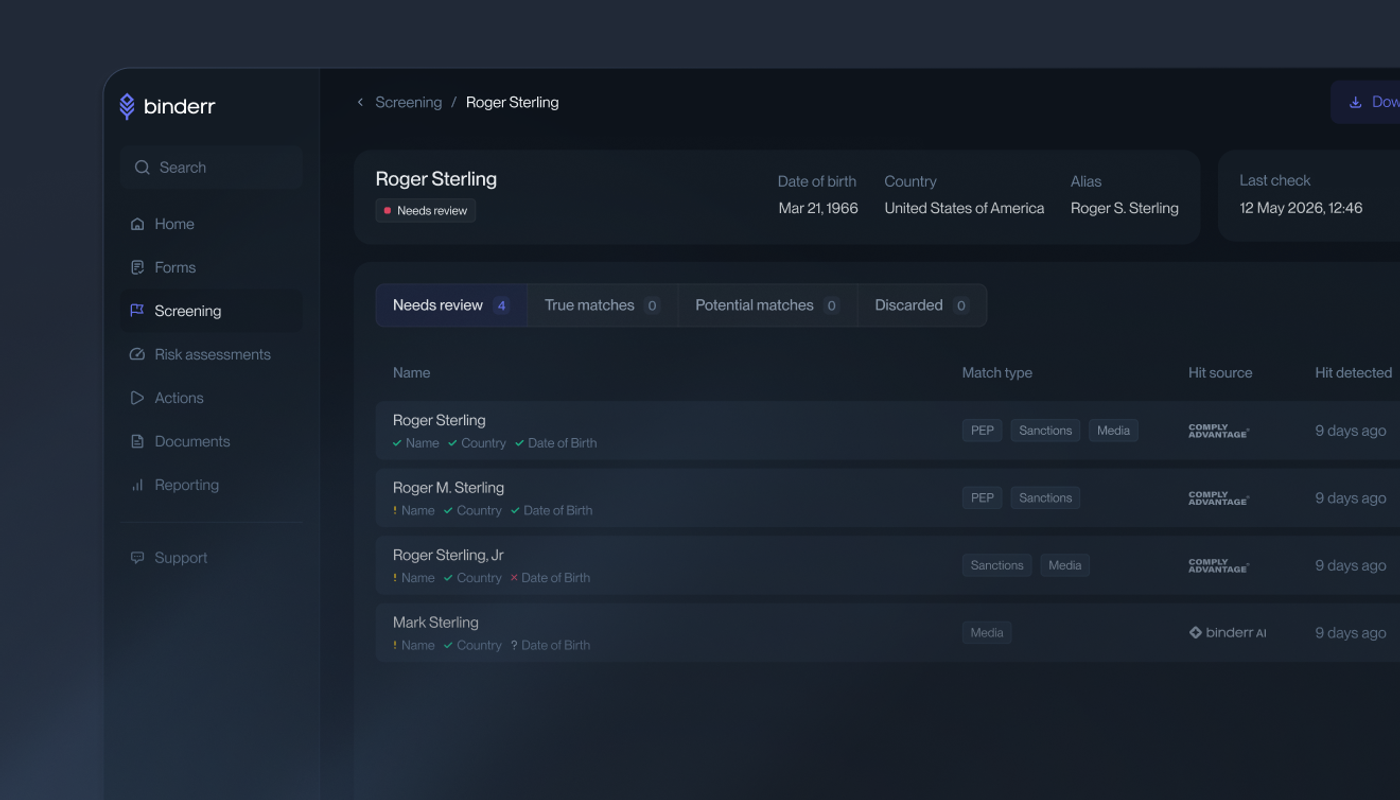
(Centralised AML screening results in Binderr: Review PEP, sanctions, and media matches using customer identifiers and clearly defined case statuses.)
Access AML Screening Tools for FREE
Step 8: Assess and Score Customer Risk
Customer risk assessment involves combining verified identity data, AML screening results, and relationship information into a structured risk profile. Based on these factors, businesses assign a documented risk rating such as low, medium, high, or prohibited. This KYC risk scoring process supports consistent decision-making and ensures that customer due diligence KYC measures are proportionate to the level of risk.
Step 9: Apply the Appropriate Level of Due Diligence
The outcome of the customer risk assessment determines the level of due diligence required. Low-risk customers may qualify for simplified due diligence where permitted by law, while most customers undergo standard customer due diligence. Higher-risk customers require enhanced due diligence, which involves deeper investigation, additional documentation, and stricter controls within cdd kyc frameworks.
Step 10: Review and Approve the Customer
The final stage of KYC due diligence involves reviewing all collected information and making a documented approval decision. This process should include clear ownership of the decision, defined escalation rules, and senior approval where required for higher-risk customers. All screening alerts must be investigated and resolved before approval, and any conditions or restrictions should be clearly recorded.
A robust approval process also requires confirmation that all required evidence has been obtained and verified. Documenting the rationale for decisions, including any overrides, ensures a strong audit trail and supports regulatory compliance. Effective review and approval controls are essential for maintaining consistency, accountability, and integrity within the customer onboarding and KYC verification process.
Streamline the KYC Due Diligence Process with Binderr
Binderr simplifies every step of the KYC workflow:
- Automates identity verification and document checks
- Runs AML screening instantly across global databases
- Calculates dynamic risk scores automatically
- Triggers EDD workflows for high-risk customers
- Centralizes all compliance data in one platform
What Triggers Enhanced Due Diligence?
Enhanced Due Diligence (EDD) is triggered when a customer or transaction presents higher financial crime risk that standard KYC cannot address. Common triggers include PEP relationships, high-risk jurisdictions, and complex ownership structures. Other indicators include large or unusual transactions without clear purpose, cash-heavy businesses, inconsistent information, unclear source of funds, adverse media, or activity that doesn’t match the customer profile. Attempts to bypass verification or repeated document failures can also signal elevated risk.
When these risks appear, firms should apply proportionate EDD measures. This may include collecting additional identity evidence, verifying beneficial ownership, checking source of funds or wealth, and reviewing adverse media. Senior approval may be required in higher-risk cases, along with stricter monitoring or onboarding conditions. Not all EDD cases require rejection decisions should depend on regulations, risk appetite, and whether risks can be managed.
Best Practices for Effective Customer Verification
Build trust and reduce risk with smarter KYC verification strategies that go beyond basic checks.
Discover how customer verification, identity verification, and risk-based KYC practices work together to strengthen compliance and onboarding efficiency.
Collect only information that serves a defined verification, risk, or regulatory purpose - Gather customer data that directly supports KYC due diligence, identity verification, and compliance requirements. Avoid collecting unnecessary information, as this can increase data protection risks and complicate customer onboarding without improving the effectiveness of customer risk assessment.
Verify customer data through reliable, independent sources - Use trusted documents, electronic databases, and identity verification tools to confirm that customer information is accurate and authentic. Reliable verification strengthens KYC compliance and reduces the risk of fraud, impersonation, and inaccurate customer profiles.
Use multiple identity attributes when resolving screening alerts - When reviewing AML screening results, rely on more than just a name match. Compare additional identifiers such as date of birth, nationality, and address to distinguish between true matches and false positives, improving the accuracy of sanctions and PEP screening.
Connect onboarding information to the customer risk assessment - Ensure that data collected during onboarding, such as occupation, expected activity, and geographic exposure, feeds directly into the customer risk scoring process. This connection helps create a more accurate and meaningful KYC risk profile.
Apply additional measures according to the specific risk identified - Tailor customer due diligence measures based on the level and type of risk. For higher-risk customers, implement enhanced due diligence steps such as source of funds checks or deeper beneficial ownership analysis to address specific AML risks.
Combine periodic reviews with event-driven monitoring - Maintain effective ongoing due diligence by scheduling regular KYC reviews while also responding to trigger events such as changes in customer behavior or new screening alerts. This approach ensures that customer risk profiles remain current and aligned with evolving risks.
Try Advanced AML Screening & Risk Detection with Binderr
Binderr enhances AML screening and risk detection with:
- Real-time sanctions, PEP, and watchlist screening
- AI-powered adverse media analysis
- Smart matching to reduce false positives
- Continuous monitoring with instant alerts
- Screening for individuals, businesses, and complex entities
How to Automate KYC Due Diligence
Streamline compliance with smart automation that transforms complex kyc due diligence into a seamless, scalable workflow.
Discover how automated KYC verification, AML screening, and risk assessment tools can enhance accuracy, reduce manual effort, and strengthen customer onboarding processes within a comprehensive customer due diligence kyc framework.
Automating Customer Data Collection
Automating customer data collection with digital onboarding forms, API integrations, and smart validation tools helps businesses capture accurate KYC information quickly while minimizing manual errors. By using structured data fields, autofill capabilities, and real-time validation, organizations can streamline customer onboarding, improve data quality, and ensure compliance with regulatory requirements as part of an effective cdd kyc process.
Automating Identity Verification
Automating identity verification enables businesses to confirm customer identities using advanced technologies such as document verification, biometric authentication, and database cross-checks. Tools like OCR, facial recognition, and liveness detection enhance fraud prevention, accelerate KYC verification processes, and ensure reliable identity validation across digital channels within broader kyc due diligence workflows.
Automating AML Screening
Automated AML screening systems allow organizations to perform real-time checks against sanctions lists, PEP databases, and adverse media sources. By integrating continuous screening and alert management, businesses can quickly identify high-risk individuals, reduce false positives, and maintain compliance with AML regulations throughout the customer lifecycle as part of customer due diligence kyc requirements.
Automating Risk Assessment
Automating risk assessment involves using configurable risk scoring models that evaluate customer profiles based on factors such as geography, transaction behavior, and customer type. These systems enable consistent, data-driven decisions, helping compliance teams assign accurate risk levels and apply appropriate due diligence measures efficiently within a structured cdd kyc framework.
Automating Ongoing Monitoring
Automating ongoing monitoring ensures continuous oversight of customer activity through transaction monitoring, periodic rescreening, and real-time alerts. By detecting changes in behavior, risk exposure, or regulatory status, businesses can proactively manage compliance risks, update customer profiles, and maintain effective kyc due diligence and AML controls over time.
Automate KYC Customer Verification
Common KYC Due Diligence Mistakes
Even the most well-designed KYC due diligence processes can fail when small but critical steps are overlooked.
Understanding these common KYC mistakes helps businesses strengthen customer verification, improve AML compliance, and reduce risk exposure.
Failing to Understand the Relationship Purpose
Problem: Many organisations fail to clearly define the purpose and intended nature of the customer relationship during KYC due diligence. Without capturing expected activity, transaction patterns, and business rationale, monitoring systems lack a meaningful baseline, weakening risk assessment and increasing the chance of missing suspicious activity.
Solution: Implement a structured process to document relationship purpose, expected behaviour, and source of funds during onboarding. Integrate this into your KYC process and risk profile so monitoring can detect anomalies, and update it regularly as part of ongoing due diligence.
Automatically Clearing or Rejecting Screening Alerts
Problem: Automatically clearing or rejecting AML screening alerts without proper investigation is a common compliance failure. Relying only on name matches without checking identifiers like date of birth, nationality, or address can cause false positives to be dismissed incorrectly or true matches to be missed, weakening sanctions and PEP screening.
Solution: Implement a structured alert investigation workflow that requires documented analysis of each potential match using multiple data points. Use screening tools that support fuzzy matching and provide context. Ensure teams can distinguish false positives from confirmed matches and keep a clear audit trail for all screening decisions.
Ignoring Beneficial Ownership
Problem: Focusing only on verifying an authorised representative during onboarding can lead to incomplete KYC due diligence. Ignoring beneficial ownership means missing the individuals who ultimately own or control a business, increasing exposure to risks like money laundering, sanctions evasion, or complex ownership structures.
Solution: Include beneficial owner identification and verification in your due diligence process. Collect ownership details, verify ultimate beneficial owners (UBOs), and assess their risk through AML screening and risk assessment. This helps ensure a clearer understanding of the customer and supports KYC compliance requirements.
Failing to Update Customer Information
Problem: Treating KYC as a one-time process leads to outdated records. Expired documents, ownership changes, or shifts in transaction behaviour can make the original risk assessment unreliable, weakening monitoring and increasing compliance risk.
Solution: Establish ongoing KYC procedures with periodic reviews and event-driven updates. Monitor changes in customer data, trigger re-verification when needed, and update risk scores. Automated alerts for document expiry and activity changes help maintain accurate, compliant profiles.
Allowing Review Backlogs to Grow
Problem: Backlogs in KYC reviews and due diligence can delay risk identification and create compliance gaps. When overdue cases are not prioritised, high-risk customers may remain insufficiently reviewed, increasing exposure to financial crime and regulatory penalties.
Solution: Use a risk-based prioritisation framework to manage review backlogs. Focus first on high-risk customers, unresolved AML alerts, and incomplete due diligence cases. Apply workflow automation and case management tools to streamline reviews, reduce delays, and ensure timely completion of KYC tasks.
Binderr Complete Compliance Solution
Binderr delivers a full end-to-end compliance platform:
- KYC and KYB verification in one system
- AML screening and monitoring
- Dynamic risk assessment and scoring
- Automated CDD and EDD workflows
- UBO identification and ownership mapping
- Audit-ready compliance reporting
Bottom Line
KYC due diligence goes beyond simple identity verification. While verifying a customer’s identity is essential, it only confirms who they are, not whether the relationship is legitimate or fits your risk appetite. A strong KYC process follows a full lifecycle: verify identity, run AML screening, assess risk, make decisions, document findings, and monitor activity. This approach helps businesses detect financial crime risks early while staying compliant with evolving regulations.
A risk-based approach is equally important, ensuring due diligence matches the level of risk. Customer data collected during onboarding should feed into ongoing monitoring and periodic reviews. By linking each stage of the KYC workflow, businesses can maintain accurate records and respond quickly to changes. Platforms like Binderr streamline this process by combining identity verification, AML screening, risk scoring, and monitoring into one integrated solution that supports both customer due diligence kyc and broader cdd kyc requirements.