• Company
  • Home
  • Security
  • News
  • About
  • Privacy Policy
  • Contact us
  • Marketplace
  • Marketplace
  • List your services
  • Compliance tools
  • Compliance & Onboarding
  • AI Screening
  • KYC - ID Verification
  • AML Screening
  • KYB - Business Verification
  • Ownership Structure Map
  • Client Risk Assessment
  • AML Reporting
  • Binderr Connect
  • Document and eSignatures
  • Terms of Service
  • Get in touch
  • support@binderr.com
  • LinkedIn
  • ​🇬🇧 Binderr Operations Ltd
    Central House, 1 Ballards Lane, London, N3 1LQ

    🇲🇹 Binderr Ltd
    Ortigia Tal- Ferha, Limiti Ta' Gharghur, Malta 

    🇪🇪 Binderr Technology OÜ
    Harju Maakond, Kesklinna Linnaosa, Aia 4, Tallinn 

    🇦🇪 Binderr MENA Electronic Brokerage LLC
    The H Dubai Office Tower Level 17, 1 Sheikh Zayed Rd,
    Dubai, United Arab Emirates 

© 2026 Binderr Ltd.

AML Screening and Monitoring Solution

Detect high-risk users using our AI-powered AML solution

  • Screen individuals and businesses
  • Ongoing AML monitoring with daily hits
  • Global watchlist and sanction screening
  • Daily updated PEP lists
  • Client risk assessment with score
AML Screening and Monitoring
image

Screen Both Individual Users and Businesses

Effortlessly screen both individuals and businesses with our AI-powered AML screening software and stay ahead of financial risks. Our AML software also enables screening of:

  • Aircraft
  • Vessels
  • Trusts
  • Foundations
  • Partnerships
image

Ongoing AML Monitoring

Continuously monitor clients and get daily updates on new hits. Our AML solution maintain updated risk profiles through scheduled checks against global sanctions lists, watchlists, and other reliable data sources.

Corporate Screening Solution


Accelerate business onboarding with powerful Know Your Business (KYB) solution. Gain full control over business verification and corporate screening process with Binderr.

Verify Ownership Structure and UBOs

Discover complex corporate structures to identify and screen UBOs and directors to identify risky business clients and maintain compliance.

Global Business AML Screening

Screen businesses and UBOs against 11,000+ trusted data sources, including global sanctions lists, PEP lists, and adverse media.

Worldwide Registry Checks

Verify businesses using 30K+ registry sources to ensures accurate validation of corporate information across 200+ countries and regions.

Corporate Document Verification

Verify corporate documents like registration, license, business proof of address, and more for all your corporate screening and KYB needs
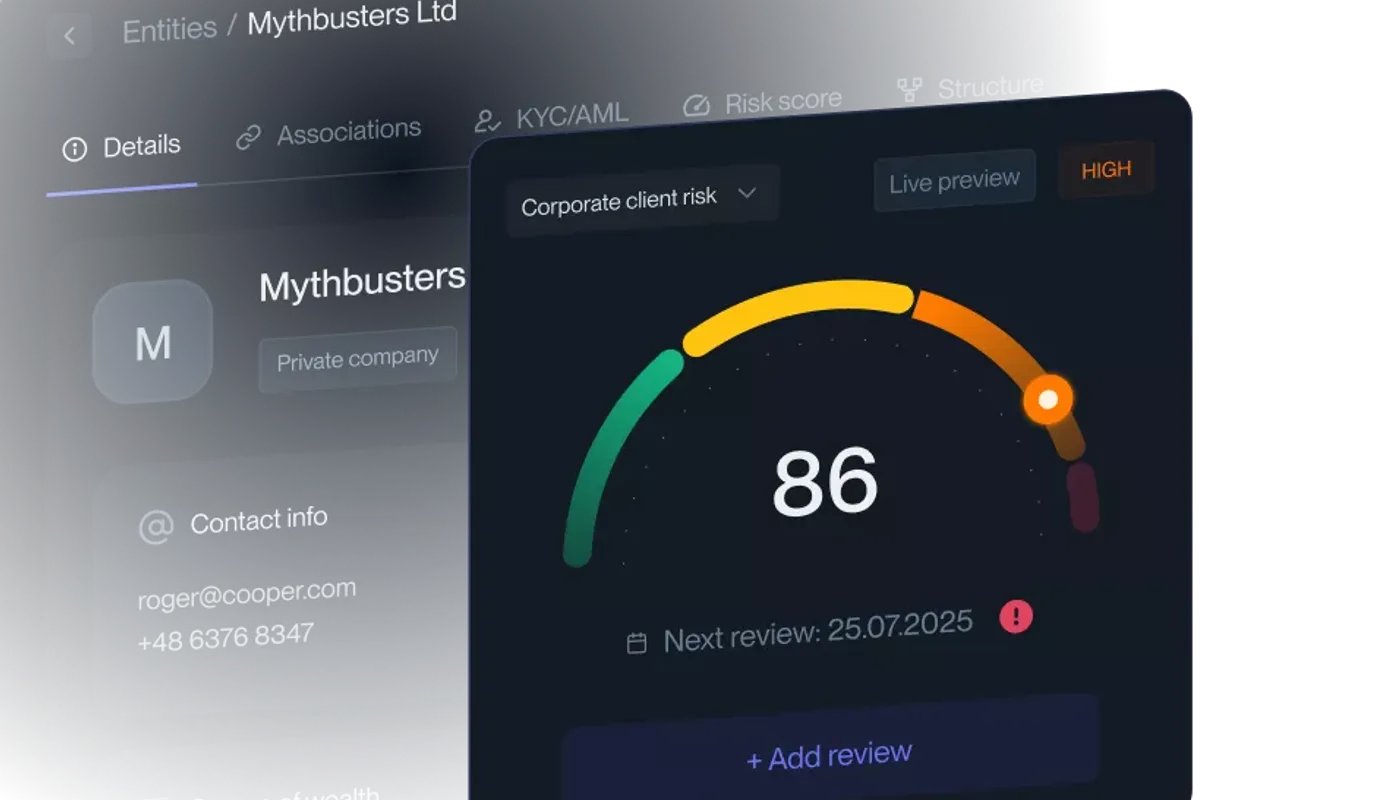
Dynamic Risk Assessment

Binderr combines advanced AML screening with continuous risk monitoring, enabling an efficient approach to managing client risk.

AI-Based Risk Scores

AML screening results are seamlessly incorporated into the client’s risk assessment, where AI-based algorithms calculate the risk score, delivering a comprehensive understanding of potential threats.

Bulk Corporate Screening

Conduct AML screenings across entire corporate structure and hierarchies, including UBOs and key stakeholders - in one click.

Real-Time Risk Monitoring

Monitor changes in your clients’ risk profiles and score with live updates from global sanctions lists, PEP lists, and adverse media sources.

AI-Based Risk Scores
image

Verify Users Globally

Verify users globally with our advanced biometric verification and facial recognition technology. Easily validate IDs and personal documents such as proof of address and source of wealth, ensuring accurate and seamless KYC verification.

What Our Customers Say About Us

Binderr enhanced our risk assessment processes, significantly aiding compliance with regulatory requirements and achieved excellent results in recent AML audits.

Gemma Garen

Gemma GarenHead Of Compliance, Fox Williams

Both as a regulated firm and a business owner, Binderr’s platform is what the industry has been looking for.

Keith Laferla

Keith LaferlaDirector, Laferla Insurance

Binderr has simplified our compliance and reduced paperwork saving us time by organising everything in one environment.

Pauliana Said

Pauliana SaidPauliana Said

Binderr's smooth migration, intuitive dashboard, and professional support exceeded all expectations.

Arthur-Douglas Turner

Arthur-Douglas TurnerParker Russell

decoration

Verify and Screen Clients
Faster with Binderr

Streamline your compliance process and drive efficiency.

What is an AML Screening?

AML (Anti-Money Laundering) screening is a compliance process designed to detect and mitigate risks associated with financial crimes, such as money laundering, terrorism financing, and fraud. It involves verifying individuals, entities, and transactions against regulatory watchlists, sanctions lists, and adverse media to ensure businesses comply with anti-money laundering regulations.

The primary goal of AML screening is to identify high-risk individuals or entities and prevent organizations from engaging in transactions with those involved in illicit activities. These checks are critical for maintaining the integrity of financial systems and protecting businesses from legal, financial, and reputational risks.

AML screening typically includes checks against several key databases. These include sanctions lists, such as those maintained by OFAC, the UN, and the EU, which identify restricted individuals and organizations. Politically Exposed Persons (PEP) lists highlight individuals in public positions or their associates who may pose higher risks due to their influence. Adverse media screening flags individuals or entities associated with negative news or criminal allegations.

Read more: What is AML Screening? The Ultimate Guide

What is AML Software?

AML software or AML solution is a specialised tool developed to help organisations meet Anti-Money Laundering (AML) regulations by automating the detection, monitoring, and prevention of financial crimes such as money laundering, terrorist financing, and fraud. By leveraging AML software, businesses can  simplify complex compliance processes, and detect risks more efficiently and accurately, reducing the burden of manual work while ensuring adherence to legal standards.

Key Features of AML Software

The core of any robust AML solution lies in its ability to perform Customer Due Diligence (CDD). This feature allows businesses to verify customer identities, assess their risk profiles, and ensure compliance during onboarding and throughout their relationship with the customer. AML software streamlines these processes, reducing errors and ensuring faster verification.

Sanctions and PEP screening is also a vital part of AML software. It ensures customers and third parties are checked against global sanctions lists, watchlists, and databases of politically exposed persons (PEPs). Many AML solutions also include adverse media screening, scanning public sources for negative information about clients or entities that could indicate financial crime risks.

Risk management is further enhanced by the risk scoring capabilities of AML software, which assign risk levels to transactions, customers, and entities based on predefined criteria. This feature allows businesses to focus on high-risk cases. Lastly, the automated reporting features of AML solutions simplify the preparation of regulatory filings, such as Suspicious Activity Reports, ensuring compliance obligations are met efficiently.

What is Ongoing Monitoring in AML?

Ongoing monitoring in AML refers to the continuous process of assessing customer activities and ensuring compliance with anti-money laundering regulations. After initial AML screening and verification, ongoing monitoring helps identify any changes in customer risk profiles or suspicious activities. This includes re-screening customers against updated sanctions lists, PEP databases, and adverse media, as well as tracking transactional behaviors for unusual patterns. Advanced AML systems and AML software automate this process, providing real-time insights and alerts to ensure businesses remain compliant and proactive in mitigating risks.

What is the AML Screening Process?

The AML screening process involves verifying individuals and entities against global watchlists, sanctions data, PEP lists, and adverse media databases to identify potential risks of financial crimes. This process typically includes:

  1. KYC Verification: Collecting customer details, such as names, dates of birth, and business affiliations.
  2. Screening: Using AML screening software to compare customer information against regulatory databases and watchlists.
  3. Risk Scoring: Assigning a risk score to assess the severity of any matches.
  4. Decision-Making: Determining whether further investigation or enhanced due diligence (EDD) is required.
  5. Ongoing Monitoring: Continuously re-evaluating customer profiles to detect new risks.

Advanced AML solutions like Binderr streamline the entire screening process, reducing manual effort and ensuring more reliable risk detection.

What is AML Watchlist Screening?

AML watchlist screening is the process of cross-referencing customer information against regulatory and private watchlists to identify individuals or entities involved in financial crimes, terrorism financing, or other illicit activities. These watchlists include:

  • Sanctions Lists: Such as OFAC, UN, and EU lists.
  • PEP Databases: Identifying politically exposed persons and their associates.
  • Special Interest Persons (SIP) Lists: Flagging high-risk individuals under investigation or convicted of crimes.

Automated AML systems and AML screening software make this process efficient by providing real-time alerts and reducing false positives.

What is Sanction Screening in AML?

Sanction screening in AML involves checking customer data against global sanctions lists to ensure compliance with international and local regulatory requirements. Sanctions lists, such as those maintained by OFAC, the EU, and the UN, contain names of individuals, entities, or countries subject to restrictions.

AML screening software automates sanction screening by continuously updating and cross-referencing databases to detect matches quickly and accurately. This ensures that businesses do not engage in prohibited transactions, mitigating the risk of fines and reputational damage.

Read More: What is Sanctions Check?

Still have questions?