
Customer onboarding often relies on fragmented KYC and AML processes that operate separately, especially when organisations rely on disconnected kyc aml software tools. Identity verification may occur in one system, AML screening in another, and risk assessment in spreadsheets, while reviews are handled through emails or manual case files.
This disconnected setup leads to duplicate records, inconsistent decisions, missed alerts, and slower approvals. Without a unified system or integrated aml kyc solutions, maintaining accurate customer profiles and managing financial crime risk becomes difficult.
KYC and AML integration connects these processes into a single compliance lifecycle. Verified customer data feeds directly into sanctions screening, PEP checks, risk scoring, and due diligence such as CDD and EDD. Regulators continue to highlight the limits of disconnected tools. The FCA reported in May 2026 that 70% of firms used automated screening and 81% conducted repeat screening, yet weaknesses in due diligence, alert handling, and governance remained.
This guide explains how unified KYC and AML systems address these gaps, covering integration, core components, workflows, benefits, challenges, and platform selection. Platforms like Binderr represent advanced aml kyc solutions that help organisations streamline these processes by combining verification, screening, and risk management into a single, efficient compliance workflow.
Binderr KYC and AML Software
Binderr stands out as a leading unified compliance platform designed to streamline onboarding and risk management:
- KYC (Identity Verification) with AI-powered document checks, biometric face matching, and liveness detection
- KYB (Business Verification) with global registry access and ownership mapping
- AML Screening across sanctions, PEPs, watchlists, and adverse media
- Ongoing AML Monitoring with real-time alerts
- Dynamic Risk Assessment with automated scoring
- UBO Identification and ownership structure visualisation
What Is KYC and AML Integration?
KYC and AML integration connects identity verification with financial crime controls in one system, allowing customer data to flow from onboarding through screening, risk scoring, and ongoing monitoring. This enables real-time identity checks, sanctions and PEP detection, and risk assessment, improving compliance and efficiency across kyc aml software environments.
By combining verification, screening, and risk assessment, organisations can build a complete, evolving customer profile. Integrated systems reduce manual work, minimise errors, and support automated, risk-based decisions while meeting regulatory requirements and strengthening fraud detection through advanced aml kyc solutions.
All-in-one AML & KYC Screening
Why KYC and AML Should Operate as One System
KYC and AML integration ensures identity verification, risk assessment, and monitoring work together seamlessly within unified kyc aml software platforms.
A unified compliance system strengthens customer due diligence, reduces risk gaps, and improves AML compliance efficiency using integrated aml kyc solutions.
Improved Regulatory Compliance and Audit Readiness
Operating KYC and AML as a unified compliance system helps organisations meet regulatory expectations by maintaining consistent records, clear audit trails, and documented decision-making. By centralising customer data, risk assessments, and ongoing monitoring activities within kyc aml software, businesses can demonstrate compliance more effectively during audits and regulatory reviews, reducing the risk of gaps or inconsistencies.
Customer Risk Extends Beyond Identity
Customer identity verification alone does not eliminate financial crime risk, as individuals or businesses may still be linked to sanctions, PEP status, adverse media, or high-risk jurisdictions. An integrated KYC and AML system ensures that identity data is combined with screening results and risk indicators before approving a customer relationship, which is a core capability of modern aml kyc solutions.
Customer Information Changes Over Time
Customer profiles are not static, as identity details, ownership structures, business activities, and geographic exposure can change after onboarding. Ongoing monitoring and periodic reviews, as required by AML regulations, help ensure that customer risk assessments remain accurate and reflect any material changes within kyc aml software systems.
Risk Assessments Must Influence Controls
Customer risk assessments should directly determine the level of due diligence, screening intensity, approval requirements, and monitoring controls applied. A risk-based approach ensures that higher-risk customers receive enhanced due diligence and closer monitoring, aligning compliance processes with regulatory expectations and supported by advanced aml kyc solutions.
Regulators Expect Evidence
Regulators expect organisations to maintain detailed records of customer data, screening results, risk assessments, and compliance decisions. A unified system supports audit readiness by preserving a complete audit trail, allowing businesses to demonstrate how and why each customer decision was made using integrated kyc aml software.
Try Binderr Compliance Tools at No Cost
How an Integrated KYC and AML Workflow Works
Discover how seamless KYC and AML integration transforms compliance into a streamlined, end-to-end process powered by modern aml kyc solutions.
Explore the step-by-step workflow connecting identity verification, AML screening, risk assessment, and ongoing monitoring.
Step 1: Collect Customer Information
Collecting accurate customer information is the foundation of KYC and AML compliance. Businesses should gather data based on customer type, risk level, and regulatory requirements to support effective identity verification and risk assessment within kyc aml software. This includes personal details for individuals and corporate data for businesses, ensuring a complete understanding of the customer profile.
Key information typically includes name, date of birth, address, nationality, occupation, company details, ownership structure, purpose of the relationship, expected account activity, and product requested. This data supports customer due diligence (CDD), enables AML screening, and helps establish a baseline for ongoing monitoring and transaction analysis.
Step 2: Verify Identity or Business Information
For individuals, perform KYC identity verification by validating government-issued documents, checking authenticity, and confirming biometric data such as facial recognition and liveness detection. This ensures the customer is who they claim to be and helps prevent identity fraud during onboarding using reliable kyc aml software.
For businesses, conduct KYB verification by confirming company registry details, legal status, directors, shareholders, and ultimate beneficial owners (UBOs). Accurate business verification supports AML compliance by identifying ownership structures and potential risk exposure linked to corporate entities within aml kyc solutions.
Step 3: Create a Unified Customer Record
Consolidate all verified KYC and KYB data into a single, unified customer profile that serves as the authoritative source of truth. This centralised record should include identity details, ownership information, and verification outcomes to support downstream compliance processes within kyc aml software.
Avoid maintaining inconsistent or duplicate data across AML screening, risk assessment, and monitoring systems. A unified compliance record improves data integrity, reduces manual errors, and enables seamless integration across the customer lifecycle.
Step 4: Run AML Screening
Screen the customer and all relevant connected parties against global sanctions lists, PEP databases, watchlists, adverse media sources, and internal risk lists. AML screening helps identify potential financial crime risks such as money laundering, terrorist financing, or corruption exposure using advanced aml kyc solutions.
Potential matches should generate alerts for compliance review rather than being automatically confirmed. Effective screening systems use risk-based matching and false-positive reduction techniques to ensure accurate and efficient alert handling within kyc aml software.
See Binderr’s AML Screening Workflow in Action
Binderr brings customer screening and match review into one structured workflow. Compliance teams can screen individuals or organisations, review potential sanctions, PEP, watchlist, and adverse media matches, and record the outcome of each alert without moving between disconnected systems.
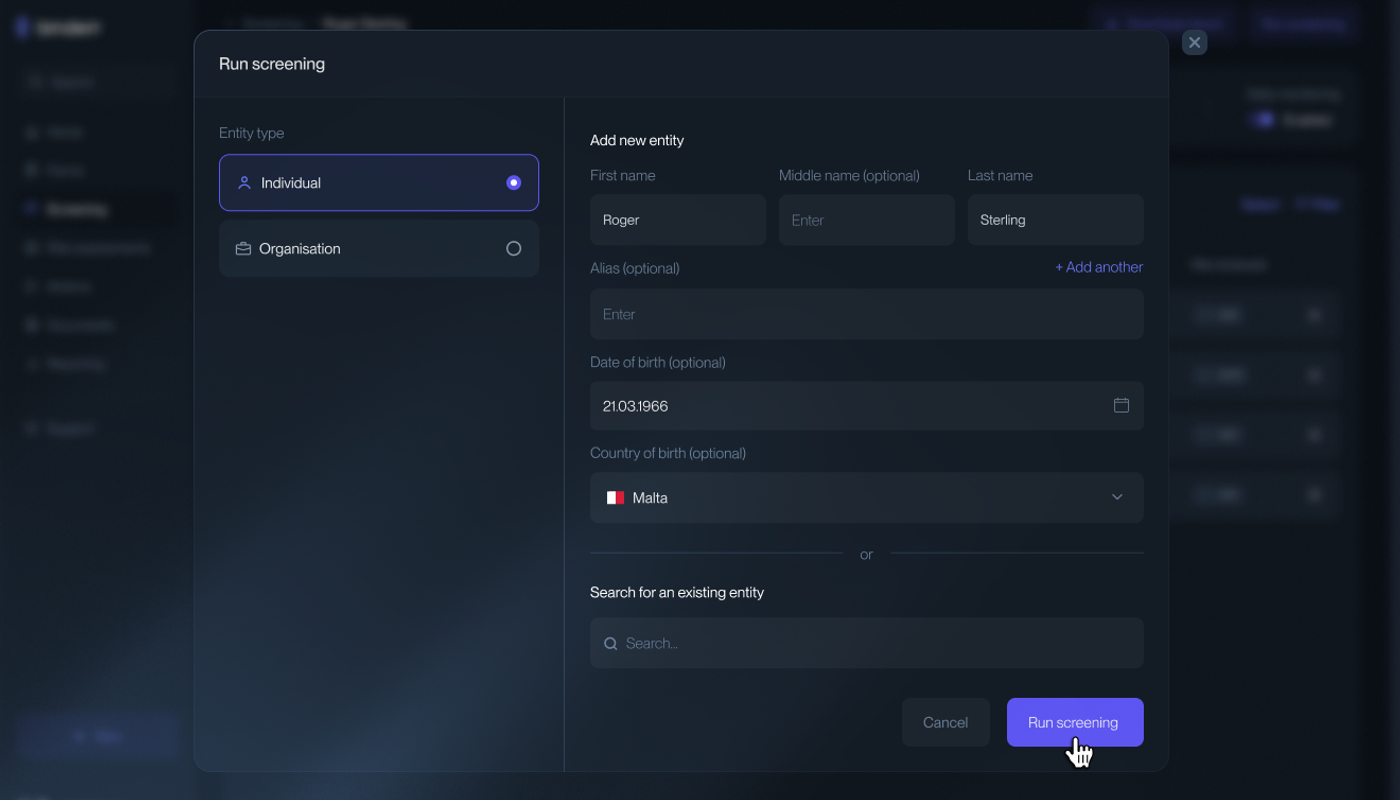
(Run AML screening for individuals and organisations. Binderr allows compliance teams to enter identifying information or select an existing customer record before running screening checks.)
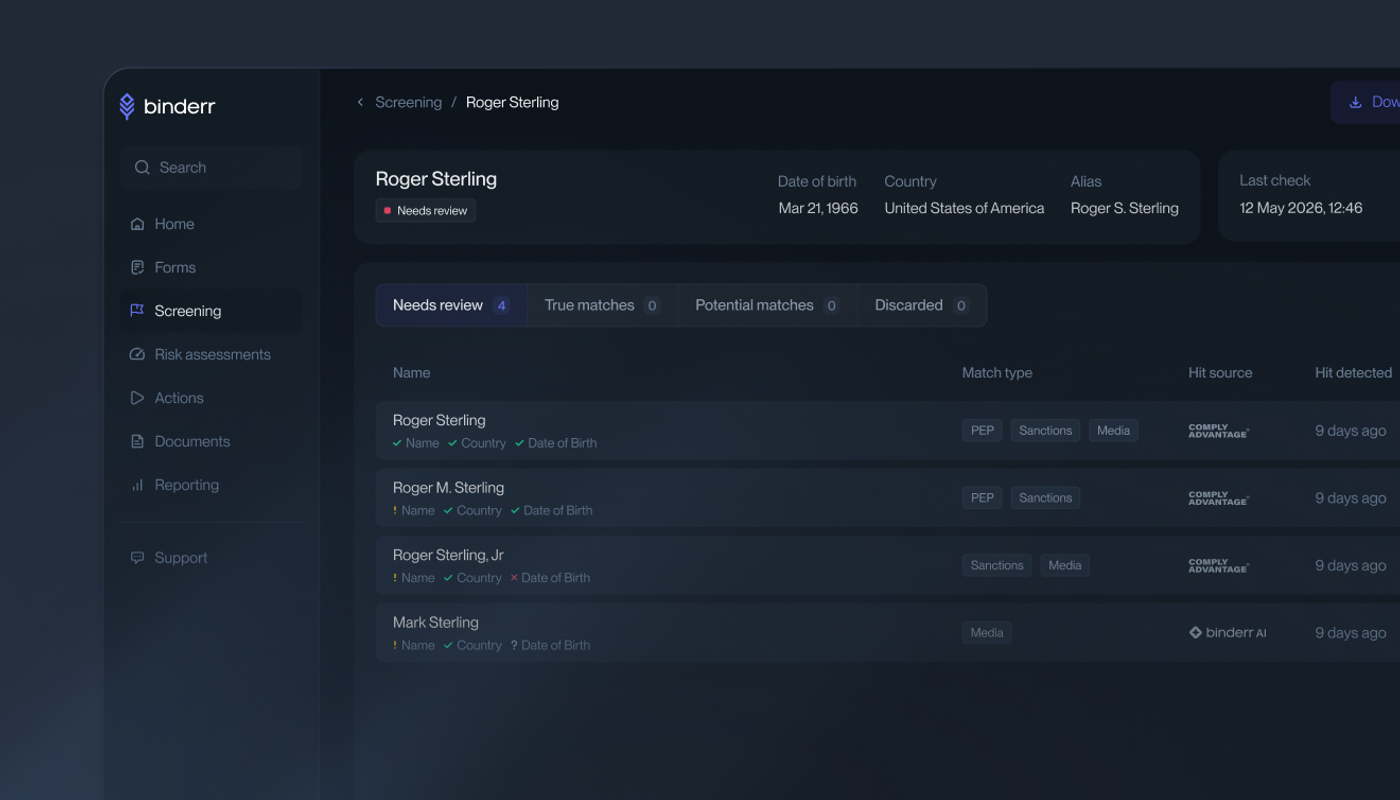
(Review potential PEP, sanctions, and adverse media matches in one place. Binderr organises screening results by match type and review status while showing which customer details support each potential match.)
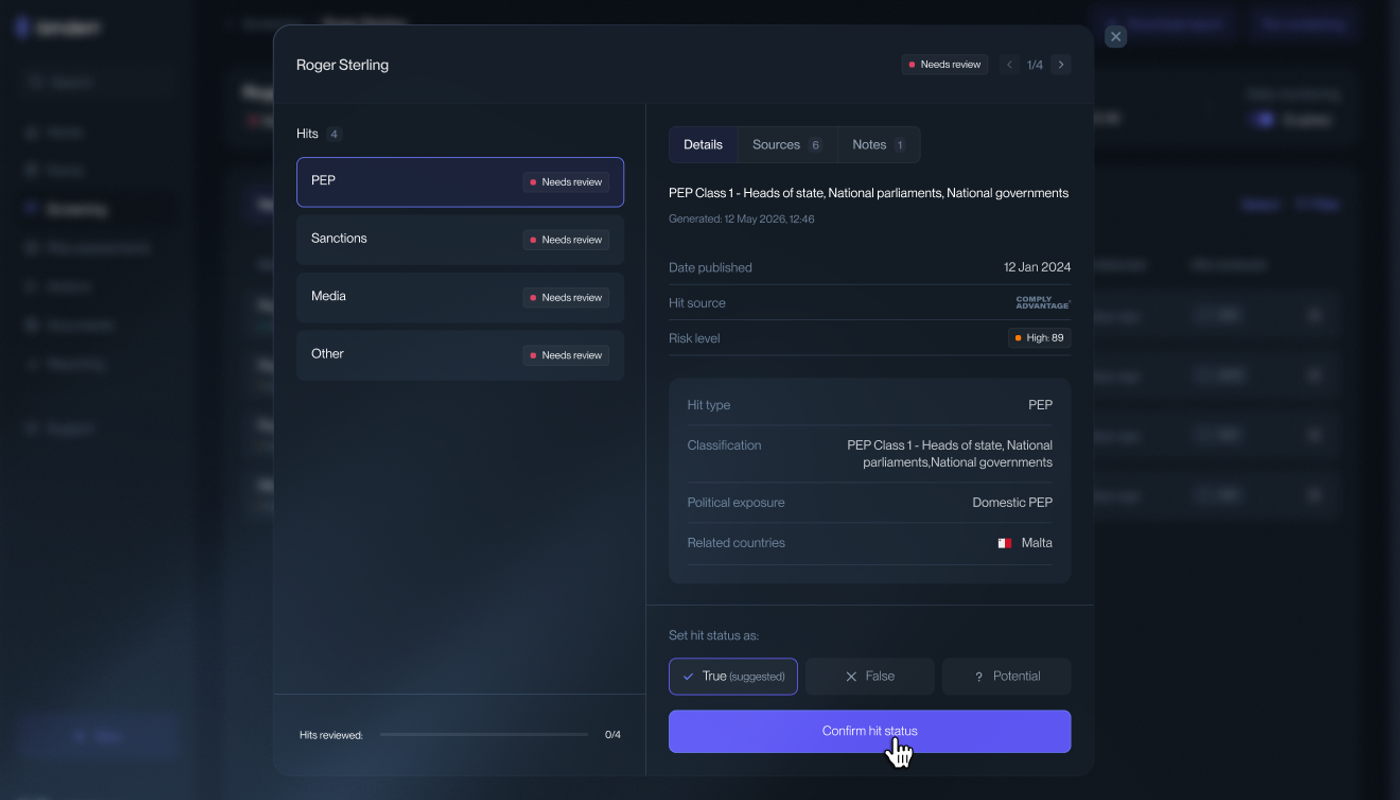
(Investigate each hit and record a defensible decision. Binderr lets analysts review source details, risk indicators, classifications, and related jurisdictions before marking a result as true, false, or potential.)
Start AML Screening for Free
Step 5: Calculate the Customer Risk Score
Use verified customer data and AML screening results to calculate a dynamic customer risk score. This risk assessment should consider factors such as geography, customer type, business activity, ownership complexity, and exposure to sanctions or PEP status.
The risk-scoring model should clearly document risk factors, weightings, scoring thresholds, hard-stop rules, overrides, final risk category, and the rationale behind each decision. Transparent risk scoring supports regulatory compliance and ensures consistent, auditable outcomes across aml kyc solutions.
Step 6: Apply CDD or EDD
Apply Customer Due Diligence (CDD) or Enhanced Due Diligence (EDD) based on the customer risk assessment and AML risk scoring. A unified KYC and AML system should automatically trigger the appropriate due diligence workflow, ensuring that low-risk customers undergo standard CDD while high-risk customers are subject to enhanced scrutiny within kyc aml software.
For higher-risk profiles, EDD may require additional documentation such as source of funds, source of wealth, beneficial ownership verification, and senior management approval. This risk-based approach ensures compliance with AML regulations while maintaining efficient customer onboarding and reducing unnecessary friction for low-risk customers.
Step 7: Approve, Reject, or Escalate
Once due diligence is complete, the system determines whether to approve, reject, or escalate the customer based on predefined compliance rules and risk thresholds. Automated decision-making can streamline low-risk approvals, while higher-risk cases are routed for manual review or escalation to compliance teams using aml kyc solutions.
Possible outcomes include automatic approval, requesting additional information, escalating to compliance officers, requiring senior approval, restricting services, or rejecting the application. This structured decision framework ensures consistent AML compliance and reduces the risk of onboarding high-risk or non-compliant customers.
Step 8: Begin Ongoing Monitoring
After approval, customers enter ongoing AML monitoring to ensure their risk profile remains accurate over time. Continuous monitoring includes sanctions screening, PEP checks, adverse media monitoring, and transaction monitoring to detect suspicious activity or changes in customer behavior within kyc aml software.
Periodic reviews and event-driven triggers, such as changes in ownership, geography, or transaction patterns, help maintain up-to-date customer risk assessments. This ongoing monitoring process is essential for identifying emerging financial crime risks and ensuring continuous compliance with AML regulations.
Step 9: Investigate Alerts
When alerts are generated from AML screening or transaction monitoring, they should be managed through a centralized case management system. Each alert should create a case that allows compliance analysts to review relevant data, assess risk, and determine appropriate actions using aml kyc solutions.
A unified compliance platform ensures analysts have access to the complete customer profile, including KYC data, screening results, risk scores, and historical decisions. This improves investigation efficiency, reduces false positives, and supports accurate and timely resolution of AML alerts.
Step 10: Maintain an Audit-Ready Record
Maintain a comprehensive audit trail that captures all KYC and AML activities, including identity verification, screening results, risk assessments, due diligence actions, and final decisions. This audit-ready record is essential for demonstrating regulatory compliance and supporting internal audits within kyc aml software.
All data changes, approvals, analyst notes, and supporting documents should be securely stored and easily retrievable. A strong audit trail not only ensures transparency but also helps organizations respond effectively to regulatory inspections and compliance reviews.
See How Binderr Streamlines the Compliance Workflow
Binderr simplifies every step of the KYC and AML process:
- Run KYC, KYB, and AML checks in one platform
- Automatically calculate risk scores
- Trigger CDD and EDD workflows dynamically
- Collect documents and approvals seamlessly
- Monitor customers continuously with real-time alerts
- Maintain full audit trails for regulatory compliance
Choosing the Right Unified KYC and AML Platform for Seamless Compliance
Find the ideal solution that combines identity verification, AML screening, risk assessment, and ongoing monitoring into one efficient compliance workflow using leading aml kyc solutions
Robust Identity Verification Capabilities
A modern KYC solution should offer robust identity verification capabilities that combine global document coverage with advanced document authenticity checks to validate passports, IDs, and licenses across jurisdictions. By integrating biometric verification, liveness detection, and fraud and deepfake detection, businesses can prevent identity spoofing and synthetic fraud while ensuring real users are present. Address verification further strengthens compliance by confirming residency details, creating a secure and reliable onboarding process aligned with AML regulations within kyc aml software.
Comprehensive Business Verification
Effective KYB processes rely on comprehensive business verification tools that provide direct registry access and accurate director and shareholder data. These systems enable seamless UBO identification and ownership mapping, helping organizations uncover complex corporate structures and beneficial ownership layers. With company status checks and multi-jurisdiction coverage, businesses can confidently verify entities across borders while meeting global compliance standards and reducing financial crime risk using aml kyc solutions.
Advanced AML Screening Tools
Advanced AML screening tools are essential for detecting financial crime risks through real-time checks against sanctions lists, PEP databases, and watchlists. By identifying relatives and close associates, analyzing adverse media, and assessing entity ownership and control exposure, organizations gain a deeper understanding of potential threats. Ongoing monitoring ensures that customer risk profiles remain up to date, allowing businesses to respond quickly to new risks and maintain continuous AML compliance within kyc aml software.
Dynamic Risk Assessment Framework
A dynamic risk assessment framework enables organizations to evaluate customer risk using custom risk factors and adjustable weightings tailored to their risk appetite. Automated scoring systems streamline decision-making, while hard-stop rules and manual overrides provide flexibility and control. With dynamic reassessment and risk-based workflow triggers, businesses can adapt to changing customer behavior and regulatory requirements, ensuring a proactive and scalable compliance strategy supported by aml kyc solutions.
Flexible CDD and EDD Workflows
Flexible CDD and EDD workflows allow compliance teams to tailor due diligence processes based on customer risk levels. Dynamic forms and conditional document requests ensure that only relevant information is collected, improving efficiency and user experience. By incorporating source-of-funds and source-of-wealth evidence, along with senior approval and case escalation mechanisms, organizations can effectively manage high-risk customers while maintaining regulatory compliance within kyc aml software.
Centralised Case Management System
A centralized case management system streamlines compliance operations by consolidating alert queues, task assignment, and analyst notes into a single platform. Features such as four-eye approval, escalation rules, and detailed investigation history ensure transparency and accountability throughout the review process. This unified approach enhances collaboration, reduces manual errors, and supports efficient handling of AML alerts and compliance cases using aml kyc solutions.
Seamless Integration Capabilities
Seamless integration capabilities are critical for connecting compliance systems with existing business infrastructure. With API access, webhooks, and prebuilt integrations, organizations can automate data exchange and streamline workflows across platforms. Data export options, customizable workflow configuration, and sandbox or test environments enable businesses to deploy and scale compliance solutions efficiently while maintaining flexibility and control within kyc aml software.
Comprehensive Reporting and Governance Controls
Comprehensive reporting and governance controls provide the transparency and oversight required for effective compliance management. Full audit trails, management information dashboards, and version history ensure that every action is documented and traceable. User permissions, data retention controls, and quality assurance processes support strong governance, while regulatory reporting capabilities help organizations meet legal obligations and demonstrate compliance to authorities using aml kyc solutions.
Key Commercial Considerations
When evaluating compliance platforms, key commercial considerations include understanding pricing structures such as monthly platform fees, per-verification charges, and per-screening costs. Businesses should also assess ongoing monitoring expenses, API charges, user limits, and minimum commitments. Additional factors like implementation fees, support costs, contract length, and availability of free credits or trial access can significantly impact total cost of ownership and should be carefully reviewed before selecting a solution among available kyc aml software providers.
Try Advanced AML Screening and Risk Detection with Binderr
Binderr enhances AML compliance with:
- Real-time sanctions and PEP screening
- AI-powered adverse media analysis
- Smart matching to reduce false positives
- Continuous monitoring with instant alerts
- Risk-based scoring integrated into CDD and EDD
- Centralised alert management for faster investigations
How Much Does an Integrated KYC and AML System Cost?
Understanding the cost of an integrated KYC and AML system requires looking beyond headline pricing and considering how different providers structure their fees. Most platforms combine subscription costs with usage-based pricing for identity checks, AML screening, and ongoing monitoring within aml kyc solutions.
Binderr stands out by offering transparent and accessible pricing starting at €99 per month for its Starter plan, €349 for the Pro plan, and custom pricing for enterprise needs. Unlike many competitors, Binderr provides a free account with free credits, requires no credit card to get started, and allows businesses to scale usage without long-term commitments or mandatory sales calls, making it a flexible option in the kyc aml software market.
Pricing Comparison Table
Compare KYC and AML pricing models, features, and costs across leading compliance platforms.
Provider | Starting Price | Free Trial / Credits | Pricing Transparency | Key Strengths |
Binderr | €99/month | Yes (free credits) | High | Unified platform, flexible pricing, no lock-in |
Sumsub | Custom | Limited | Low | Global coverage, strong identity verification |
Ondato | Custom | Limited | Medium | EU-focused compliance, onboarding tools |
Trulioo | Custom | No | Low | Extensive global data sources |
Idenfy | Custom | Limited | Medium | Identity verification and fraud prevention |
Start Using Binderr for Free
Streamlining Compliance: Smart Strategies for Integrated KYC and AML Systems
Build a resilient, efficient compliance framework by applying proven best practices for managing unified KYC, AML, and risk-based workflows using kyc aml software and aml kyc solutions
Maintain one authoritative customer profile - A unified customer profile ensures that all KYC and AML data, including identity verification, screening results, and risk assessments, are stored in one place. This reduces duplication, improves data accuracy, and allows compliance teams to make consistent decisions based on a single source of truth.
Connect risk scores with practical control decisions - Risk scores should directly influence compliance actions such as CDD, EDD, approval levels, and monitoring intensity. By linking risk assessment outputs to real operational controls, businesses can apply a risk-based approach that aligns with regulatory expectations and improves AML compliance.
Use event-driven reviews alongside scheduled reviews - In addition to periodic reviews, event-driven triggers such as changes in customer activity, new adverse media, or sanctions updates should prompt immediate reassessment. This approach ensures that customer risk profiles remain current and supports effective ongoing monitoring.
Test screening thresholds and false-positive rates - Regular testing of AML screening configurations helps balance detection accuracy with operational efficiency. By adjusting thresholds and reviewing false-positive rates, compliance teams can reduce unnecessary alerts while maintaining effective sanctions and PEP screening within kyc aml software.
Review risk models against actual customer behaviour - Risk models should be validated against real transaction patterns and customer activity to ensure they remain relevant. Comparing expected behaviour with actual data helps refine risk scoring and improves the effectiveness of AML risk assessment.
Maintain oversight of external providers - Even when using third-party kyc aml software, organisations remain responsible for compliance. Ongoing oversight, performance monitoring, and validation of external providers ensure that identity verification, screening, and monitoring processes meet regulatory standards.
Get End-to-End Compliance with Binderr
Binderr provides a complete compliance solution:
- KYC and KYB verification
- AML screening and monitoring
- Dynamic risk assessment
- UBO identification and ownership mapping
- Automated CDD and EDD workflows
- Case management and audit trails
Bottom Line
Effective kyc aml integration ensures customer verification is not just a one-time onboarding task but part of a continuous, risk-based compliance lifecycle. By connecting identity verification, AML screening, risk assessment, CDD, EDD, transaction monitoring, and ongoing monitoring, businesses maintain a consistent view of customer risk. This approach improves compliance, reduces errors, strengthens financial crime detection, and ensures decisions are backed by verified data and clear audit trails.
Binderr enables organisations to manage this workflow within a single platform. As a comprehensive kyc aml software and provider of aml kyc solutions, it supports KYC and KYB verification, AML screening, UBO identification, risk scoring, and automated CDD and EDD. With tools for forms, e-signatures, alerts, audit trails, and reporting, businesses can scale compliance while maintaining visibility and control.