
Across global markets, digital onboarding has become the primary way banks, fintech companies, and crypto platforms acquire customers. Organisations must confirm identities within seconds while preventing identity theft, forged documents, account fraud, and exposure to sanctions risks.
In today’s regulatory environment, basic ID checks are no longer enough to address evolving fraud risks or compliance demands. Modern KYC software combines document verification, OCR data extraction, biometric face matching, liveness detection, AML screening, and customer risk scoring into a single workflow. With digital identity checks expected to exceed 70 billion globally by 2027, continuous monitoring and automated CDD and EDD processes are now essential for maintaining compliance across both traditional institutions and crypto KYC providers.
This guide compares top KYC software for banks, fintech, and crypto platforms based on verification, fraud prevention, AML tools, coverage, scalability, and integrations to help teams choose secure, scalable solutions from the best KYC providers.
Binderr KYC Software for Banks, Fintech & Crypto
- AI-powered identity verification with document checks and OCR extraction
- Biometric face matching and liveness detection to prevent fraud
- AML screening across sanctions, PEPs, watchlists, and adverse media
- Dynamic risk scoring and automated CDD/EDD workflows
- Ongoing monitoring with real-time alerts
- Global coverage across 230+ countries and 11,000+ ID types
What Is KYC Software?
KYC software is a digital tool that helps businesses verify customer identities, assess risk, and meet compliance requirements. It prevents fraud, money laundering, and identity theft while enabling faster onboarding, making it a core component of the best KYC software solutions.
It automates processes like ID verification, biometric checks, AML screening, and risk scoring, replacing manual workflows with scalable systems used by leading crypto KYC providers and financial institutions.
What Should a Modern KYC Screening Platform Cover?
Identity verification alone does not provide a complete view of customer risk. A broader compliance process should connect sanctions screening, PEP checks, adverse media analysis, business verification, and enhanced due diligence within the same customer profile.
Binderr brings these checks together, helping compliance teams move from basic identity verification to risk-based customer screening.
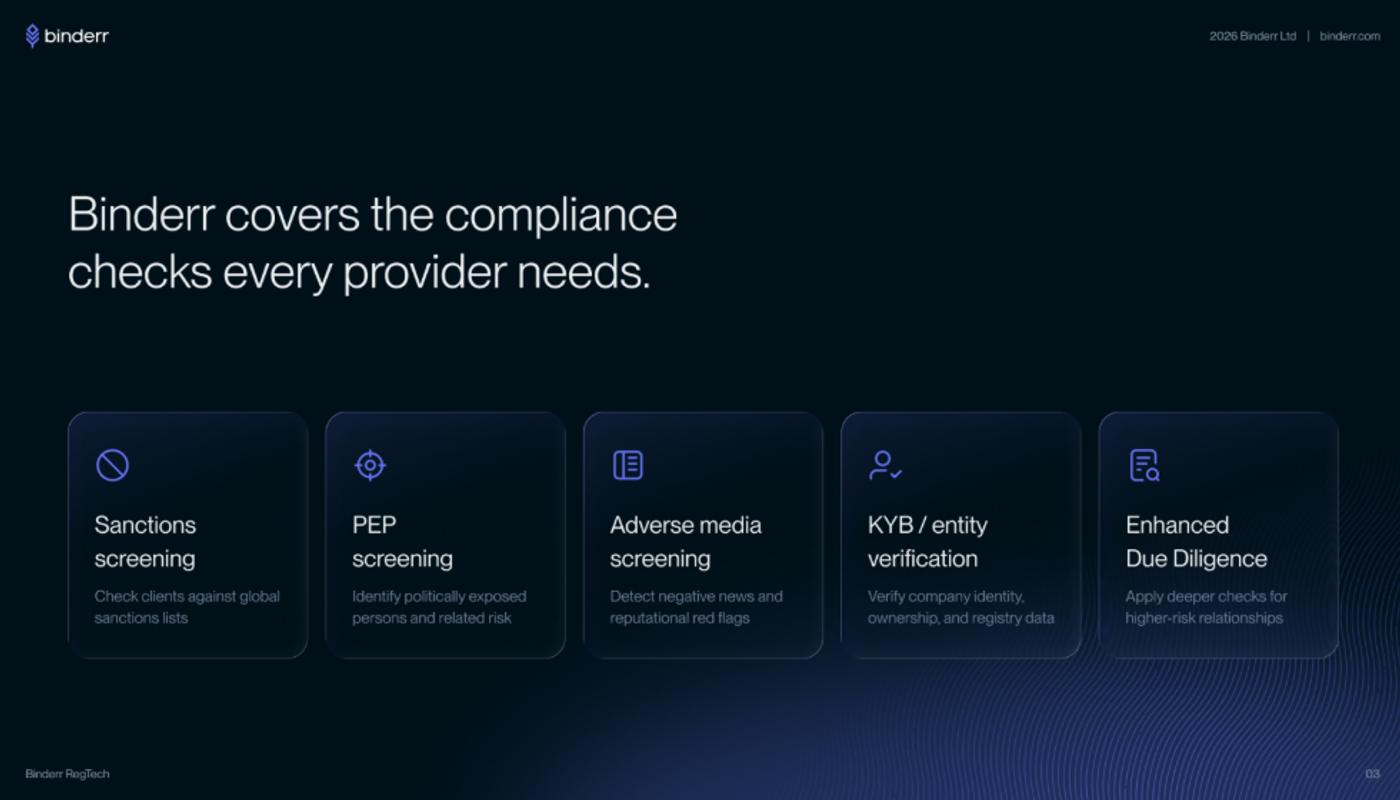
(Binderr combines sanctions, PEP and adverse media screening with KYB verification and enhanced due diligence.)
Screen users for FREE in seconds with Binderr
Why Banks, Fintech Companies and Crypto Platforms Need KYC Software
From onboarding to ongoing monitoring, modern financial services rely on KYC software to verify identities, prevent fraud, and meet evolving AML compliance requirements. This applies equally to traditional institutions using KYC software for banks and emerging crypto KYC providers.
Banks, fintech companies, and crypto platforms use digital KYC solutions to streamline customer verification, reduce risk, and support secure, scalable growth across global markets.
Faster onboarding with compliance - Modern KYC software enables faster onboarding by automating identity verification while maintaining full compliance with regulatory standards. Businesses can verify customers in real time using digital KYC tools, reducing delays without compromising AML and compliance requirements.
Reduces fraud with automated checks - Automated checks such as document verification, biometric authentication, and liveness detection help reduce fraud by identifying fake identities and suspicious activity early in the onboarding process. This strengthens fraud prevention and protects businesses from financial crime.
Meets AML and regulatory requirements: KYC software helps organisations meet AML and regulatory requirements by integrating sanctions screening, PEP checks, and customer due diligence into a single workflow. This ensures consistent compliance with global regulations and reduces the risk of penalties.
Scales across multiple regions: A global KYC platform allows businesses to scale across multiple regions by supporting international identity documents, languages, and compliance frameworks. This makes it easier to onboard customers in different jurisdictions while maintaining regulatory alignment.
Improves customer experience: Digital onboarding solutions improve customer experience by offering fast, intuitive verification processes that minimise friction. Features like mobile-friendly interfaces and automated data capture help increase completion rates and reduce drop-offs.
Supports ongoing risk monitoring: KYC software supports ongoing risk monitoring by continuously screening customers against updated sanctions lists, PEP databases, and adverse media. This helps businesses detect changes in customer risk profiles and maintain compliance throughout the customer lifecycle.
Try Binderr KYC screening for Free
Quick Comparison Between Leading KYC Software at a Glance
Explore key features, capabilities, and use cases across top KYC platforms for banks, fintech, and crypto businesses
Feature | Binderr | Sumsub | Onfido | Jumio | Ondato |
ID Document Verification | ✅ | ✅ | ✅ | ✅ | ✅ |
Global Document Support | ✅ | ✅ | ✅ | ✅ | ✅ |
Proof of Address Verification | ✅ | ✅ | ❌ | ❌ | ❌ |
Face Match and Liveness Detection | ✅ | ✅ | ✅ | ✅ | ✅ |
Deepfake and Identity Fraud Detection | ✅ | ✅ | ✅ | ✅ | ✅ |
AML, Sanctions, PEP and Adverse Media Screening | ✅ | ✅ | ✅ | ✅ | ✅ |
Integrated KYB and UBO Verification | ✅ | ✅ | ❌ | ❌ | ✅ |
Automated CDD and EDD Workflows | ✅ | ✅ | ❌ | ✅ | ✅ |
Built-In E-Signatures | ✅ | ❌ | ❌ | ❌ | ✅ |
Custom Forms, Document Requests and E-Signatures | ✅ | ❌ | ❌ | ❌ | ❌ |
Essential Features to Look for in KYC Software
Discover the must-have capabilities that power secure, compliant, and seamless customer onboarding across global markets.
From identity verification and biometric authentication to AML screening and risk-based workflows, these features define modern KYC software.
Identity Document Verification
Identity document verification is a foundational component of KYC software, ensuring that customers are who they claim to be before accessing financial services. By validating government-issued IDs such as passports, national identity cards, and driving licences, businesses can prevent identity fraud, impersonation, and account misuse. Advanced verification systems use OCR (optical character recognition) to extract data accurately, reducing manual errors and speeding up onboarding processes.
Modern identity verification tools also analyse document security features, including holograms, fonts, MRZ codes, and layout consistency, to detect forged or altered documents. These systems can identify signs of tampering, such as image manipulation or mismatched data fields, helping compliance teams flag suspicious applications early. Reliable document verification strengthens AML compliance and builds trust in digital onboarding environments.
Facial Recognition and Biometric Matching
Facial recognition and biometric matching enhance identity verification by confirming that the person submitting the document is its rightful owner. During onboarding, the system captures a live selfie or video and compares it with the photo on the identity document using advanced facial recognition algorithms. This process helps prevent identity theft and ensures that stolen or borrowed documents cannot be used to create fraudulent accounts.
Biometric matching improves both security and user experience by enabling fast, automated verification without requiring in-person checks. High-accuracy face matching technology can detect subtle differences in facial features, even across varying lighting conditions or camera quality. As a result, fintech companies, banks, and crypto platforms can reduce fraud risk while maintaining seamless digital onboarding journeys.
Liveness and Deepfake Detection
Liveness detection is critical in preventing spoofing attacks during biometric verification. Active liveness checks may require users to perform actions such as blinking, smiling, or turning their head, while passive liveness detection analyses subtle cues like skin texture, lighting reflections, and micro-movements without user interaction. These techniques help confirm that a real person is present rather than a static image or pre-recorded video.
Deepfake detection has become increasingly important as AI-generated identities and manipulated videos grow more sophisticated. KYC systems must detect replay attacks, masks, injection attacks, and synthetic media designed to bypass verification controls. By combining liveness detection with AI-driven fraud analysis, businesses can protect against emerging threats and maintain strong identity assurance in digital environments.
AML, Sanctions and PEP Screening
While identity verification confirms a customer’s identity, AML screening determines whether that individual poses a financial crime or regulatory risk. KYC software screens customers against global sanctions lists, politically exposed persons (PEP) databases, and adverse media sources to identify potential links to money laundering, corruption, or terrorist financing. This step is essential for meeting regulatory obligations and avoiding penalties.
Reducing Adverse Media Review Work
Adverse media screening can generate large volumes of articles, duplicate reports, and unrelated name matches. Analysts must determine whether the article refers to the customer, whether the allegation is relevant, and whether it materially changes the customer’s risk profile.
Binderr uses an AI screening agent to identify relevant customer mentions, review the underlying articles, and explain why a result may require attention. Binderr’s product material states that this approach can reduce adverse media review effort by up to 80%.
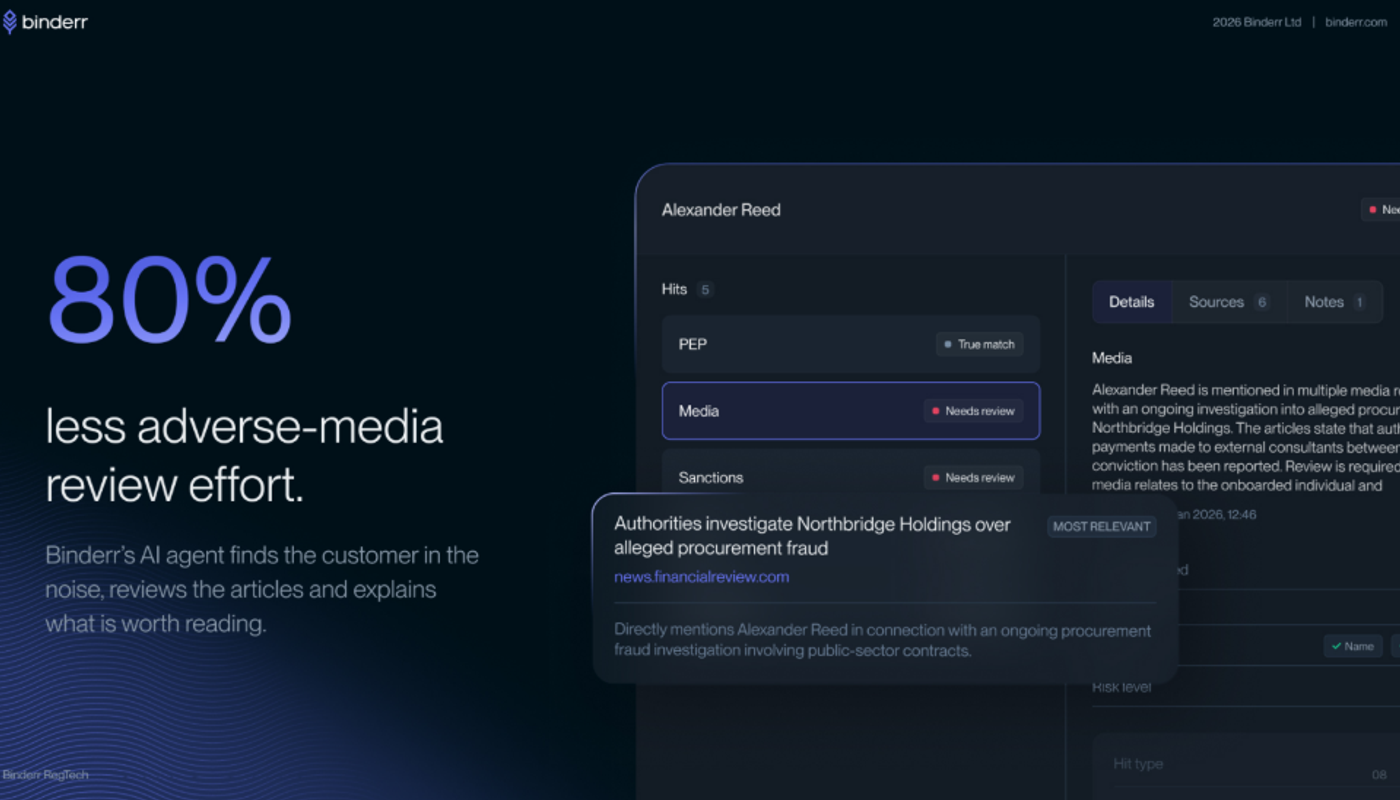
(Binderr’s AI agent helps analysts identify relevant adverse media and understand why a result may matter.)
Effective AML screening goes beyond initial checks by incorporating ongoing monitoring and real-time alerts when a customer’s risk profile changes. For example, a previously low-risk customer may later appear on a sanctions list or become associated with negative news. By integrating sanctions screening and PEP checks into onboarding workflows, businesses can maintain continuous compliance and reduce exposure to financial crime.
Try FREE AI-powered AML screening with Binderr
Customer Risk Scoring
Customer risk scoring allows businesses to assess and categorise customers based on their potential exposure to financial crime. KYC platforms analyse multiple risk factors, including customer type, country of residence, nationality, occupation, and transaction behaviour, to assign a risk level. Additional indicators such as PEP status, sanctions exposure, adverse media, and source of funds further refine the risk profile.
By applying risk-based scoring models, organisations can tailor their due diligence processes more effectively. Low-risk customers may pass through simplified onboarding, while higher-risk individuals trigger enhanced due diligence (EDD) and additional verification steps. This approach ensures regulatory compliance while optimising operational efficiency, allowing compliance teams to focus on the most critical risks.
CDD and EDD Workflow Automation
Modern KYC software should support automated Customer Due Diligence (CDD) and Enhanced Due Diligence (EDD) workflows that adapt dynamically to customer risk profiles. When predefined risk thresholds are exceeded, such as high-risk jurisdictions, PEP status, or adverse media hits, the system should automatically trigger additional identity verification steps, request supporting documents like proof of funds or source of wealth, and escalate cases for manual review. This risk-based approach ensures compliance with AML regulations while maintaining efficient onboarding processes.
Advanced workflow automation also enables configurable approval hierarchies, where high-risk cases are routed to senior compliance officers or MLROs for final decision-making. By integrating real-time risk scoring, sanctions screening, and fraud detection signals, KYC platforms can streamline compliance operations, reduce manual errors, and ensure consistent application of regulatory policies across all customer segments.
Ongoing Monitoring
KYC is not a one-time process but a continuous obligation that extends throughout the customer lifecycle. Ongoing monitoring ensures that customer profiles remain accurate and up to date by regularly screening against sanctions lists, PEP databases, and adverse media sources. Changes such as new sanctions designations, shifts in political exposure, or emerging negative news can significantly alter a customer’s risk profile and must be detected promptly.
Effective KYC software should provide automated rescreening, real-time alerts, and periodic review workflows to identify unusual activity, expired identity documents, or changes in ownership structures. Continuous monitoring helps financial institutions maintain AML compliance, detect suspicious behavior early, and respond proactively to evolving regulatory risks.
KYB and UBO Verification
Know Your Business (KYB) and Ultimate Beneficial Owner (UBO) verification are essential for onboarding corporate clients, merchants, and institutional users. KYC software should enable businesses to verify company registration details, legal status, and ownership structures by accessing global corporate registries and databases. Identifying UBOs is critical to uncover hidden ownership and prevent misuse of corporate entities for money laundering or fraud.
Automated KYB workflows should map complex ownership hierarchies, verify directors and shareholders, and screen all associated individuals against sanctions and PEP lists. This ensures transparency and compliance with AML regulations, particularly for banks, fintech companies, and crypto platforms dealing with cross-border corporate clients and high-risk jurisdictions.
Binderr extends screening beyond individual customers by connecting directors, shareholders, beneficial owners, and corporate entities within a visual ownership structure. Compliance teams can see which parties have been verified, where screening hits exist, and where additional information may still be required.
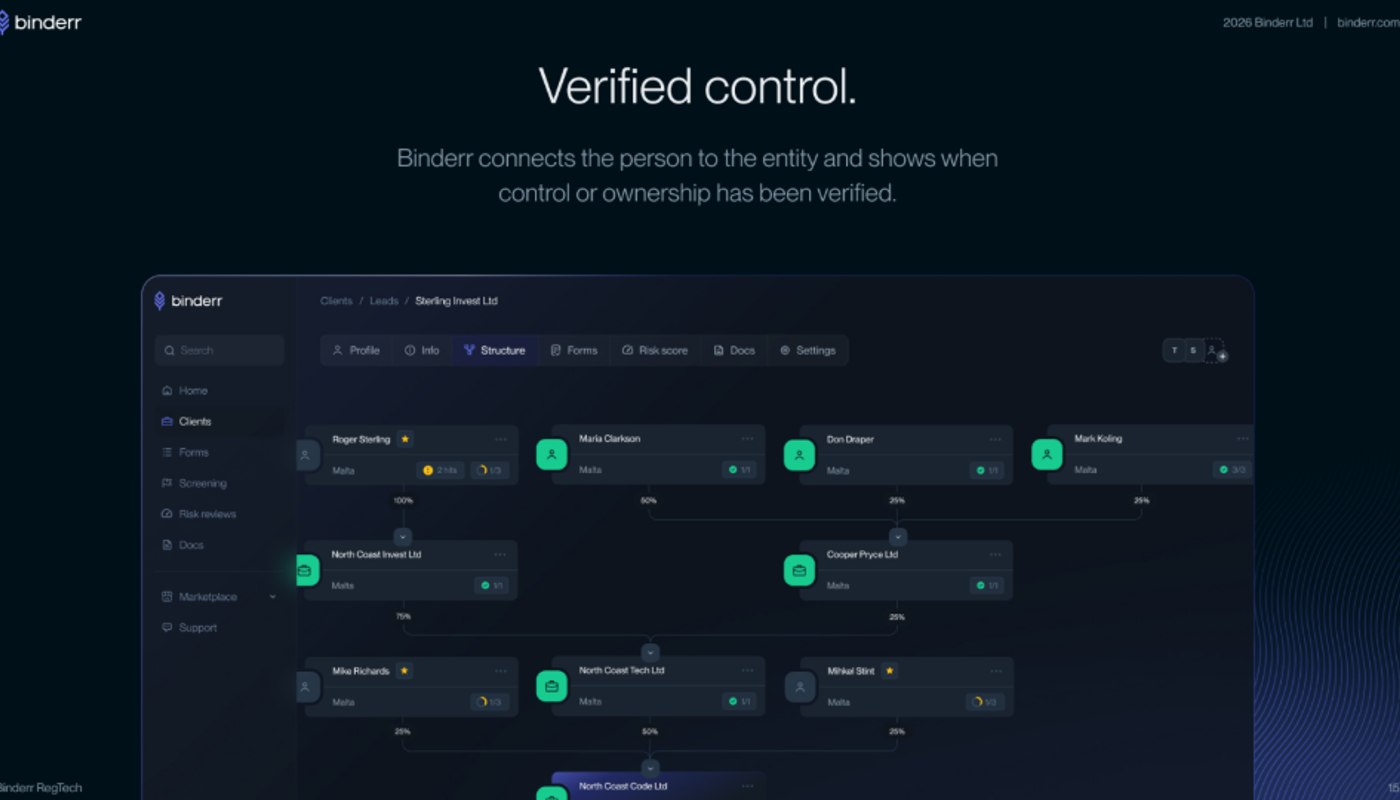
(Binderr maps company ownership and connects verified individuals with the entities they control.)
Audit Trails and Compliance Reporting
Robust audit trails and compliance reporting are fundamental features of any KYC software platform. Every action taken during the onboarding and monitoring process, such as identity verification results, screening outcomes, reviewer decisions, and document submissions, should be logged with timestamps and user details. This creates a transparent and traceable record that supports internal audits and regulatory inspections.
Comprehensive reporting tools should allow compliance teams to generate regulator-ready reports, track risk changes over time, and demonstrate adherence to AML and KYC requirements. By maintaining structured decision logs, supporting evidence, and historical data, organizations can ensure accountability, improve governance, and respond efficiently to compliance inquiries or investigations.
Simplify KYC, AML, and Risk Assessment with Binderr
- Run KYC, KYB, and AML checks in one unified platform
- Automatically assign risk scores based on real-time data
- Trigger EDD workflows for high-risk customers
- Collect documents dynamically with custom forms and e-signatures
- Monitor customers continuously with real-time alerts
- Maintain full audit trails for compliance reporting
Best KYC Software for Banks, Fintech and Crypto
Discover the tools redefining digital identity verification, AML compliance, and seamless onboarding across global financial ecosystems.
Explore leading KYC platforms designed to power banks, fintech innovation, and crypto compliance with speed, security, and scalability, including some of the best KYC providers and crypto KYC providers available today.
Binderr
Binderr is a unified compliance platform designed to simplify and strengthen customer onboarding for regulated businesses. As one of the best KYC providers, it brings together identity verification, business verification, AML screening, and risk management into a single system.
Binderr’s screening workflow is designed to give analysts greater visibility into why a potential match has appeared. Rather than providing unexplained alerts, the platform supports transparent screening results, configurable risk policies, and more focused review queues.
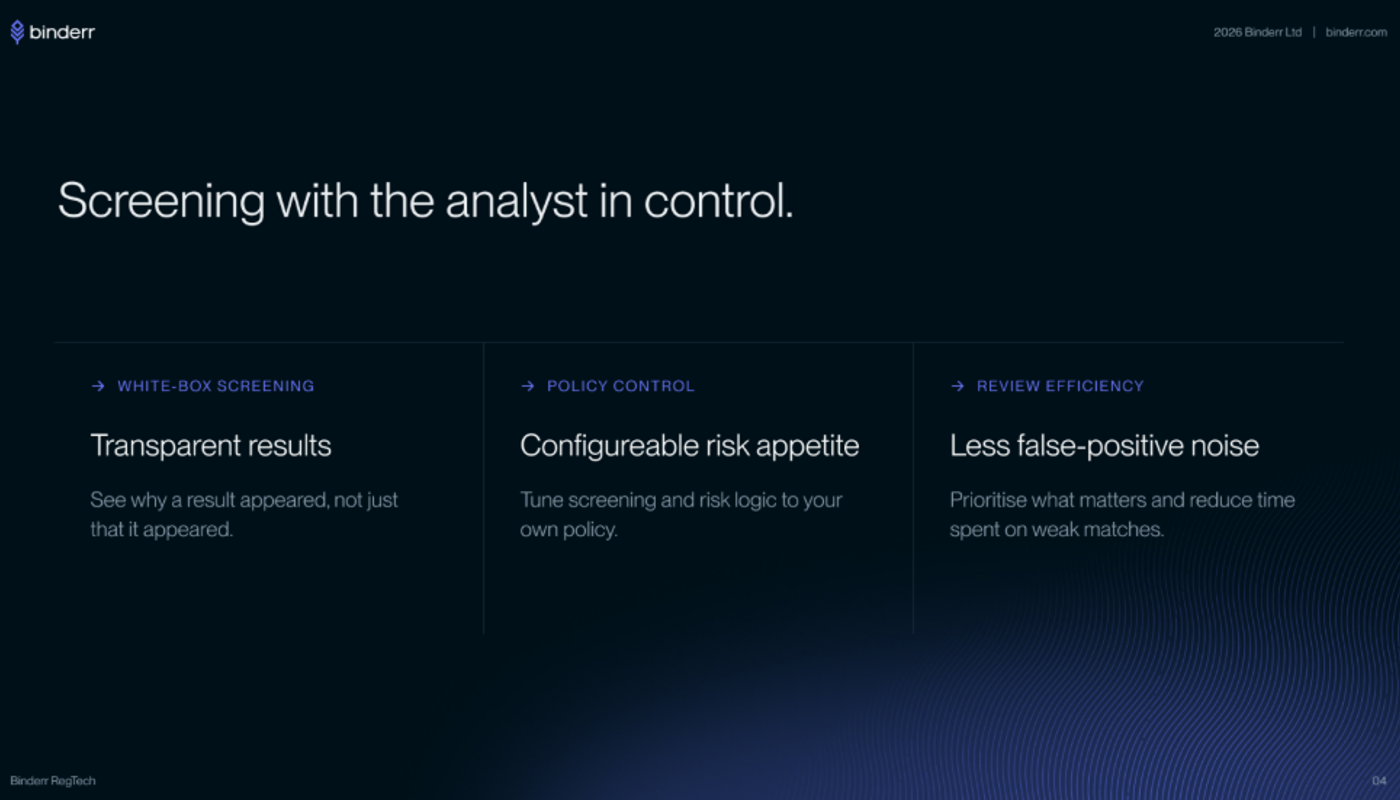
(Binderr provides transparent screening results, configurable policy controls, and tools for reducing false-positive noise.)
Key Features:
- Comprehensive identity and document verification: Binderr supports a wide range of global identity documents, including passports, national ID cards, and driving licences. Its AI-driven verification engine analyses document authenticity, extracts key data, and helps detect tampering or forgery, enabling reliable onboarding across international markets.
- Advanced biometric verification and liveness detection: The platform uses facial recognition and liveness checks to confirm that the person submitting the identity document is physically present and matches the document photo. This helps prevent impersonation, deepfake attacks, and other forms of identity fraud.
- Integrated AML screening and risk intelligence: Binderr screens customers against sanctions lists, PEP databases, watchlists, and adverse media sources. These checks are embedded directly into the onboarding workflow, allowing compliance teams to identify regulatory risks early and take appropriate action.
- Dynamic risk-based onboarding and due diligence: The platform applies automated risk scoring based on customer data, geography, and screening results. Higher-risk customers can be automatically routed through enhanced due diligence (EDD) workflows, including additional document requests and approval steps.
- Unified KYC and KYB workflows: Binderr enables businesses to verify both individuals and corporate entities within the same system. It supports company verification, director and shareholder checks, and ultimate beneficial owner (UBO) identification, ensuring full visibility of ownership structures.
- Ongoing monitoring and audit-ready compliance records: The platform continuously monitors customers for changes in sanctions status, PEP exposure, or adverse media. It maintains detailed audit trails, including verification results, risk assessments, and decision logs, helping organisations stay prepared for regulatory reviews.
Best For: Binderr is best suited to regulated businesses that need a single platform to manage both individual and corporate onboarding. It works particularly well for organisations operating across multiple jurisdictions with varying compliance requirements. Ideal for teams looking to automate KYC, KYB, AML screening, and ongoing monitoring without relying on fragmented tools.
Sumsub
Sumsub is a comprehensive compliance and fraud-prevention platform designed to help regulated businesses manage the full customer lifecycle, from onboarding to ongoing monitoring. It brings together identity verification, AML screening, fraud detection, and transaction monitoring into a single system, allowing organisations to reduce operational complexity while strengthening compliance controls.
The platform is widely used by financial institutions, fintech companies, payment providers, trading platforms, and crypto businesses that need to verify customers across multiple jurisdictions while maintaining a smooth user experience.
Key Features:
- End-to-end identity verification: Sumsub supports automated verification of identity documents across multiple countries, combining document checks with OCR data extraction and validation to ensure accuracy and reduce manual input errors.
- Advanced biometric and liveness checks: The platform uses facial recognition, face matching, and both active and passive liveness detection to confirm that the user is physically present and matches their identity document, helping prevent spoofing, deepfakes, and impersonation.
- Integrated fraud detection engine: Sumsub analyses a wide range of signals, including device data, behavioural patterns, IP intelligence, and identity attributes, to detect suspicious activity such as synthetic identities, account takeovers, and coordinated fraud attempts.
- Comprehensive AML screening: The platform screens individuals and businesses against global sanctions lists, PEP databases, and adverse media sources, helping organisations identify regulatory risks and meet compliance obligations across jurisdictions.
- Transaction monitoring and risk analysis: Beyond onboarding, Sumsub monitors user activity and transactions to detect unusual patterns, flag suspicious behaviour, and support ongoing compliance with AML requirements.
- Crypto and Travel Rule compliance tools: Sumsub provides specialised features for crypto businesses, including wallet verification, transaction risk analysis, and Travel Rule data exchange, helping platforms meet evolving regulatory expectations in the digital asset space.
Best For: Sumsub is best suited to fast-growing fintech, payments, trading, gaming, and crypto companies that need a scalable compliance solution. It works particularly well for businesses operating across multiple jurisdictions with varying regulatory requirements.
Onfido
Entrust Identity Verification, formerly Onfido, is a digital identity verification solution designed to help businesses onboard customers securely while maintaining a smooth user experience. It combines document verification, biometric analysis, and flexible workflow tools to support remote onboarding across web and mobile environments. By leveraging AI-driven checks and user-friendly capture technology, the platform helps organisations confirm that customers are genuine while reducing friction during the verification process.
The solution is particularly focused on enabling scalable identity verification through APIs and SDKs, allowing businesses to embed verification directly into their applications. Its approach balances automation with human review, helping organisations manage both efficiency and risk when verifying customers across different regions and use cases.
Key Features:
- Advanced document verification: Analyses a wide range of global identity documents to detect signs of tampering, forgery, or inconsistencies while extracting key customer data accurately.
- Facial similarity and biometric matching: Compares a live image or video of the user with the photo on their identity document to confirm identity ownership and reduce impersonation risks.
- Liveness detection technology: Uses selfie or video-based checks to ensure that a real person is present during verification, helping prevent spoofing attempts such as photos, masks, or screen replays.
- Smart capture and user guidance: Provides intuitive prompts and real-time feedback to help users capture high-quality images, improving completion rates and reducing verification errors.
- Flexible workflow configuration: Allows businesses to design tailored verification journeys based on customer type, geography, or risk level, supporting both simple and complex onboarding flows.
- Developer-friendly integrations: Offers robust APIs, web SDKs, and mobile SDKs that enable seamless integration into existing platforms, along with tools for scaling verification across multiple products and markets.
Best For: Entrust Identity Verification is best suited to fintech companies, digital banks, and online platforms that need flexible, embedded identity verification. It works well for businesses prioritising user experience alongside strong biometric checks. Ideal for organisations scaling digital onboarding across multiple regions and customer segments.
Jumio
Jumio is an enterprise-grade identity verification and compliance platform designed to help regulated businesses securely onboard customers in digital environments. It is widely used by banks, financial institutions, fintech companies, and global digital platforms that require high levels of assurance when verifying customer identities at scale.
The platform combines advanced identity document verification with biometric authentication and AML screening to create a comprehensive onboarding solution. By embedding these capabilities directly into digital account-opening journeys, Jumio enables organisations to reduce fraud, improve compliance, and deliver a smoother customer experience without compromising security.
Key Features:
- Automated identity document verification: Jumio uses AI-driven technology to analyse and validate a wide range of government-issued identity documents in real time, checking for authenticity, tampering, and inconsistencies while extracting key data accurately.
- Biometric authentication and liveness detection: The platform applies facial recognition and liveness checks to confirm that the person completing the verification is physically present and matches the identity document, helping prevent spoofing, deepfakes, and impersonation attempts.
- Comprehensive AML screening: Jumio screens customers against global sanctions lists, politically exposed persons (PEP) databases, and other watchlists, enabling businesses to identify regulatory risks early in the onboarding process.
- Identity intelligence and fraud detection: By linking identity signals across multiple transactions and interactions, Jumio can detect patterns associated with fraud, such as repeated use of the same identity, synthetic identities, or coordinated fraud networks.
- Risk-based decisioning and workflow automation: The platform allows businesses to apply configurable rules and risk thresholds to automatically approve, reject, or refer applications for manual review, ensuring consistent and compliant decision-making.
- Scalable APIs and enterprise integration: Jumio offers flexible APIs and SDKs that integrate seamlessly into existing onboarding systems, supporting high verification volumes and complex workflows across multiple regions and customer segments.
Best For: Jumio is best suited to large banks, financial institutions, and enterprise fintech platforms that require high-assurance identity verification at scale. It is particularly valuable for organisations handling high-risk or high-volume onboarding across multiple jurisdictions.
Ondato
Ondato is a digital identity and compliance platform that helps regulated businesses streamline onboarding while maintaining AML and risk controls. It combines identity verification, business verification, transaction monitoring, and ongoing compliance tools in one system.
The platform supports both individual and corporate verification, making it suitable for businesses onboarding different customer types across multiple jurisdictions. Its configurable workflows allow teams to automate routine checks while managing higher-risk cases.
Key Features:
- End-to-end digital identity verification: Enables remote onboarding through automated document and identity checks.
- Biometric verification and liveness detection: Uses facial recognition and liveness checks to confirm identity and reduce fraud.
- AML screening: Screens customers against sanctions, PEPs, watchlists, and adverse media.
- Customer risk assessment: Assigns risk scores based on factors like geography, profile, and screening results.
- Ongoing monitoring: Tracks changes such as new sanctions or adverse media alerts.
- KYB and transaction monitoring: Supports business verification and detects suspicious activity after onboarding.
Best For: Ondato is best suited to fintech companies, payment providers, lenders, and digital platforms needing flexible onboarding workflows. It works well for organisations onboarding both individuals and businesses across multiple jurisdictions.
Best KYC Software for Banks, Fintech and Crypto
Discover the tools redefining digital identity verification, AML compliance, and seamless onboarding across global financial ecosystems.
Explore leading KYC platforms designed to power banks, fintech innovation, and crypto compliance with speed, security, and scalability, including some of the best KYC providers and crypto KYC providers available today.
No single provider is ideal for every business. The right choice depends on the organisation’s regulatory obligations, customer types, risk appetite, target jurisdictions, products, transaction volumes, and existing compliance infrastructure.
Binderr
Binderr is a unified compliance platform designed to simplify and strengthen customer onboarding for regulated businesses. As one of the best KYC providers, it brings together identity verification, business verification, AML screening, and risk management into a single system.
Binderr’s screening workflow is designed to give analysts greater visibility into why a potential match has appeared. Rather than providing unexplained alerts, the platform supports transparent screening results, configurable risk policies, and more focused review queues.
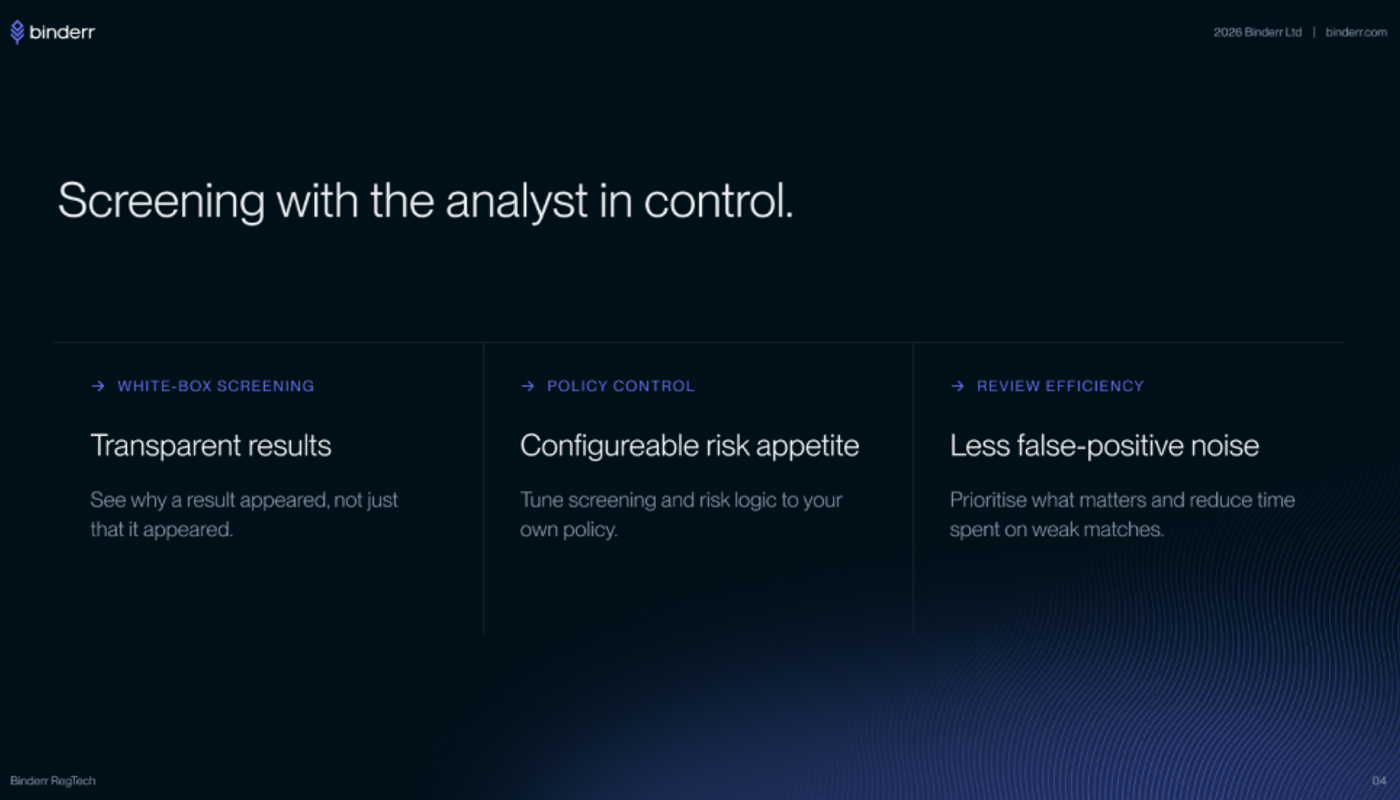
(Binderr provides transparent screening results, configurable policy controls, and tools for reducing false-positive noise.)
Key Features:
- Comprehensive identity and document verification: Binderr supports a wide range of global identity documents, including passports, national ID cards, and driving licences. Its AI-driven verification engine analyses document authenticity, extracts key data, and helps detect tampering or forgery, enabling reliable onboarding across international markets.
- Advanced biometric verification and liveness detection: The platform uses facial recognition and liveness checks to confirm that the person submitting the identity document is physically present and matches the document photo. This helps prevent impersonation, deepfake attacks, and other forms of identity fraud.
- Integrated AML screening and risk intelligence: Binderr screens customers against sanctions lists, PEP databases, watchlists, and adverse media sources. These checks are embedded directly into the onboarding workflow, allowing compliance teams to identify regulatory risks early and take appropriate action.
- Dynamic risk-based onboarding and due diligence: The platform applies automated risk scoring based on customer data, geography, and screening results. Higher-risk customers can be automatically routed through enhanced due diligence (EDD) workflows, including additional document requests and approval steps.
- Unified KYC and KYB workflows: Binderr enables businesses to verify both individuals and corporate entities within the same system. It supports company verification, director and shareholder checks, and ultimate beneficial owner (UBO) identification, ensuring full visibility of ownership structures.
- Ongoing monitoring and audit-ready compliance records: The platform continuously monitors customers for changes in sanctions status, PEP exposure, or adverse media. It maintains detailed audit trails, including verification results, risk assessments, and decision logs, helping organisations stay prepared for regulatory reviews.
Best For: Binderr is best suited to regulated businesses that need a single platform to manage both individual and corporate onboarding. It works particularly well for organisations operating across multiple jurisdictions with varying compliance requirements. Ideal for teams looking to automate KYC, KYB, AML screening, and ongoing monitoring without relying on fragmented tools.
Sumsub
Sumsub is a comprehensive compliance and fraud-prevention platform designed to help regulated businesses manage the full customer lifecycle, from onboarding to ongoing monitoring. It brings together identity verification, AML screening, fraud detection, and transaction monitoring into a single system, allowing organisations to reduce operational complexity while strengthening compliance controls.
The platform is widely used by financial institutions, fintech companies, payment providers, trading platforms, and crypto businesses that need to verify customers across multiple jurisdictions while maintaining a smooth user experience.
Key Features:
- End-to-end identity verification: Sumsub supports automated verification of identity documents across multiple countries, combining document checks with OCR data extraction and validation to ensure accuracy and reduce manual input errors.
- Advanced biometric and liveness checks: The platform uses facial recognition, face matching, and both active and passive liveness detection to confirm that the user is physically present and matches their identity document, helping prevent spoofing, deepfakes, and impersonation.
- Integrated fraud detection engine: Sumsub analyses a wide range of signals, including device data, behavioural patterns, IP intelligence, and identity attributes, to detect suspicious activity such as synthetic identities, account takeovers, and coordinated fraud attempts.
- Comprehensive AML screening: The platform screens individuals and businesses against global sanctions lists, PEP databases, and adverse media sources, helping organisations identify regulatory risks and meet compliance obligations across jurisdictions.
- Transaction monitoring and risk analysis: Beyond onboarding, Sumsub monitors user activity and transactions to detect unusual patterns, flag suspicious behaviour, and support ongoing compliance with AML requirements.
- Crypto and Travel Rule compliance tools: Sumsub provides specialised features for crypto businesses, including wallet verification, transaction risk analysis, and Travel Rule data exchange, helping platforms meet evolving regulatory expectations in the digital asset space.
Best For: Sumsub is best suited to fast-growing fintech, payments, trading, gaming, and crypto companies that need a scalable compliance solution. It works particularly well for businesses operating across multiple jurisdictions with varying regulatory requirements.
Onfido
Entrust Identity Verification, formerly Onfido, is a digital identity verification solution designed to help businesses onboard customers securely while maintaining a smooth user experience. It combines document verification, biometric analysis, and flexible workflow tools to support remote onboarding across web and mobile environments. By leveraging AI-driven checks and user-friendly capture technology, the platform helps organisations confirm that customers are genuine while reducing friction during the verification process.
The solution is particularly focused on enabling scalable identity verification through APIs and SDKs, allowing businesses to embed verification directly into their applications. Its approach balances automation with human review, helping organisations manage both efficiency and risk when verifying customers across different regions and use cases.
Key Features:
- Advanced document verification: Analyses a wide range of global identity documents to detect signs of tampering, forgery, or inconsistencies while extracting key customer data accurately.
- Facial similarity and biometric matching: Compares a live image or video of the user with the photo on their identity document to confirm identity ownership and reduce impersonation risks.
- Liveness detection technology: Uses selfie or video-based checks to ensure that a real person is present during verification, helping prevent spoofing attempts such as photos, masks, or screen replays.
- Smart capture and user guidance: Provides intuitive prompts and real-time feedback to help users capture high-quality images, improving completion rates and reducing verification errors.
- Flexible workflow configuration: Allows businesses to design tailored verification journeys based on customer type, geography, or risk level, supporting both simple and complex onboarding flows.
- Developer-friendly integrations: Offers robust APIs, web SDKs, and mobile SDKs that enable seamless integration into existing platforms, along with tools for scaling verification across multiple products and markets.
Best For: Entrust Identity Verification is best suited to fintech companies, digital banks, and online platforms that need flexible, embedded identity verification. It works well for businesses prioritising user experience alongside strong biometric checks. Ideal for organisations scaling digital onboarding across multiple regions and customer segments.
Jumio
Jumio is an enterprise-grade identity verification and compliance platform designed to help regulated businesses securely onboard customers in digital environments. It is widely used by banks, financial institutions, fintech companies, and global digital platforms that require high levels of assurance when verifying customer identities at scale.
The platform combines advanced identity document verification with biometric authentication and AML screening to create a comprehensive onboarding solution. By embedding these capabilities directly into digital account-opening journeys, Jumio enables organisations to reduce fraud, improve compliance, and deliver a smoother customer experience without compromising security.
Key Features:
- Automated identity document verification: Jumio uses AI-driven technology to analyse and validate a wide range of government-issued identity documents in real time, checking for authenticity, tampering, and inconsistencies while extracting key data accurately.
- Biometric authentication and liveness detection: The platform applies facial recognition and liveness checks to confirm that the person completing the verification is physically present and matches the identity document, helping prevent spoofing, deepfakes, and impersonation attempts.
- Comprehensive AML screening: Jumio screens customers against global sanctions lists, politically exposed persons (PEP) databases, and other watchlists, enabling businesses to identify regulatory risks early in the onboarding process.
- Identity intelligence and fraud detection: By linking identity signals across multiple transactions and interactions, Jumio can detect patterns associated with fraud, such as repeated use of the same identity, synthetic identities, or coordinated fraud networks.
- Risk-based decisioning and workflow automation: The platform allows businesses to apply configurable rules and risk thresholds to automatically approve, reject, or refer applications for manual review, ensuring consistent and compliant decision-making.
- Scalable APIs and enterprise integration: Jumio offers flexible APIs and SDKs that integrate seamlessly into existing onboarding systems, supporting high verification volumes and complex workflows across multiple regions and customer segments.
Best For: Jumio is best suited to large banks, financial institutions, and enterprise fintech platforms that require high-assurance identity verification at scale. It is particularly valuable for organisations handling high-risk or high-volume onboarding across multiple jurisdictions.
Ondato
Ondato is a digital identity and compliance platform that helps regulated businesses streamline onboarding while maintaining AML and risk controls. It combines identity verification, business verification, transaction monitoring, and ongoing compliance tools in one system.
The platform supports both individual and corporate verification, making it suitable for businesses onboarding different customer types across multiple jurisdictions. Its configurable workflows allow teams to automate routine checks while managing higher-risk cases.
Key Features:
- End-to-end digital identity verification: Enables remote onboarding through automated document and identity checks.
- Biometric verification and liveness detection: Uses facial recognition and liveness checks to confirm identity and reduce fraud.
- AML screening: Screens customers against sanctions, PEPs, watchlists, and adverse media.
- Customer risk assessment: Assigns risk scores based on factors like geography, profile, and screening results.
- Ongoing monitoring: Tracks changes such as new sanctions or adverse media alerts.
- KYB and transaction monitoring: Supports business verification and detects suspicious activity after onboarding.
Best For: Ondato is best suited to fintech companies, payment providers, lenders, and digital platforms needing flexible onboarding workflows. It works well for organisations onboarding both individuals and businesses across multiple jurisdictions.
Cut compliance time. Screen and detect risk for FREE.
Step 5: Test geographic coverage
Confirm that the provider supports the required countries, languages, document types, databases, and regulatory checks. Ensure global KYC coverage includes local identity documents, regional AML databases, and compliance with jurisdiction-specific onboarding requirements.
Step 6: Review integration requirements
Evaluate APIs, SDKs, webhooks, workflow configuration, implementation resources, and compatibility with existing systems. Ensure seamless integration with core banking platforms, CRM systems, payment gateways, and fraud prevention tools to enable scalable and automated onboarding.
Step 7: Measure operational performance
Track completion rates, false positives, manual referrals, verification times, fraud detection accuracy, and compliance-team workload. Use analytics dashboards to optimise onboarding flows, reduce friction, and improve customer experience while maintaining strong compliance controls.
Step 8: Review data protection controls
Assess data residency, retention, deletion, access control, encryption, sub-processors, and cross-border transfers. Ensure compliance with data protection regulations such as GDPR and implement robust security measures to protect sensitive customer information throughout the KYC lifecycle.
Get Advanced Identity Verification with Binderr
- Detect fake documents and synthetic identities
- Prevent deepfake and spoofing attacks
- Reduce false positives with AI-powered matching
- Improve onboarding speed with real-time verification
- Enhance fraud detection using multiple risk signals
Common KYC Software Implementation Mistakes
Avoid costly compliance gaps by understanding where KYC software implementations often go wrong in banks, fintech, and crypto platforms.
From poor onboarding workflows to weak AML integration, these common mistakes can undermine identity verification, fraud prevention, and regulatory compliance.
Selecting Software Based Only on Verification Price - Choosing KYC software based only on a low per-check price can lead to hidden costs. Many providers exclude features like AML screening, monitoring, and fraud detection. This can force businesses to use multiple tools, increasing complexity. A better approach is to assess full capabilities, not just the initial price.
Using the Same KYC Process for Every Customer - Using the same KYC process for all customers can reduce efficiency. Low-risk users may face unnecessary friction, while high-risk users may not get proper checks. A risk-based approach allows tailored workflows, improving both compliance and user experience.
Treating KYC as a One-Time Check - KYC is an ongoing process, not a one-time task. Customer risk can change due to new sanctions, behavior, or ownership updates. Without monitoring, risks may go unnoticed. Good KYC software should include rescreening and continuous monitoring.
Ignoring False Positives and Manual Review Work - Automated systems can still produce false positives. Ignoring this can overload compliance teams and slow onboarding. Businesses should choose tools that reduce unnecessary alerts and support efficient case handling.
Failing to Test Real Customer Journeys - Skipping real-world testing can lead to poor user experience. Customers use different devices and conditions, which can affect verification. Testing various scenarios helps ensure smooth and accurate onboarding.
Separating KYC, KYB and AML Data - Using separate systems for KYC, KYB, and AML creates data silos. This makes it harder to assess risk and spot connections. A unified platform improves visibility, speeds up decisions, and strengthens compliance.
Binderr End-to-End Compliance Platform
- KYC (Identity Verification) with AI-powered checks
- KYB (Business Verification) with global registry access
- AML Screening across sanctions, PEPs, and watchlists
- Dynamic Risk Assessment and scoring
- UBO Identification and ownership mapping
- Automated CDD and EDD workflows
Bottom Line
Choosing the best KYC software for banks, fintech companies, and crypto platforms requires balancing speed, security, and compliance. The right solution should support real-time identity verification, biometric checks, document validation, and risk-based workflows while maintaining strong AML controls.
Financial institutions should prioritise platforms that combine identity verification with AML screening, customer risk scoring, and ongoing monitoring. This unified approach helps streamline onboarding and reduce risk.
Binderr helps regulated businesses automate KYC, KYB, AML screening, and ongoing monitoring through one connected compliance platform, making it a strong contender among the best KYC providers.