
Real estate remains one of the most attractive channels for money laundering due to high-value transactions, complex ownership structures, and cross-border investments. Regulators across the United States, Europe, the United Kingdom, and other major markets are increasing scrutiny of property transactions, making AML software for real estate companies an essential part of modern compliance programs.
The scale of the risk is significant. According to the United Nations Office on Drugs and Crime (UNODC), an estimated 2% to 5% of global GDP is laundered each year. Real estate is frequently used to conceal illicit funds through shell companies, trusts, and nominee arrangements. To address these risks, real estate businesses are adopting real estate AML compliance software that supports customer due diligence, sanctions screening, adverse media screening, source of funds checks, source of wealth verification, and beneficial ownership verification.
In this guide, we compare the top AML software for real estate companies based on features, usability, scalability, compliance capabilities, risk scoring, and suspicious activity detection.
Access Free Binderr Screening Tool
Binderr AML Software for Real Estate Companies
- Sanctions, PEP, watchlist, and adverse media screening
- Screening for both individuals and businesses
- AI-powered smart matching to reduce false positives
- Continuous monitoring with instant risk alerts
- Dynamic risk scoring for CDD and EDD workflows
- Support for complex entities and ownership structures
- Full audit trails for compliance reviews
Why AML Compliance Matters for Real Estate Companies
Real estate transactions are increasingly subject to anti-money laundering (AML) regulations due to their potential use in concealing illicit funds, sanctions evasion, and beneficial ownership structures. Real estate companies must implement effective AML compliance measures to identify risks, verify clients, conduct source of funds checks, and meet regulatory obligations.
From customer due diligence (CDD) and identity verification to AML screening, UBO checks, beneficial ownership verification, and ongoing monitoring, the right compliance processes help property businesses reduce financial crime risk, strengthen real estate fraud prevention efforts, and maintain regulatory compliance.
Large transaction values - Real estate transactions often involve significant amounts of money, making them attractive for money laundering schemes. Criminals may use property purchases to move or store illicit funds while appearing to engage in legitimate investment activity. Because of the high value of these transactions, real estate companies must apply strong AML compliance measures, customer due diligence procedures, and risk scoring methodologies.
Cash-intensive transactions - Although many property purchases are financed through banks, some transactions still involve substantial cash payments or complex funding arrangements. Large cash contributions can make it more difficult to verify the source of funds, increasing AML risk. AML software helps identify unusual payment patterns, supports suspicious activity detection, and strengthens compliance with anti-money laundering regulations.
Cross-border property purchases - International buyers frequently invest in residential and commercial real estate, creating additional compliance challenges. Cross-border transactions may involve multiple jurisdictions, varying regulatory requirements, and higher sanctions screening obligations. Real estate AML compliance software can help verify identities, perform document verification, and assess risk across global markets.
Beneficial ownership concealment - Property purchases are often conducted through companies, trusts, or other legal entities that can obscure the true owner of the asset. Identifying ultimate beneficial owners (UBOs) is a critical part of customer due diligence and risk management. AML platforms help uncover ownership structures, support beneficial ownership verification, and improve transparency through ownership mapping.
Luxury real estate risks - High-end properties are commonly targeted by individuals seeking to launder large sums of money through valuable assets. Luxury real estate transactions may involve complex ownership arrangements, offshore entities, or high-risk clients. Enhanced due diligence, source of wealth verification, and ongoing monitoring are often necessary to manage these risks effectively.
Politically exposed persons (PEPs) - Politically exposed persons present elevated compliance risks because of their public positions and potential exposure to corruption or bribery concerns. Real estate companies must conduct PEP screening and assess whether additional due diligence is required before proceeding with a transaction. Automated AML screening tools help identify PEPs, monitor changes in risk status over time, and support enhanced due diligence workflows.
Simplify Real Estate AML Screening with Binderr
AML checks in real estate can quickly become complex, especially when transactions involve international buyers, corporate investors, trusts, offshore entities, or politically exposed persons.
With Binderr, real estate teams can:
- Run screening checks on individuals and businesses
- Check customers against sanctions lists, PEP lists, watchlists, and adverse media
- Automatically assign risk scores based on screening results
- Trigger enhanced due diligence for high-risk clients
- Collect additional documents for the source of funds and source of wealth checks
- Monitor customers continuously for new risks
- Maintain full audit trails for regulatory reporting
Comparison Table: Top AML Software for Real Estate Companies
In real estate compliance, the right technology can make the difference between efficient risk management and costly regulatory exposure. Choosing the right AML software for real estate companies requires evaluating key compliance capabilities such as identity verification, AML screening, customer due diligence (CDD), beneficial ownership verification, risk scoring, and ongoing monitoring.
Use this table to compare the best AML software for real estate, property companies, brokers, developers, and real estate investment firms based on features, compliance coverage, and ideal use cases.
Provider | ID Verification | AML Screening | UBO Checks | Ongoing Monitoring | Risk Scoring |
Binderr | ✅ | ✅ | ✅ | ✅ | ✅ |
Sumsub | ✅ | ✅ | ❌ | ✅ | ✅ |
Trulioo | ✅ | ✅ | Limited | ❌ | Limited |
Ondato | ✅ | ✅ | ✅ | ✅ | ✅ |
Persona | ✅ | ✅ | Limited | Limited | ✅ |
Veriff | ✅ | Via integrations | ❌ | ❌ | Limited |
Run Free AML Checks in Minutes with Binderr
Key Features to Look for in AML Software for Real Estate
Choosing the right AML software for real estate companies requires more than basic identity checks. The best platforms combine identity verification, AML screening, customer due diligence, beneficial ownership verification, ongoing monitoring, compliance automation, and audit trail capabilities to help property businesses meet regulatory requirements while reducing compliance risk.
When comparing real estate AML compliance software, focus on features that improve onboarding efficiency, strengthen risk management, support suspicious activity detection, and enable long-term compliance.
Robust Identity Verification and Fraud Prevention
Effective AML software for real estate companies should provide strong identity verification tools that confirm a client's identity before any property transaction moves forward. Features such as passport verification, government-issued ID checks, document verification, and OCR technology help extract and validate information quickly while reducing manual errors. These capabilities streamline customer onboarding and support compliance with KYC and anti-money laundering regulations.
Advanced fraud prevention measures add another layer of protection through biometric verification, facial recognition, and liveness detection. By confirming that a real person is present during verification, real estate businesses can reduce identity fraud, synthetic identity risks, and document forgery while creating a secure and compliant onboarding experience.
Comprehensive AML Screening and Risk Detection
A reliable real estate AML platform should perform comprehensive AML screening against global sanctions lists, politically exposed persons (PEP) databases, and regulatory watchlists. Automated screening helps identify high-risk individuals and entities before transactions are completed, reducing exposure to financial crime and regulatory penalties.
Adverse media monitoring further strengthens risk detection by uncovering negative news, criminal allegations, fraud investigations, or corruption concerns linked to clients. Combined with sanctions screening, PEP checks, and suspicious activity detection, these tools provide a complete risk profile that supports informed compliance decisions and stronger due diligence processes.
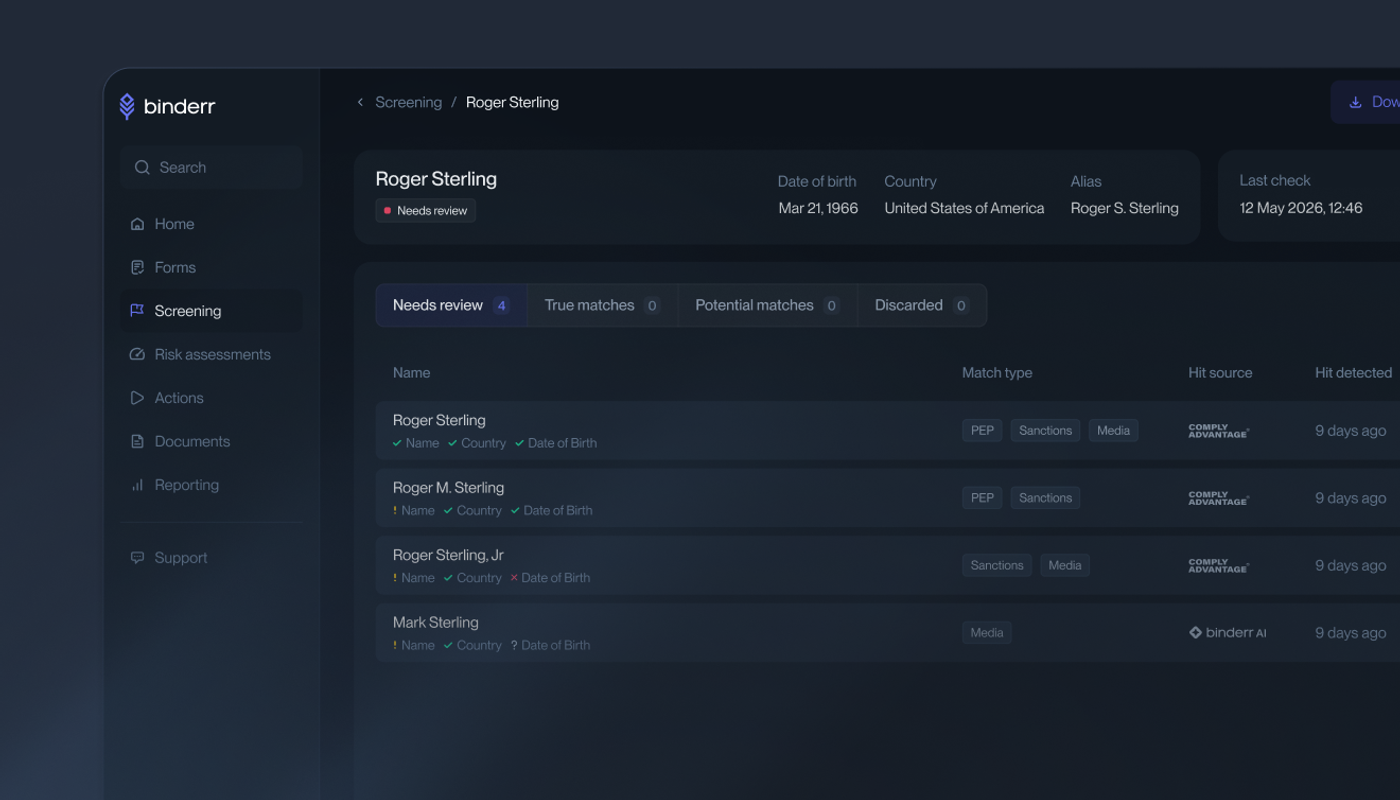
(Binderr Centralized screening review dashboard. Compliance teams can quickly review sanctions, PEP, and adverse media matches, compare confidence indicators, and prioritize investigations from a single workspace.)
Automated Customer Due Diligence (CDD) Workflows
Customer due diligence is a critical component of AML compliance in real estate. Modern AML software automates risk assessments by collecting customer information, verifying identities, and assigning risk scores based on predefined compliance rules. This reduces administrative workloads while ensuring consistent compliance procedures across all transactions.
Automated workflows can also trigger enhanced due diligence (EDD) when higher-risk indicators are detected, such as large transaction values, foreign ownership structures, PEP involvement, or concerns identified during source of funds checks. These intelligent workflows help compliance teams focus resources where they are needed most while maintaining regulatory compliance.
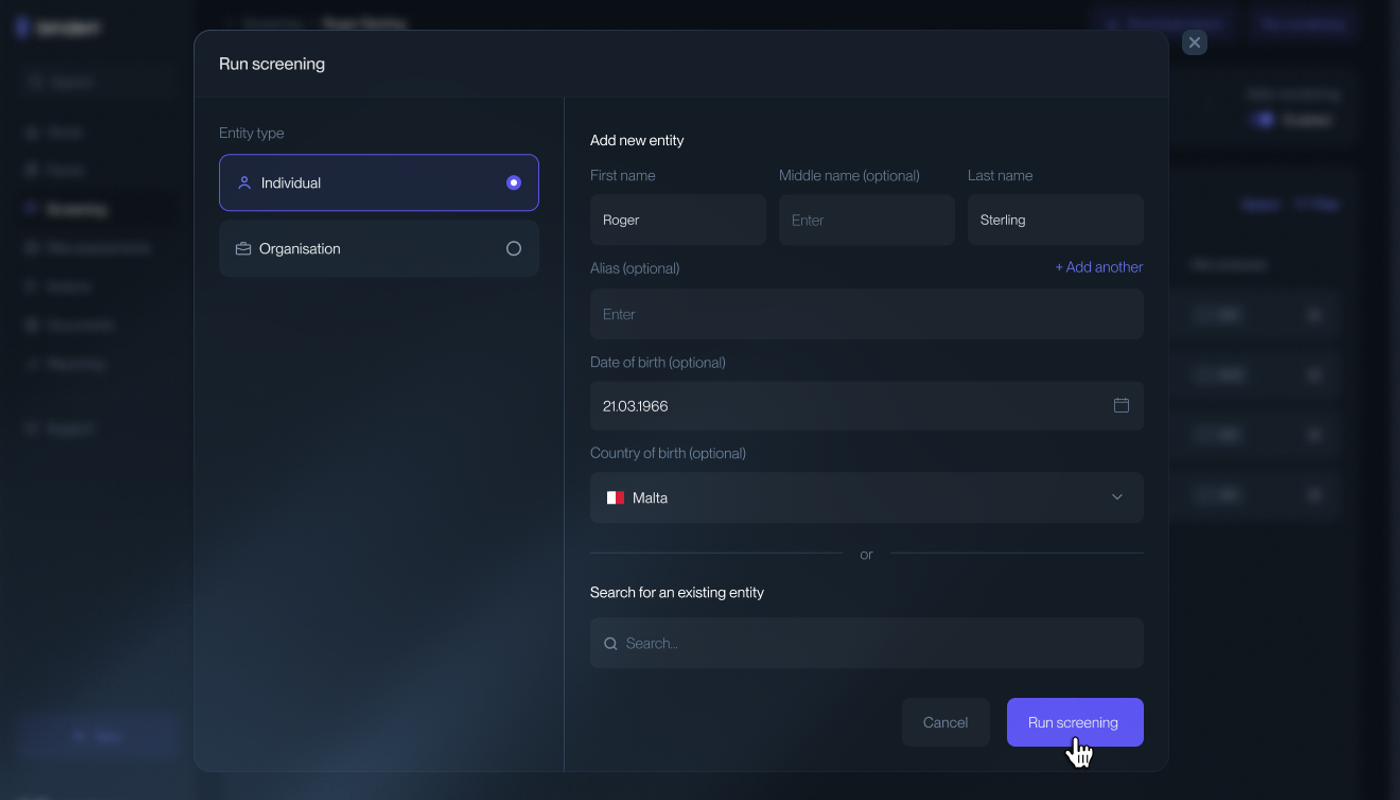
(Compliance teams can screen individuals or organizations, capture identity details, aliases, dates of birth, and jurisdictions, then launch sanctions, PEP, and adverse media screening directly from Binderr.)
Beneficial Ownership and UBO Verification
Real estate transactions often involve corporations, trusts, and complex ownership structures that can conceal the true owners of assets. AML software should include beneficial ownership verification tools that identify ultimate beneficial owners (UBOs) and reveal who ultimately controls a company or investment vehicle.
Ownership mapping and corporate structure analysis provide greater transparency by visualizing relationships between entities and stakeholders. These capabilities help real estate firms detect hidden ownership risks, comply with beneficial ownership regulations, and prevent money laundering through shell companies or layered corporate structures.
Continuous Monitoring and Ongoing Compliance
AML compliance does not end after onboarding. Continuous monitoring capabilities allow real estate companies to automatically rescreen clients against updated sanctions lists, watchlists, and adverse media sources throughout the customer relationship lifecycle. This ensures that emerging risks are identified as soon as they arise.
Real-time risk alerts and profile change notifications help compliance teams respond quickly to new developments, such as sanctions designations, changes in ownership, or adverse media findings. Ongoing monitoring supports a proactive compliance strategy and helps maintain continuous adherence to AML regulations.
Audit Trails, Case Management, and Regulatory Reporting
Comprehensive audit trails are essential for demonstrating compliance during regulatory reviews and internal audits. AML software should automatically record verification activities, screening results, risk assessments, compliance decisions, and suspicious activity investigations, creating a complete and searchable compliance history.
Integrated case management and investigation workflows enable compliance teams to review alerts, document findings, and escalate suspicious activities efficiently. Combined with regulatory reporting, secure record retention, and audit trail functionality, these features help real estate businesses maintain transparency, improve operational efficiency, and meet AML reporting obligations with confidence.
Binderr AML Screening Built for Real Estate Risk
Binderr’s AML Screening solution helps property companies detect risk early by screening individuals, businesses, and complex entities against global risk databases.
Key capabilities include:
- Sanctions screening across global sanctions lists
- PEP screening to identify politically exposed persons
- Watchlist screening against regulatory and enforcement databases
- Adverse media screening to uncover negative news and reputational risks
- AI-powered smart matching to reduce false positives
- Continuous monitoring with real-time risk alerts
- Risk scoring to support CDD and EDD decisions
Top 6 AML Software for Real Estate Companies
Choosing the right AML software for real estate companies is essential for meeting regulatory requirements, reducing compliance risk, and streamlining client onboarding. The leading platforms combine identity verification, AML screening, customer due diligence, beneficial ownership checks, ongoing monitoring, risk scoring, and compliance automation to help property businesses stay compliant.
Below, we compare the best AML software for real estate, highlighting key features, strengths, and ideal use cases for real estate agencies, property developers, brokers, and investment firms.
Binderr
Binderr is a comprehensive AML and compliance platform designed to help real estate companies manage customer onboarding, due diligence, and ongoing regulatory obligations from a single system. Real estate transactions often involve high-value assets, complex ownership structures, and cross-border buyers, making compliance both critical and time-consuming.
Binderr simplifies these processes by automating identity verification, AML screening, business verification, risk monitoring, beneficial ownership verification, and compliance automation, helping firms reduce manual work while maintaining strong compliance standards.
Key Features:
- Identity Verification: Verify the identity of buyers, sellers, investors, and tenants using government-issued IDs, biometric checks, facial recognition, liveness detection, and automated document verification to reduce fraud and accelerate onboarding.
- AML Screening: Screen individuals and entities against global sanctions lists, politically exposed persons (PEP) databases, watchlists, and adverse media sources to identify potential compliance risks before transactions proceed.
- KYB Verification: Conduct Know Your Business (KYB) checks on corporate buyers, investment firms, trusts, and other legal entities involved in property transactions, ensuring transparency and regulatory compliance.
- UBO Identification: Identify and verify Ultimate Beneficial Owners (UBOs) behind companies and complex ownership structures, helping uncover hidden ownership and reduce exposure to financial crime.
- Risk Scoring: Automatically assess customer risk levels based on factors such as geography, ownership structure, transaction type, source of funds information, and screening results, enabling a risk-based compliance approach.
- Ongoing Monitoring: Continuously monitor customers and businesses for changes in sanctions status, PEP exposure, adverse media mentions, and other risk indicators throughout the customer relationship.
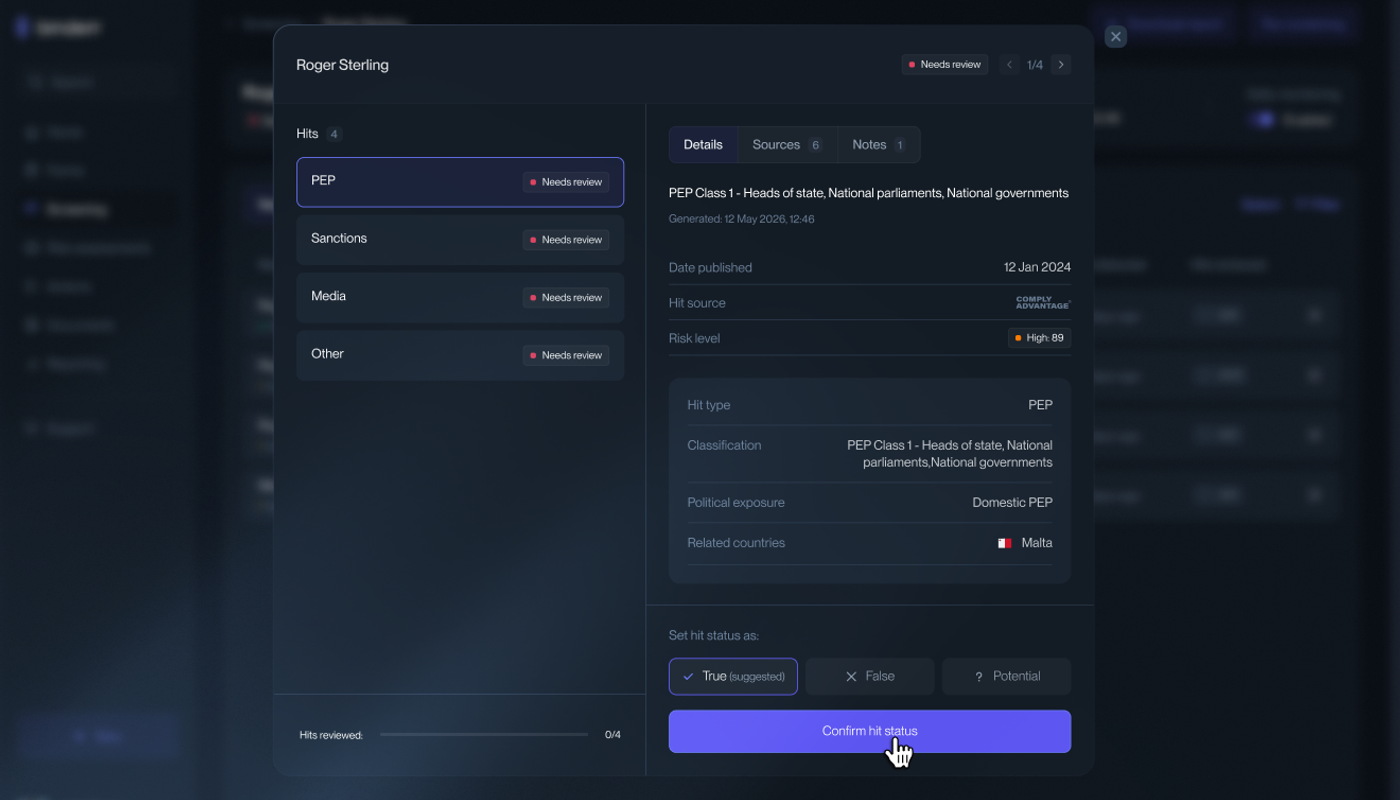
(Investigate and resolve potential matches. Binderr provides detailed source information, PEP classifications, risk scores, supporting evidence, and decision workflows to help compliance teams document reviews and maintain audit-ready records.)
- Compliance Workflows: Automate customer due diligence (CDD), enhanced due diligence (EDD), approvals, document collection, source of wealth verification, and review processes to improve operational efficiency and consistency.
Ideal For: Real estate agencies handling residential and commercial property transactions that require efficient customer onboarding and AML compliance controls. Property developers and investment firms are working with corporate entities, international investors, and complex ownership structures that require enhanced due diligence.
Sumsub
Sumsub is a widely used compliance and identity verification platform that helps businesses streamline customer onboarding while meeting global AML and KYC requirements. For real estate companies handling domestic and international buyers, the platform provides a combination of identity verification, risk assessment, and ongoing monitoring tools designed to reduce compliance workloads and improve customer experience. Its extensive global coverage makes it particularly useful for firms that regularly work with foreign investors, high-value property transactions, and clients from multiple jurisdictions.
Key Features:
- KYC Verification: Verifies customer identities using government-issued documents, biometric checks, facial recognition, and automated verification workflows to accelerate onboarding.
- AML Screening: Screens individuals against global sanctions lists, politically exposed persons (PEP) databases, watchlists, and adverse media sources to identify potential compliance risks.
- Fraud Prevention: Uses advanced fraud detection technologies to identify forged documents, identity spoofing attempts, duplicate accounts, suspicious activity, and other compliance concerns.
- Risk Assessment: Automatically evaluates customer risk profiles based on geography, transaction behavior, screening results, and other compliance factors.
- Ongoing Monitoring: Continuously monitors customers for changes in sanctions status, PEP exposure, adverse media mentions, and other risk indicators throughout the business relationship.
Ideal For: Growing real estate firms expanding into new markets and onboarding larger volumes of clients. Agencies and brokers that need reliable identity verification and AML screening for both domestic and international buyers. Property businesses are seeking to automate compliance processes while maintaining a smooth and efficient customer onboarding experience.
Trulioo
Trulioo is a well-established identity verification and AML compliance platform designed for businesses that need to verify customers and organizations across multiple countries. Its extensive global data network makes it particularly valuable for real estate companies dealing with international buyers, foreign investors, and cross-border property transactions. By combining identity verification, business verification, AML screening, and customer due diligence support, Trulioo helps organizations streamline onboarding while maintaining compliance with regulatory requirements.
Key Features:
- Global identity verification across hundreds of countries and territories using trusted data sources to validate customer identities quickly and accurately.
- AML screening against sanctions lists, politically exposed persons (PEPs), watchlists, adverse media databases, and other risk databases to help identify high-risk individuals and entities.
- Business verification capabilities that enable companies to validate corporate entities, confirm registration details, and support Know Your Business (KYB) requirements.
- Watchlist checks that continuously compare customers and businesses against global regulatory and enforcement databases to detect potential compliance risks.
- Access to a large international data network, making it easier to onboard customers from different jurisdictions without relying on multiple verification providers.
- Automated verification workflows that help reduce manual compliance work and improve onboarding efficiency.
- Support for risk-based compliance programs by providing verification data that can be incorporated into customer due diligence, risk scoring, and risk assessment processes.
Ideal For: International identity verification for real estate companies that work with overseas clients, foreign investors, and multinational business entities. It is especially useful for organizations that require broad geographic coverage and reliable access to global verification data sources. Companies looking to simplify cross-border compliance processes can benefit from Trulioo's extensive international reach.
Ondato
Ondato is a compliance and identity verification platform designed to help businesses automate customer onboarding and regulatory compliance processes. It combines KYC, AML, ongoing monitoring, and compliance automation capabilities into a single solution, making it easier for real estate companies to manage compliance requirements while reducing manual workloads. Its workflow-driven approach helps organizations streamline due diligence, improve operational efficiency, and maintain consistent compliance standards across client onboarding and monitoring activities.
Key Features:
- KYC Verification: Automates customer identity verification using document checks, biometric verification, facial recognition, and identity validation tools to ensure clients are properly verified before transactions proceed.
- AML Screening: Screens individuals and businesses against global sanctions lists, politically exposed persons (PEP) databases, watchlists, and adverse media sources to identify potential compliance risks early in the onboarding process.
- Risk Scoring: Assigns risk levels to customers based on predefined criteria, helping compliance teams prioritize reviews and apply appropriate due diligence measures.
- Ongoing Monitoring: Continuously monitors customer profiles for changes in risk status, sanctions exposure, adverse media mentions, or other compliance-related developments.
- Workflow Automation: Enables businesses to create automated compliance workflows that reduce manual intervention, improve consistency, accelerate onboarding and review processes, and strengthen audit trail documentation.
Ideal For: Real estate companies that want to reduce manual compliance tasks and accelerate client onboarding can benefit from Ondato's automation-focused platform. It is particularly useful for organizations handling a high volume of customer verifications and ongoing compliance checks. The platform helps compliance teams standardize processes, improve accuracy, and maintain regulatory readiness as the business grows.
Persona
Persona is a flexible identity and compliance platform designed to help businesses create tailored onboarding experiences while maintaining strong AML and fraud prevention controls. Its highly configurable approach allows organizations to build verification workflows that match their specific risk profiles, customer types, and regulatory requirements. For real estate companies that work with a mix of individual buyers, corporate entities, investors, and international clients, Persona provides the flexibility needed to streamline onboarding without sacrificing compliance.
Key Features:
- Identity verification: Verify customer identities using government-issued IDs, document authentication, biometric checks, facial recognition, and automated verification workflows to reduce manual review requirements.
- AML checks: Screen customers against global sanctions lists, politically exposed persons (PEP) databases, watchlists, and adverse media sources to identify potential compliance risks during onboarding.
- Fraud prevention: Detect suspicious activity through device intelligence, behavioral analysis, duplicate account detection, and risk signals that help prevent identity fraud and account misuse.
- Custom workflows: Build tailored onboarding journeys with configurable verification steps, risk-based decisioning, automated approvals, enhanced due diligence triggers, and escalation paths that adapt to different customer profiles and compliance requirements.
Ideal For: Persona is best suited for real estate companies that need highly customizable onboarding and compliance workflows. It works particularly well for organizations serving diverse customer segments, including domestic buyers, international investors, and corporate entities. Businesses looking for flexibility, automation, and developer-friendly integrations will benefit most from the platform.
Veriff
Veriff is a leading identity verification platform designed to help businesses verify customers quickly while reducing fraud and compliance risks. The platform uses advanced AI-powered technology to authenticate identity documents, perform biometric checks, facial recognition analysis, and detect suspicious activity during onboarding. For real estate companies, Veriff can streamline client verification processes, improve customer experience, and support AML compliance efforts through integrations with third-party screening providers.
Key Features:
- AI-Powered ID Verification: Verifies government-issued identity documents from a wide range of countries, helping real estate businesses onboard domestic and international clients with confidence.
- Facial Recognition Technology: Compares a user's selfie with their identity document photo to confirm that the person presenting the document is its legitimate owner.
- Liveness Detection: Uses advanced liveness checks to ensure that a real person is present during verification, preventing spoofing attempts using photos, videos, or deepfakes.
- AML and Compliance Integrations: Connects with AML screening, sanctions monitoring, and compliance platforms to support broader customer due diligence and risk management workflows.
- Fraud Detection Capabilities: Identifies suspicious behavior, document tampering, and other indicators of identity fraud before transactions are completed.
- Global Verification Coverage: Supports identity verification across numerous countries and document types, making it suitable for firms dealing with international property buyers and investors.
- Real-Time Verification Results: Delivers fast verification decisions that help reduce onboarding delays and improve the customer experience.
- Developer-Friendly APIs: Offers flexible integration options that allow businesses to embed identity verification directly into existing onboarding and compliance processes.
Ideal For: Veriff is best suited for real estate companies that prioritize secure and accurate identity verification during client onboarding. It is particularly valuable for organizations handling remote transactions, international buyers, or high-value property deals where fraud prevention is critical. Businesses looking for strong biometric verification and document authentication capabilities will benefit most from the platform.
How Real Estate Companies Use AML Software
Real estate companies use AML software to streamline customer due diligence, identity verification, AML screening, and ongoing compliance monitoring throughout the property transaction lifecycle. These platforms help agencies, brokers, developers, and property managers detect financial crime risks, verify client identities, and meet anti-money laundering regulatory requirements more efficiently.
From residential property sales to complex commercial real estate transactions, AML software enables businesses to automate compliance workflows, perform sanctions and PEP checks, verify beneficial ownership, and reduce exposure to money laundering and fraud risks.
Residential Property Transactions
Residential property transactions often involve first-time buyers, investors, and sellers who must undergo identity verification and customer due diligence checks. AML software helps real estate companies verify identities, screen clients against sanctions and PEP lists, and detect suspicious activity before a transaction is completed.
By automating AML screening, risk scoring, and document verification, real estate agencies can reduce compliance workloads while maintaining regulatory compliance. Ongoing monitoring also helps identify changes in customer risk profiles throughout the property transaction lifecycle.
Commercial Real Estate Deals
Commercial real estate deals typically involve higher transaction values, corporate entities, and complex ownership structures. AML software supports KYB verification, beneficial ownership checks, and enhanced due diligence to uncover hidden risks and verify the legitimacy of businesses involved in a transaction.
Automated compliance workflows help firms assess the source of funds, identify ultimate beneficial owners (UBOs), and maintain detailed audit trails. This reduces exposure to money laundering risks while streamlining commercial property transactions.
Luxury Property Purchases
Luxury property purchases are considered high-risk because they often attract high-net-worth individuals, foreign investors, and politically exposed persons. AML software enables enhanced due diligence, adverse media screening, and sanctions checks to identify potential compliance concerns before closing a deal.
Real-time risk monitoring and source of wealth verification help real estate professionals detect unusual activity and comply with anti-money laundering regulations. These tools are especially valuable when handling multimillion-dollar property acquisitions.
International Property Buyers
Cross-border property transactions introduce additional AML challenges, including sanctions exposure, foreign ownership structures, and varying regulatory requirements. AML software helps verify international buyers through global identity verification and comprehensive AML screening databases.
Automated customer due diligence and ongoing monitoring allow real estate companies to assess risk consistently across jurisdictions. This improves compliance while reducing delays during international property purchases.
Property Management Companies
Property management companies frequently onboard landlords, tenants, contractors, and corporate clients, creating ongoing compliance obligations. AML software simplifies identity verification, risk assessments, and customer screening throughout the onboarding process.
Continuous monitoring and automated alerts help property managers identify high-risk individuals or entities as circumstances change. This strengthens fraud prevention efforts and supports long-term AML compliance.
Real Estate Investment Firms
Real estate investment firms often manage complex portfolios involving multiple investors, trusts, and corporate structures. AML software helps perform enhanced due diligence, beneficial ownership verification, and investor screening to reduce financial crime risks.
With automated AML compliance tools, firms can monitor investor activity, maintain regulatory records, and conduct ongoing risk assessments at scale. This improves transparency, supports regulatory reporting, and protects investment operations from compliance violations.
How to Choose the Right AML Software for Your Real Estate Business
Selecting the right AML software for real estate companies requires careful evaluation of your compliance obligations, transaction volumes, client risk profiles, and operational needs. The best solution should streamline customer due diligence, identity verification, AML screening, and ongoing monitoring while helping your business meet regulatory requirements efficiently.
When comparing real estate AML compliance software, focus on features such as KYC verification, sanctions screening, PEP checks, beneficial ownership verification, risk scoring, workflow automation, and integration capabilities.
Assess Transaction Volume
The number of property transactions your business handles each month should play a major role in selecting AML software for real estate companies. High-volume real estate agencies, brokers, and property management firms benefit from automated customer due diligence, identity verification, AML screening, and risk scoring tools that can process large numbers of clients efficiently. Businesses with lower transaction volumes may prioritize ease of use and affordability while still maintaining strong compliance controls.
Evaluate International Exposure
If your company works with overseas buyers, foreign investors, or cross-border property transactions, choose a real estate AML compliance software platform with extensive global coverage. Features such as international sanctions screening, PEP checks, adverse media monitoring, and multilingual identity verification help reduce risk when onboarding clients from different jurisdictions. Strong global data sources are essential for detecting hidden compliance risks and meeting international AML requirements.
Review Regulatory Requirements
AML obligations vary across regions, making it important to select software that aligns with the regulations affecting your business. Whether you must comply with local anti-money laundering laws, customer due diligence requirements, beneficial ownership verification rules, or enhanced due diligence procedures, the platform should support accurate record-keeping, audit trails, and regulatory reporting. Choosing a solution built for compliance can help reduce the risk of fines and enforcement actions.
Consider Automation Needs
Manual compliance processes can slow down property transactions and increase operational costs. Modern AML platforms automate KYC checks, document verification, risk assessments, ongoing monitoring, and suspicious activity detection, allowing compliance teams to focus on higher-risk cases. The right level of automation improves efficiency, accelerates client onboarding, and strengthens overall compliance performance.
Compare Integration Capabilities
Real estate businesses often rely on CRM systems, property management software, document management platforms, and payment solutions. AML software that integrates seamlessly with existing systems can streamline workflows, eliminate duplicate data entry, and improve compliance visibility across the organization. API access and flexible integrations are especially valuable for growing firms seeking a connected compliance ecosystem.
Evaluate Pricing and Scalability
Pricing should be evaluated alongside long-term business growth. While smaller agencies may prefer cost-effective AML solutions, larger real estate companies often require advanced features such as UBO checks, ongoing monitoring, and enterprise-level reporting. Selecting a scalable AML platform ensures that compliance processes can expand alongside transaction volumes, new markets, and evolving regulatory requirements without requiring a complete system replacement.
Binderr: Complete AML Compliance for Real Estate Companies
Binderr brings these requirements into one complete compliance platform, helping real estate companies move from manual, fragmented checks to a fully automated, risk-based due diligence system.
Key capabilities include:
- Identity verification for individuals
- Business verification and KYB checks
- Sanctions, PEP, watchlist, and adverse media screening
- Beneficial ownership and UBO identification
- Customer due diligence (CDD) workflows
- Enhanced due diligence (EDD) for high-risk clients
- Source of funds and source of wealth verification
- Continuous monitoring and risk alerts
Bottom Line
AML compliance is increasingly important for real estate companies as regulators focus on preventing money laundering and financial crime in property transactions. Modern AML software helps automate identity verification, screening, due diligence, risk assessments, and ongoing monitoring, making compliance more efficient and reliable.
The best solution depends on your business size, transaction complexity, and international exposure. By choosing the right AML platform, real estate companies can reduce compliance risk, streamline operations, and maintain stronger trust with clients and regulators.
For real estate companies seeking an all-in-one compliance solution, Binderr Compliance provides powerful identity verification, AML screening, KYB checks, UBO verification, and ongoing monitoring tools designed to simplify compliance and support business growth.


-5-360x240.webp?w=3840&q=75)