
Business onboarding has moved online, but corporate risk is harder to detect. A registration number may confirm a company exists, but it does not show if the applicant is authorised or if ownership details are accurate. It also fails to reveal whether ultimate beneficial owners pose sanctions, fraud, or financial crime risks. Digital KYB addresses these gaps through remote business verification, registry checks, UBO verification, and AML screening.
Regulators now require clearer proof of ownership and control. Companies House plans to verify 6 to 7 million UK directors and people with significant control by November 2026. This reflects a major shift toward verified corporate data. Automated KYB helps businesses respond by validating entities, mapping directors and shareholders, and screening connected parties before approval.
This guide explains how digital KYB and remote business verification work. It covers corporate document checks, ownership mapping, business risk assessment, and continuous monitoring. It also outlines fraud risks, compliance needs, software features, pricing models, and ways to speed up remote KYB onboarding without weakening due diligence.
Binderr Digital KYB and Business Verification Software
- Access global corporate registry data instantly
- Retrieve company status directors shareholders details
- Identify and verify ultimate beneficial owners
- Map complex ownership structures across jurisdictions
- Screen businesses and individuals against AML
Remote business verification requires more than a company registry search. Binderr combines KYB, sanctions screening, PEP checks, adverse media analysis, and enhanced due diligence within one connected platform.
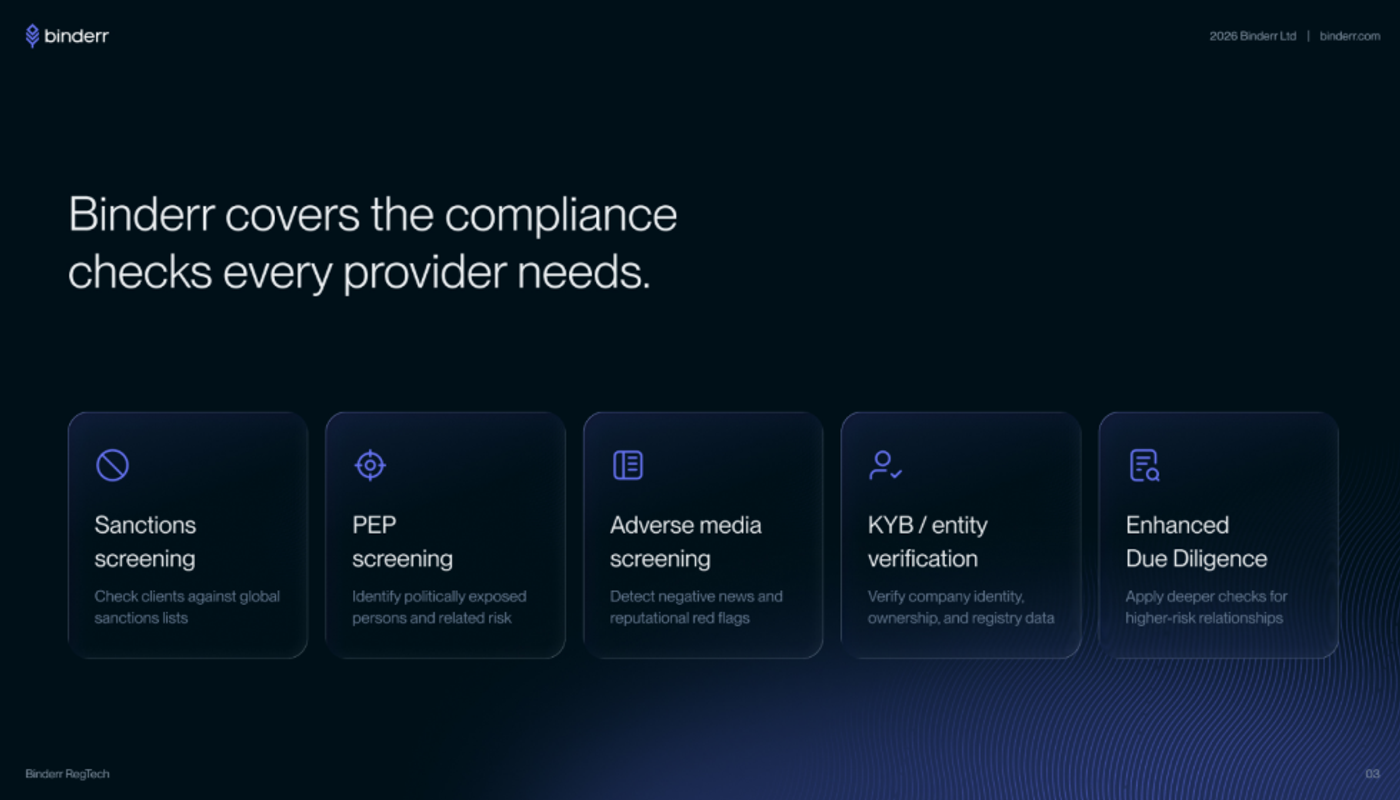
(Binderr connects business verification, AML screening, and enhanced due diligence in one compliance platform.)
What Is Digital KYB?
Digital KYB, or digital Know Your Business, is an automated process for confirming that a company is legitimate, active, and represented by authorised individuals. It combines company registry verification, corporate document checks, ownership structure mapping, UBO verification, sanctions and PEP screening, business risk assessment, and continuous monitoring.
Unlike a basic online business search, digital KYB reveals who owns and controls a legal entity, identifies compliance risks, and creates an auditable foundation for faster remote KYB onboarding.
Run Your First KYB Check Online
Why Remote Business Verification Is Becoming Essential
Remote business verification helps companies confirm legal entities, ownership structures, and compliance risks without requiring in-person checks.
As corporate onboarding expands across borders, digital KYB provides the speed, consistency, and visibility needed to make safer business decisions.
Growth of Remote and Cross-Border Business Relationships - Companies now onboard customers, suppliers, and partners from multiple jurisdictions. Cross-border business verification helps confirm company registration, operating locations, ownership details, and regulatory status before a relationship begins.
Higher Volumes of Corporate Onboarding - Manual checks become difficult to manage as application volumes increase. Automated online business verification allows teams to process more businesses while maintaining consistent company registry checks, document reviews, and risk controls.
Complex Multinational Ownership Structures - Corporate ownership may pass through several companies, trusts, or jurisdictions before reaching a natural person. Digital ownership mapping helps trace these layers, calculate indirect interests, and identify ultimate beneficial owners.
Fraud Involving Fake Companies and Stolen Identities - Fraudsters may use fabricated entities, altered corporate documents, or stolen director identities to access financial services. Remote business verification combines document authenticity checks, registry data, KYC, and fraud detection to expose inconsistencies.
Increased Scrutiny of Beneficial Ownership - Regulators expect businesses to understand who ultimately owns or controls their customers. UBO verification supports this requirement by connecting declared ownership information with registry records, identity checks, and AML screening.
Fragmented Data Across Registries and Jurisdictions - Corporate data differs in format, language, availability, and reliability across countries. KYB compliance software brings information from multiple sources into one workflow, making remote customer due diligence easier to review and document.
Together, these pressures make digital KYB essential for remote kyb onboarding, stronger fraud prevention, accurate beneficial ownership verification, and continuous compliance monitoring.
Start Business Verification for Free with Binderr
How Digital KYB and Remote Business Verification Work
Every trustworthy business relationship starts by proving what sits behind the company name. Digital KYB turns online business verification into a structured workflow covering company data, corporate documents, beneficial ownership, AML screening, risk scoring, and continuous monitoring.
Step 1: Collect Core Business Information
The process begins by collecting the company’s legal name, trading name, registration number, incorporation date, legal form, jurisdiction, registered address, tax details, and contact information. These details create the foundation for accurate legal entity verification.
The applicant should also explain its business activities, operating markets, intended products, source of funds, and expected transaction volumes. Dynamic digital KYB forms can adjust these questions according to the company’s jurisdiction, industry, entity type, and initial risk profile.
Step 2: Verify the Company Against Authoritative Sources
The submitted information is compared with national company registries, regulatory databases, licensing authorities, tax records, and other trusted sources. Company registry verification confirms whether the legal entity exists, remains active, and is registered in the declared jurisdiction.
The check should compare names, addresses, registration dates, company status, directors, and identification numbers across available records. Missing or conflicting corporate data should trigger a clarification request or manual compliance review.
Step 3: Authenticate Corporate Documents
The business may need to provide a certificate of incorporation, registry extract, articles of association, shareholder register, director register, business licence, or certificate of good standing. Corporate document verification confirms whether these records support the information declared during remote KYB onboarding.
OCR and automated data extraction can capture names, dates, registration numbers, and other details for comparison. However, document authenticity also requires checks for alteration, expiry, inconsistent formatting, unverifiable issuers, and contradictions with official registry data.
Step 4: Identify Directors and Authorised Representatives
Digital KYB should establish who manages the company and who has permission to act on its behalf. Registry records, board resolutions, mandates, and authorisation letters can help confirm the roles of directors, officers, and account representatives.
KYC checks may then verify each relevant individual through identity documents, facial matching, biometric verification, or liveness detection. This prevents unauthorised representatives and stolen identities from being used to complete digital business onboarding.
Step 5: Identify UBOs and Map the Ownership Structure
Ownership structure mapping traces shareholdings through parent companies, intermediate entities, trusts, and other corporate layers. The process calculates direct and indirect ownership interests until the relevant ultimate beneficial owners are identified.
The applicable UBO threshold depends on the jurisdiction, sector, and regulatory framework. Complex, circular, nominee-based, or unexplained structures should be escalated for enhanced due diligence instead of being accepted at face value.
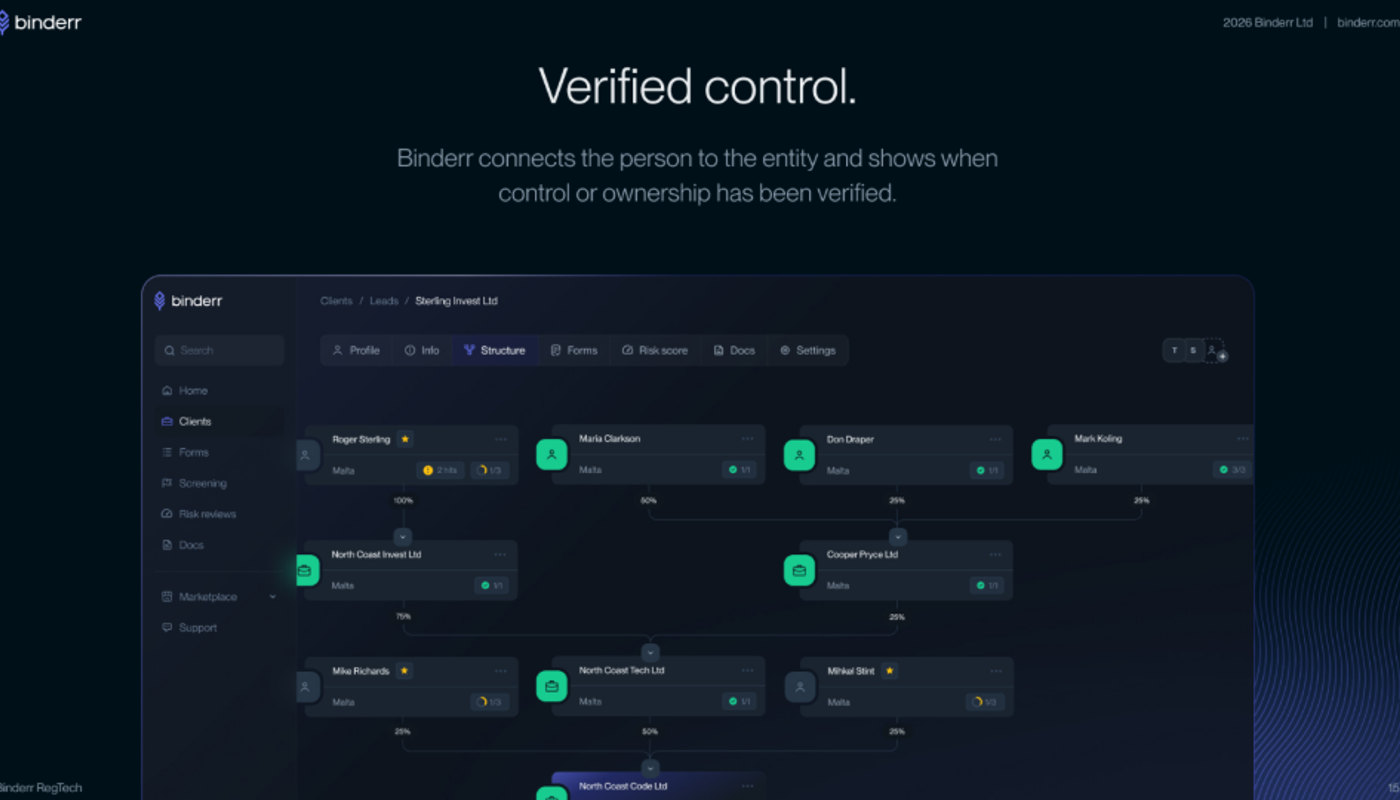
(Binderr visualises verified ownership and control across complex corporate structures.)
Step 6: Verify the Ultimate Beneficial Owners
Once the UBOs are identified, their identities must be confirmed using appropriate KYC controls. Common checks include government-issued identity documents, proof of address, date of birth, nationality, biometric verification, and evidence supporting the ownership or control relationship.
UBO verification establishes whether the natural persons behind the business are genuine and accurately disclosed. Higher-risk cases may also require evidence of source of funds, source of wealth, or the commercial purpose behind the ownership arrangement.
Step 7: Conduct AML and Risk Screening
The company, directors, shareholders, UBOs, and authorised representatives should be screened against sanctions, PEP, watchlist, regulatory enforcement, and adverse media data. AML business screening helps uncover financial crime exposure that a company registry check cannot reveal.
Effective screening accounts for aliases, spelling variations, transliteration, dates of birth, nationality, and other identifying details. Potential matches require contextual review to distinguish genuine risks from false positives before a compliance decision is made.
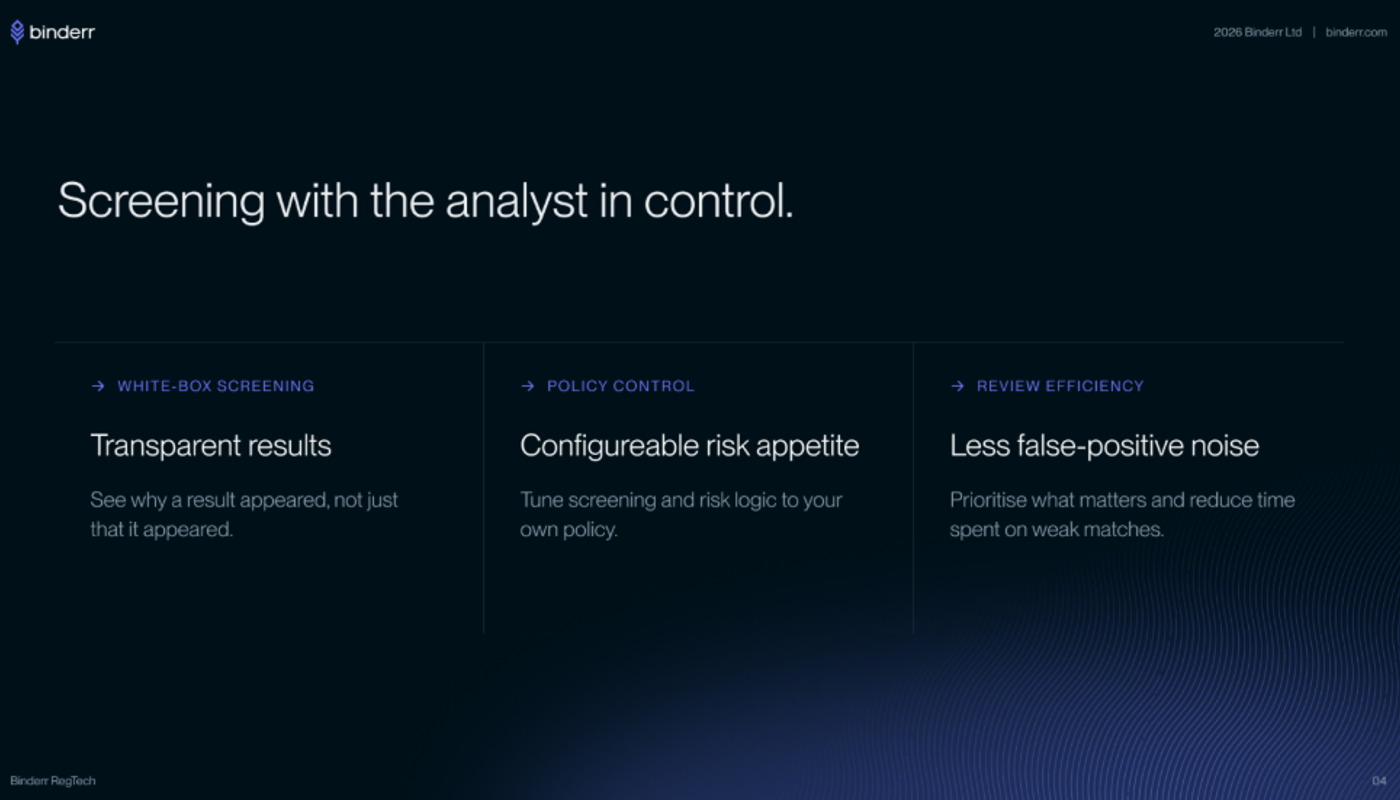
(Binderr gives compliance analysts transparent screening results with control over risk rules and review decisions.)
Start AML Screening for Free with Binderr
Step 8: Calculate the Business Risk Score
A business risk assessment combines factors such as incorporation jurisdiction, operating countries, industry, ownership complexity, UBO profile, requested services, expected activity, and AML screening results. Configurable risk scoring can classify the applicant as low, standard, medium, or high risk.
The score should determine which due diligence measures, approval levels, and monitoring frequency apply. Automated online business verification supports consistent decisions, but compliance teams should retain human oversight for unusual, complex, or higher-risk cases.
Step 9: Approve, Reject, or Escalate the Application
Once the checks are complete, the business can be approved, approved with conditions, referred for enhanced due diligence, or rejected according to the organisation’s risk policy. Missing evidence or unresolved discrepancies may require further documents before any final decision.
Every outcome should record the evidence reviewed, screening results, risk score, decision rationale, reviewer, and timestamp. A complete audit trail supports internal governance, regulatory reporting, and future compliance reviews.
Step 10: Begin Ongoing Monitoring
Digital KYB continues after the customer is approved. Continuous KYB monitoring can detect changes to company status, directors, shareholders, beneficial owners, registered addresses, business licences, sanctions exposure, PEP status, and adverse media.
Alerts should trigger a proportionate response, such as reviewing new information, updating the business risk assessment, requesting documents, or beginning EDD. Scheduled periodic reviews can complement event-based monitoring by confirming that customer information remains accurate and current.
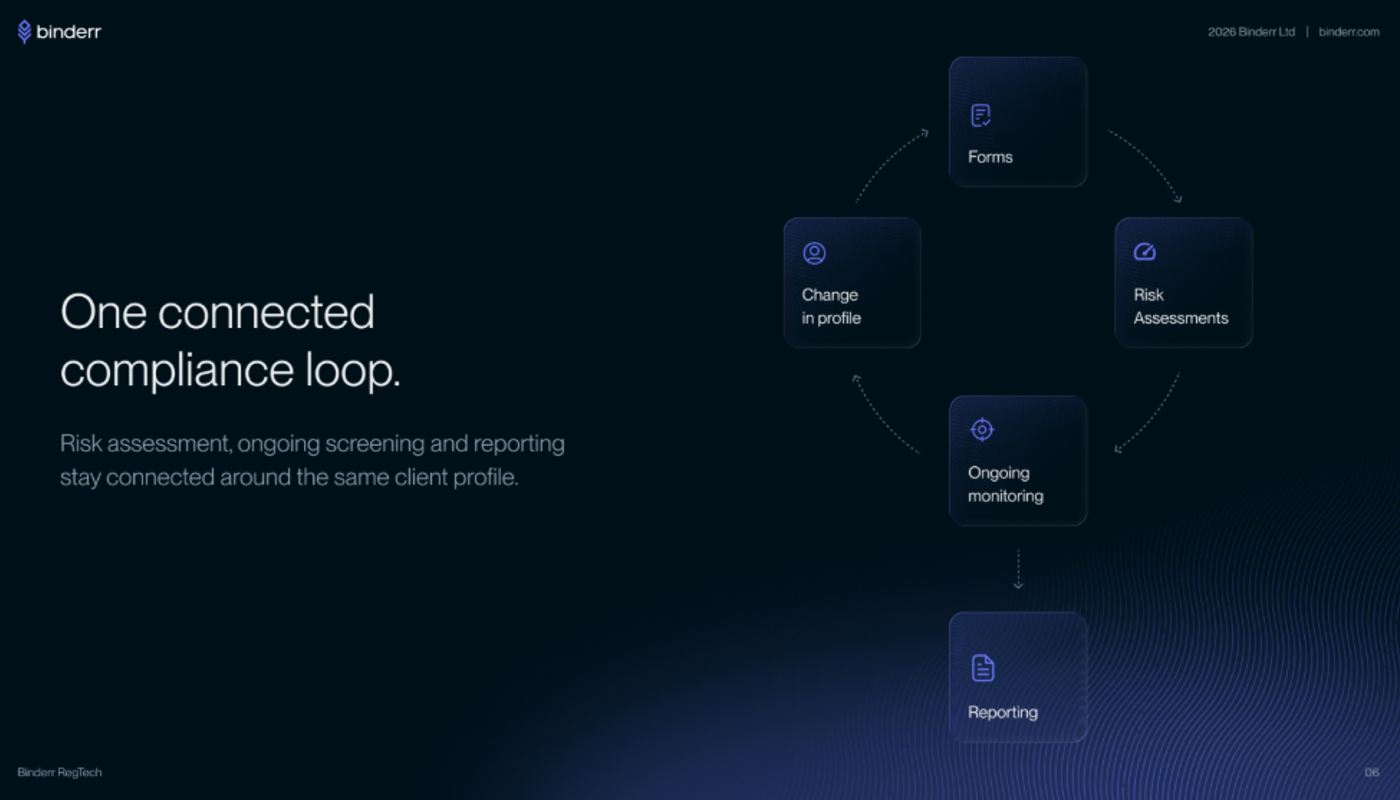
(Binderr connects onboarding, dynamic risk assessment, ongoing monitoring, and compliance reporting around one customer profile.)
Simplify the Complete Remote KYB Process with Binderr
- Verify company registration status address jurisdiction
- Retrieve official directors shareholders corporate records
- Validate corporate documents and business information
- Identify UBOs and verify through KYC
- Assign dynamic risk scores using AML data
What Information and Documents Are Required for Digital KYB?
Digital KYB begins with the company’s legal name, registration number, jurisdiction, legal form, incorporation date, registered address, tax details, and business activities. Remote business verification also examines operating markets, expected account activity, source of funds, regulatory status, and the purpose of the proposed relationship.
Corporate document verification may require a certificate of incorporation, registry extract, constitutional documents, shareholder register, director register, business licence, proof of address, and authorisation records. Ownership details should identify directors, shareholders, controlling parties, and ultimate beneficial owners across every relevant corporate layer.
The exact requirements should reflect the company’s structure, jurisdiction, and business risk assessment. Automated KYB verification can retrieve reliable registry data, pre-fill known information, and request extra evidence only when discrepancies or higher-risk indicators appear, reducing onboarding friction without weakening remote customer due diligence.
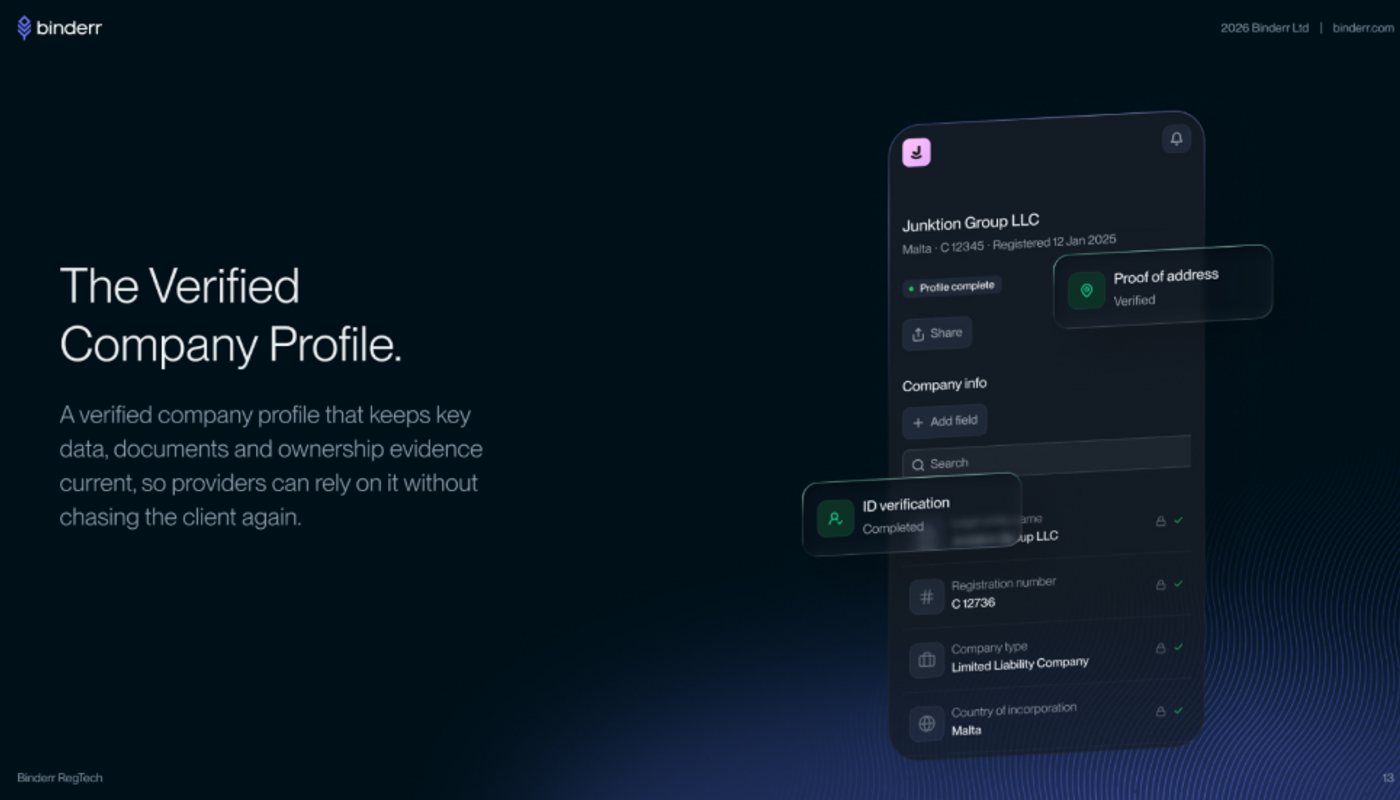
(Binderr creates a verified company profile that keeps corporate data, documents, and ownership evidence current.)
Digital KYB Compliance Requirements
Digital KYB compliance begins with proving that a legal entity exists, identifying its directors and authorised representatives, and determining who ultimately owns or controls it. Online business verification should also establish the purpose of the relationship, expected account activity, source of funds, and the customer’s overall business risk profile.
A risk-based KYB process combines company registry verification, corporate document checks, UBO verification, sanctions and PEP screening, adverse media searches, and enhanced due diligence where higher-risk indicators appear. FATF standards emphasise access to adequate, accurate, and current beneficial ownership information, while the EBA expects remote onboarding controls to be reliable, secure, and proportionate to risk.
Compliance does not end once a business passes onboarding. Organisations must preserve an audit trail, protect personal and corporate data, refresh customer information, and apply continuous KYB monitoring for ownership, management, licence, sanctions, and adverse media changes. Exact requirements vary by jurisdiction, sector, product, and risk exposure, so digital KYB workflows should reflect the rules that apply to each business relationship.
Verify Companies with Confidence
How to Reduce Friction Without Weakening KYB Controls
A strong digital KYB process should feel simple to legitimate businesses without creating blind spots for compliance teams. The goal is to remove unnecessary steps while preserving accurate remote business onboarding, UBO identification, AML screening, and risk-based decision-making.
Ask Only for Relevant Information - Tailor each digital KYB application to the company’s entity type, jurisdiction, industry, and risk level. A low-risk local company should not receive the same document list as a multinational business with a layered ownership structure.
Pre-Fill Forms with Registry Data - Use reliable corporate registry data to populate legal names, registration numbers, addresses, incorporation dates, directors, and company status. Pre-filled information speeds up digital business onboarding and reduces typing errors.
Avoid Duplicate Document Requests - Do not ask applicants to upload documents when the same information can be retrieved from an authoritative company registry. Request additional evidence only when data is unavailable, outdated, inconsistent, or required for enhanced due diligence.
Show Application Progress Clearly - Display completed checks, outstanding requirements, and the next action in the remote KYB onboarding journey. Visible progress reduces uncertainty and prevents applicants from abandoning forms that appear longer than expected.
Use Jurisdiction-Specific Requirements - Corporate records and legal structures vary between countries. Configure document requests, ownership thresholds, business licence checks, and registry verification rules according to the jurisdiction instead of relying on one global checklist.
Run Automated Checks First - Complete automated company registry verification, sanctions screening, PEP checks, and data comparisons before requesting more documents. This helps the system identify genuine gaps and avoids unnecessary customer follow-ups.
Route Only Exceptions to Human Review - Straightforward applications that satisfy the required KYB controls can move forward automatically. Compliance analysts can then focus on complex ownership structures, adverse media matches, document inconsistencies, and higher-risk entities.
Measure Where Applicants Drop Out - Track abandonment rates by question, document request, verification step, and jurisdiction. These insights reveal where digital business onboarding creates unnecessary friction and where instructions or workflows need improvement.
Invite Directors and UBOs Securely - Allow authorised representatives to send secure verification links directly to directors, shareholders, and ultimate beneficial owners. Each person can complete identity verification without sharing sensitive documents through email.
Apply Risk-Based Review Cycles - Not every business requires the same monitoring frequency. Use the customer’s business risk assessment, ownership complexity, industry, and geographic exposure to set proportionate refresh periods and continuous KYB monitoring rules.
When these controls work together, automated KYB verification becomes faster for legitimate applicants and more focused for compliance teams. The result is a smoother customer experience without compromising legal entity verification, beneficial ownership transparency, or financial crime controls.
Reveal Hidden Ownership and Connected Risk with Binderr
- Visualise complex corporate hierarchies and relationships
- Trace ownership across multiple jurisdictions easily
- Identify indirect shareholders and controlling individuals
- Verify UBO identities using biometric KYC
- Screen entities against sanctions PEPs watchlists
How to Choose Digital KYB Software
The right digital KYB software should make remote business verification faster without hiding how decisions are made. Evaluate whether the platform supports your jurisdictions, entity types, risk methodology, remote KYB onboarding volumes, and ongoing compliance obligations.
Direct Company Registry Access
Reliable company registry verification should confirm legal names, registration numbers, incorporation dates, addresses, company status, directors, and shareholders. Check whether the data is retrieved directly, how often it is refreshed, and whether its source and timestamp remain visible.
Corporate Document Collection and Extraction
The software should securely collect incorporation certificates, registry extracts, constitutional documents, shareholder registers, and business licences. OCR and automated extraction can reduce manual entry, but the platform should also flag missing pages, expired records, and inconsistent data.
Director and Shareholder Identification
A digital KYB platform should identify the individuals and entities involved in managing or owning a company. It should compare declared directors and shareholders with registry data and highlight recent changes, missing parties, or conflicting information. This process strengthens transparency and reduces the risk of hidden ownership.
Multi-Layer UBO Mapping
Look for ownership structure mapping that can trace interests through parent companies, intermediate entities, trusts, and multiple jurisdictions. Effective UBO verification should calculate indirect ownership and reveal the natural persons who ultimately own or control the business. This is essential for uncovering complex ownership chains that may obscure risk.
Configurable Business Risk Scoring
The platform should let compliance teams define risk factors, weightings, thresholds, and escalation rules. Configurable business risk assessment helps apply consistent decisions based on jurisdiction, industry, ownership complexity, AML screening results, and expected activity. This flexibility allows organisations to tailor risk models to their specific regulatory requirements.
Case Management and Manual Review
Not every application can be decided automatically. Built-in case management should allow analysts to review alerts, request documents, add notes, record decisions, assign cases, and escalate higher-risk customers for enhanced due diligence. This supports efficient collaboration and consistent decision-making across teams.
API and No-Code Onboarding Options
An API allows digital KYB checks to be embedded within existing products and onboarding journeys. No-code tools give compliance teams the flexibility to create forms, workflows, and verification rules without waiting for engineering resources. This combination enables faster deployment and easier process adjustments.
Audit Trails and Exportable Reports
The software should record what was checked, which data sources were used, how alerts were resolved, and who approved the customer. A complete audit trail supports regulatory reporting, quality assurance, internal reviews, and future customer risk assessments. Exportable reports make it easier to share findings with regulators and stakeholders.
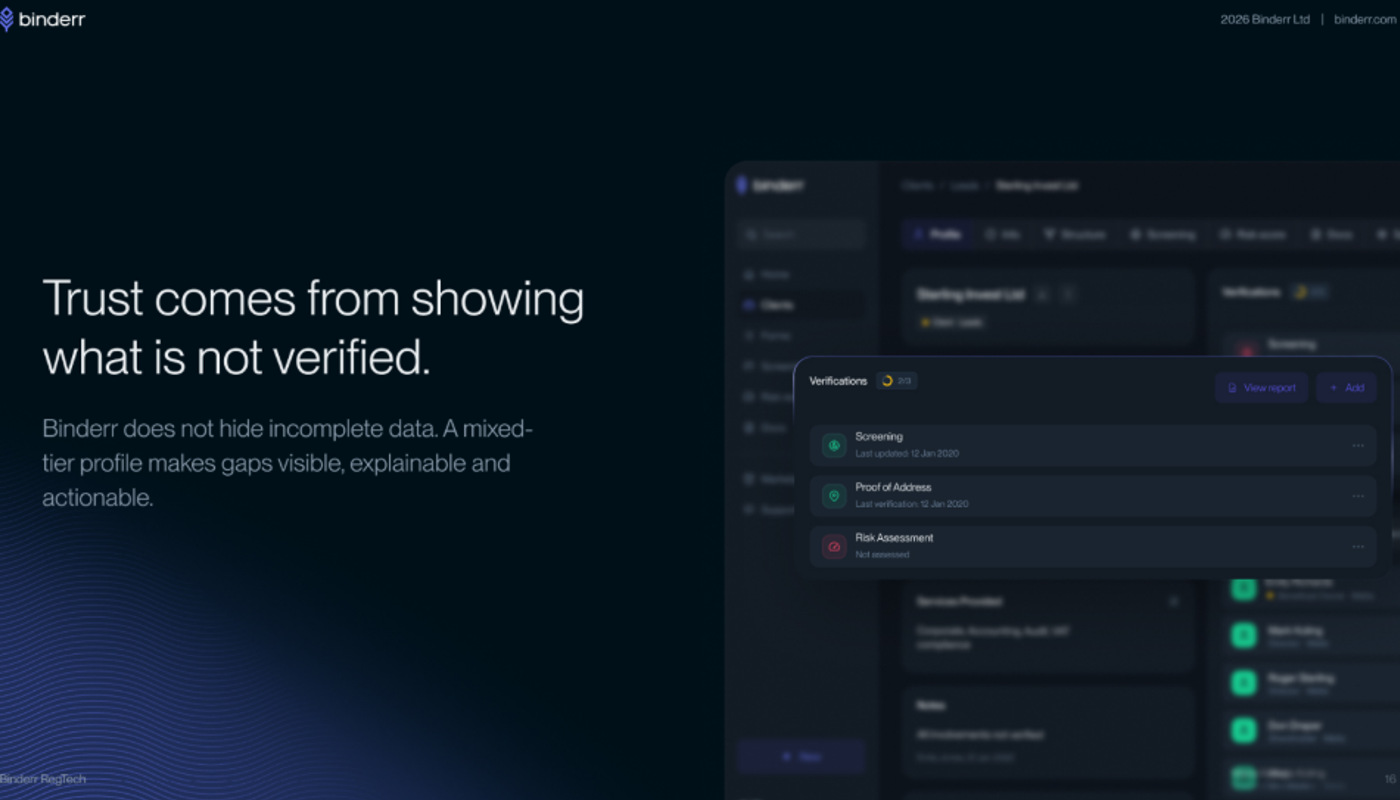
(Binderr shows what has been verified, where information is incomplete, and which compliance actions remain outstanding.)
Data Security and Retention Controls
Review how the provider encrypts data, manages access, handles data residency, and responds to security incidents. The platform should also support configurable retention and deletion policies aligned with applicable privacy and AML record-keeping requirements. Strong security practices help protect sensitive business and personal information.
Try Binderr KYB at No Cost
How Much Does a Digital KYB Solution Cost?
The cost of a digital KYB solution depends on verification volume, company registry access, UBO complexity, AML screening requirements, ongoing monitoring, integrations, and the level of manual review or support needed. Some providers offer subscription plans, while others use usage-based pricing or provide custom quotes based on business size and compliance needs.
Binderr offers a free account with free credits, allowing businesses to test digital KYB features without a credit card. Paid plans start at €99 for Starter and €349 for Pro, depending on usage and verification requirements. This provides a clearer entry point compared to providers that only disclose pricing after consultations or demos.
ComplyAdvantage, Sumsub, Ondato, and Trulioo typically use custom, usage-based, or product-based pricing. Final costs may vary depending on verification volumes, registry lookups, AML screening, monitoring scope, integrations, and support levels.
Digital KYB Software Pricing Comparison
Platform | Pricing model | Published starting price | Free access |
Binderr Services | Subscription based on usage and needs | Starter from €99; Pro from €349 | Free account and credits |
ComplyAdvantage | Custom and usage-based pricing | Not publicly available | Demo or consultation |
Sumsub | Product and volume-based pricing | Confirm with provider | Demo available |
Ondato | Usage-based and custom pricing | Selected service prices available | Demo available |
Trulioo | Custom volume-based pricing | Not publicly available | Demo or consultation |
Middesk | Usage-based and custom pricing | Not publicly available | Demo or consultation |
Binderr: Your Entire Compliance Journey in One Platform
- Verify individuals using AI powered KYC
- Verify businesses using global KYB data
- Screen entities against sanctions PEPs watchlists
- Calculate automated risk scores from data
- Monitor ongoing compliance and risk changes
Bottom Line
Digital KYB gives companies a faster and more reliable way for remote KYB onboarding while preserving visibility into legal existence, directors, shareholders, ultimate beneficial owners, and financial crime risk. By combining company registry verification, corporate document checks, ownership mapping, AML screening, and business risk assessment, organisations can reduce onboarding friction without compromising remote customer due diligence.
Effective online business verification requires more than automated checks. Reliable corporate data, risk-based controls, accurate UBO verification, human oversight, clear audit trails, and continuous KYB monitoring are essential for detecting changes and keeping compliance decisions current after remote KYB onboarding.
Binderr brings online business verification, UBO mapping, AML screening, risk scoring, and ongoing monitoring into one streamlined digital KYB workflow.