
Compliance risk assessment tools help organisations identify regulatory, financial crime, operational, cybersecurity, and third party risks before they lead to fines or reputational damage. Modern software adds structure to risk identification, allowing teams to assess exposure across customers, vendors, and internal processes more efficiently.
Relying on spreadsheets and manual reviews often leads to inconsistent risk scoring, fragmented documentation, and outdated risk profiles. According to Deloitte, 57 percent of organisations struggle with fragmented risk data across departments, which limits visibility and delays decision making. Automated compliance risk management software solves this by centralising data, standardising scoring, and improving oversight.
This guide compares five of the best compliance risk assessment tools for 2026, focusing on key features. It shows how each platform handles risk scoring, automation, monitoring, reporting, integrations, pricing, and real-world use cases to help you choose the right solution.
Binderr Compliance Risk Assessment Software
Binderr Compliance Platform helps streamline risk assessment and onboarding with:
- KYC (Identity Verification) with AI-powered document checks, biometric face matching, and liveness detection
- KYB (Business Verification) with global registry access and corporate data retrieval
- AML Screening across sanctions lists, watchlists, PEPs, and adverse media
- Ongoing AML Monitoring with real-time alerts for risk changes
- Dynamic Risk Assessment with automated risk scoring
- Automated CDD and EDD workflows
What Is Compliance Risk Assessment Software?
Compliance risk assessment software helps organisations identify, score, monitor, and document risks that could lead to regulatory breaches or financial loss. It replaces manual processes with automated workflows, improving consistency, visibility, and audit readiness.
There are two main types:
- Customer and entity risk assessment: Evaluates individuals, businesses, UBOs, transactions, sanctions exposure, PEP status, and other AML risks.
- Enterprise and GRC risk assessment: Focuses on internal controls, regulatory obligations, vendors, cybersecurity, and organisation-wide risks.
Some tools specialise in one area, while others combine both.
Compliance Risk Assessment vs Risk Management Software
Compliance risk assessment software focuses on identifying and evaluating risks, helping organisations assign risk levels to customers, transactions, or processes based on predefined criteria. It is typically used during onboarding or periodic reviews, and increasingly through continuous monitoring, to ensure risks are detected early and assessed consistently.
Risk management software, often part of broader GRC or ERM platforms, goes further by supporting the full lifecycle of risk. In addition to identifying risks, it helps organisations manage controls, track remediation efforts, monitor regulatory changes, and produce reports for audits and senior management, making it suitable for ongoing oversight and governance.
Start Risk Screening Today with Binderr
Quick Comparison of the Best Compliance Risk Assessment Tools
Compare leading compliance risk assessment software, AML tools, and automated risk management platforms to find the best fit for your business needs.
Feature | Binderr | ComplyAdvantage | Sumsub | Ondato | Trulioo |
Configurable risk scoring | ✅ | ✅ | ✅ | ✅ | ❌ |
KYC and identity verification | ✅ | ❌ | ✅ | ✅ | ✅ |
KYB and business verification | ✅ | ❌ | ✅ | ✅ | ✅ |
UBO identification and ownership mapping | ✅ | ❌ | ❌ | ❌ | ❌ |
Sanctions, PEP, and watchlist screening | ✅ | ✅ | ✅ | ✅ | ✅ |
AI-powered adverse media screening | ✅ | ✅ | ❌ | ❌ | ❌ |
Automated CDD and EDD workflows | ✅ | ❌ | ✅ | ✅ | ❌ |
Ongoing compliance monitoring | ✅ | ✅ | ❌ | ❌ | ❌ |
Transaction monitoring | ❌ | ✅ | ✅ | ✅ | ❌ |
Key Features to Look for in Compliance Risk Assessment Tools
The best compliance risk assessment software should do more than run an initial database check. It should collect accurate information, calculate risk consistently, escalate higher-risk cases, and detect changes throughout the customer relationship.
Configurable Risk Scoring
A strong compliance risk assessment tool should offer configurable risk scoring models that let businesses tailor factors, weightings, and thresholds based on customer profiles, jurisdictions, industries, ownership structures, and source-of-funds data. Advanced platforms combine automated scoring with manual overrides, ensuring transparency and flexibility while supporting consistent, auditable decisions aligned with regulatory requirements and risk appetite.
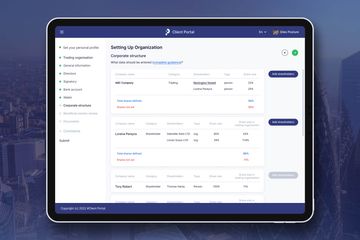
Binderr connects onboarding data directly with its risk assessment engine. Dynamic forms adapt to the entity type, jurisdiction, and answers provided, while the collected information contributes to customer, geographical, product, delivery-channel, and compliance risk scores.
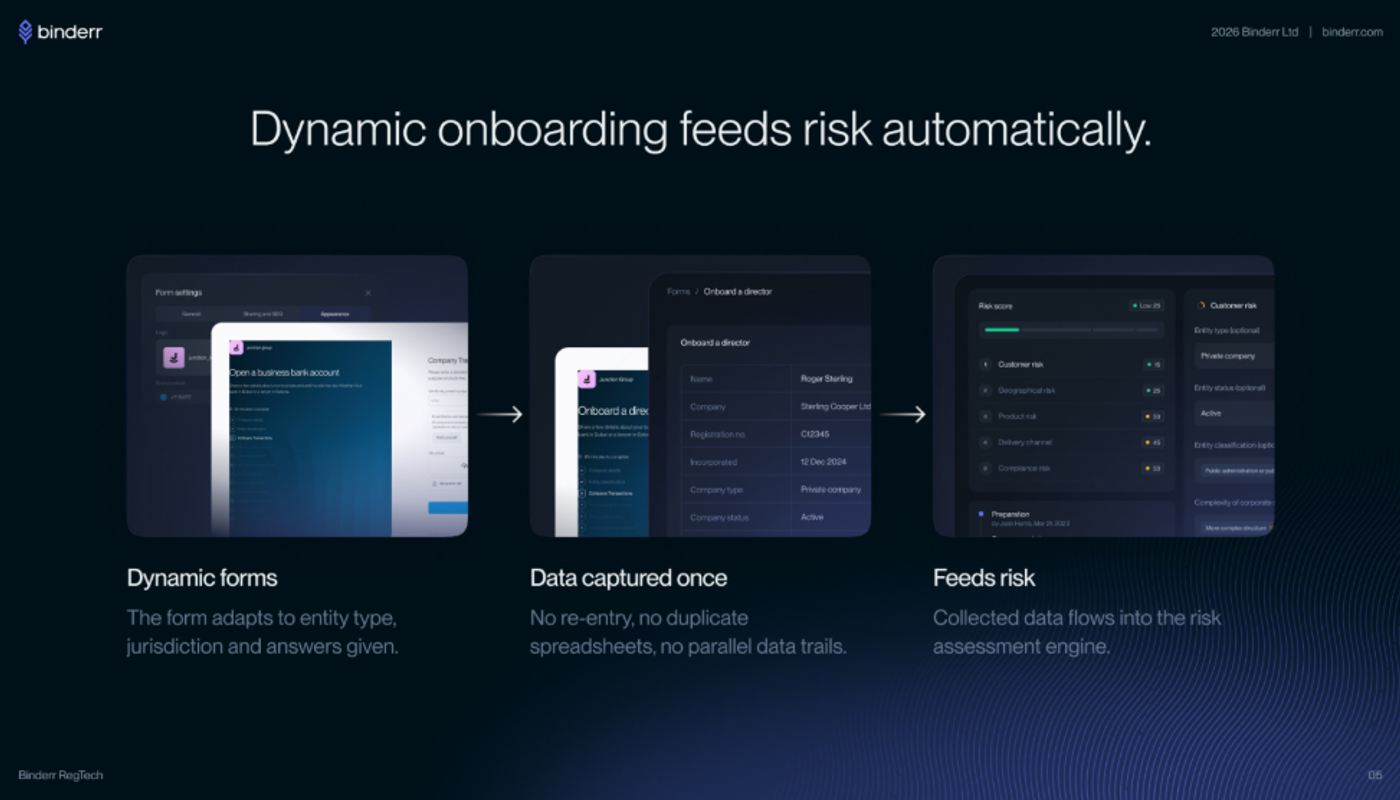
(Binderr uses information collected during onboarding to generate consistent, data-driven risk assessments.)
KYC, KYB, and UBO Verification
Effective compliance risk assessment software should support KYC (Know Your Customer), KYB (Know Your Business), and UBO (Ultimate Beneficial Owner) verification. This includes validating identity documents, accessing company registries, and identifying directors, shareholders, and beneficial owners to uncover risks and support AML compliance.
Sanctions, PEP, Watchlist, and Adverse Media Screening
A compliance platform should screen individuals and entities against sanctions lists, PEP databases, watchlists, and adverse media. Advanced tools use fuzzy matching and multilingual data to reduce false positives and improve accuracy, helping businesses identify high-risk customers and stay compliant.
Screening automation should assist analysts without obscuring how decisions are reached. Binderr provides transparent results, configurable screening logic, and tools for prioritising stronger matches, helping teams focus on material risk rather than low-quality alerts.
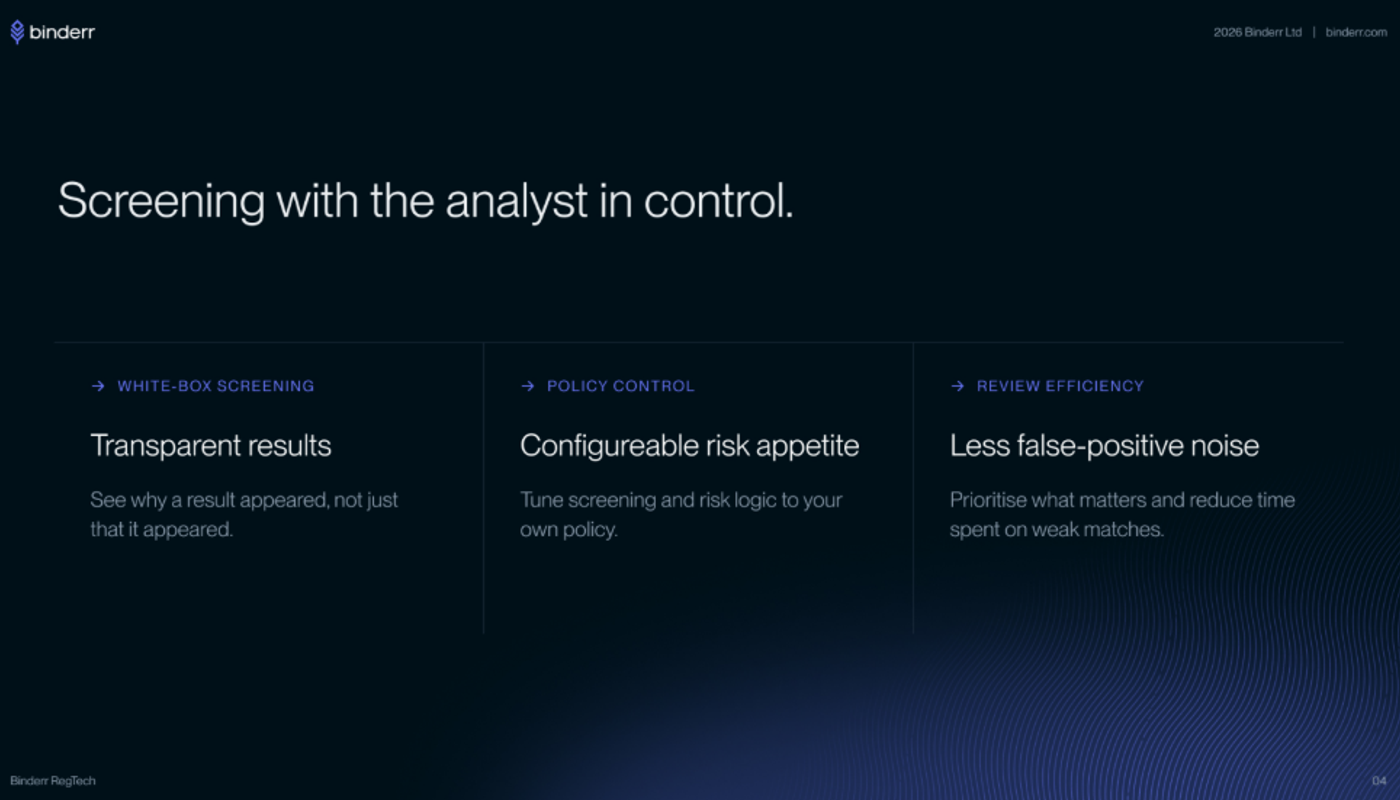
(Binderr keeps analysts in control with transparent screening results, configurable risk policies, and more efficient alert review.)
Automated CDD and EDD Workflows
Automated Customer Due Diligence (CDD) and Enhanced Due Diligence (EDD) workflows adjust requirements based on risk levels. Low-risk customers undergo simplified checks, while high-risk profiles trigger deeper reviews, such as source-of-funds verification, additional documentation, and senior approval. This improves efficiency, reduces manual work, and ensures consistent compliance.
Ongoing Monitoring and Real-Time Alerts
Continuous compliance monitoring helps detect changes in customer risk profiles over time. The best tools provide real-time alerts for sanctions matches, PEP updates, adverse media, ownership changes, and suspicious activity. This enables businesses to reassess risk and take timely action to prevent regulatory breaches or financial crime exposure.
Binderr maintains a connected compliance loop around the same client profile. Information collected through forms informs the initial risk assessment, while ongoing screening detects relevant changes and supports updated reporting throughout the relationship.
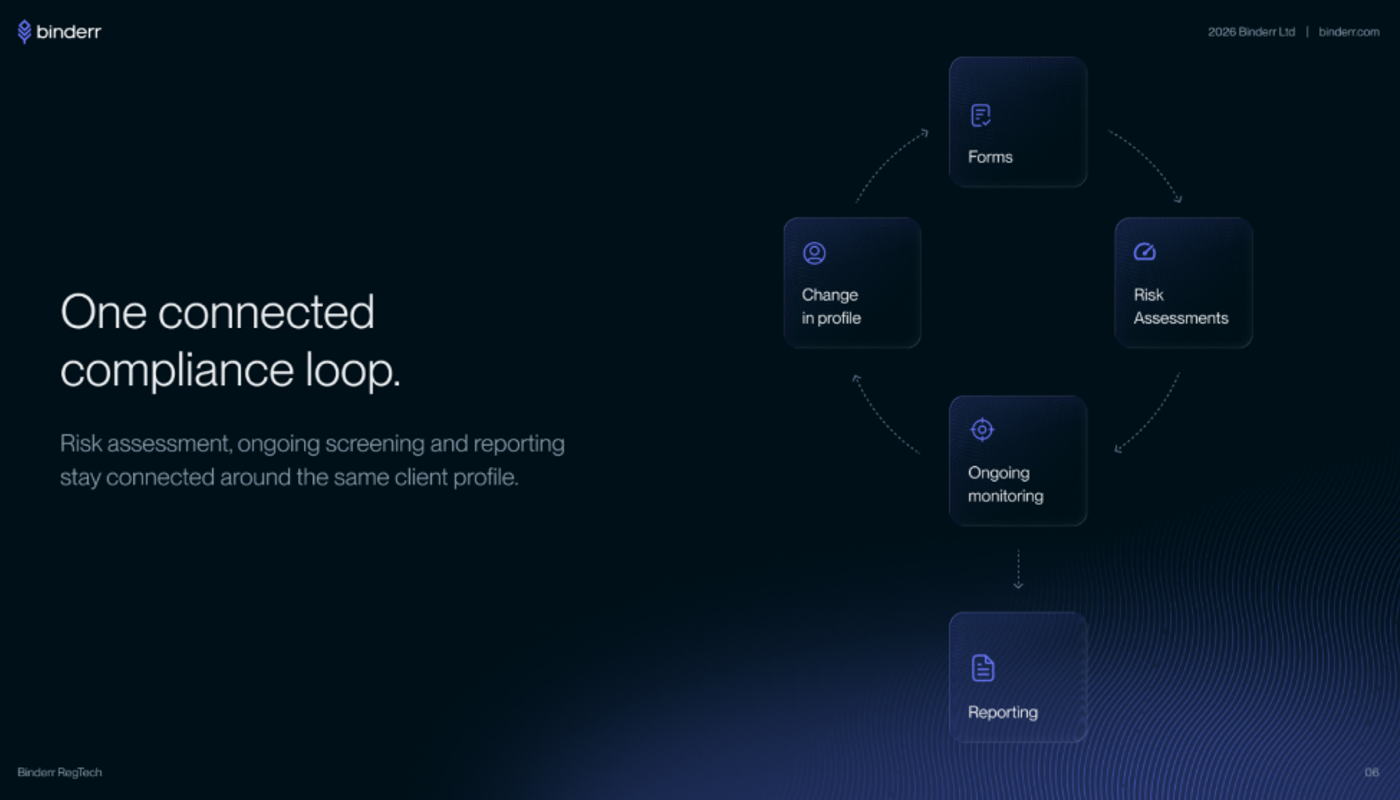
(Binderr connects onboarding, risk assessment, ongoing monitoring, profile changes, and compliance reporting.)
Never Miss a Compliance Change with Binderr
Transaction Monitoring
Transaction monitoring is essential for businesses handling payments or financial flows. Advanced systems use behavioural analytics, rule-based engines, and machine learning to detect unusual patterns, threshold breaches, and suspicious activity. These tools support case management, investigations, and regulatory reporting such as SARs or STRs, helping organisations stay compliant with AML regulations.
Audit Trails and Compliance Reporting
A reliable compliance risk assessment platform should maintain audit trails that capture key actions such as screening results, risk scores, document submissions, and approvals. Reporting tools and dashboards help teams generate insights, support audits, and demonstrate compliance during inspections.
Integrations, Security, and Scalability
Modern compliance software should integrate with systems like CRM platforms, onboarding tools, payment gateways, and case management systems via APIs. It should also include strong security features such as encryption, role-based access controls, and data privacy protections. Scalable infrastructure is important to support growing user volumes, screening activity, and monitoring needs without affecting performance or costs.
Try Advanced AML Risk Assessment with Binderr
Binderr enhances compliance risk assessment with:
- Real-time sanctions, PEP, and watchlist screening
- AI-powered adverse media analysis
- Smart matching to reduce false positives
- Screening for individuals, businesses, and complex entities
- Continuous monitoring with instant alerts
6 Best Compliance Risk Assessment Tools
Stay ahead of regulatory challenges with the best compliance risk assessment software, automated risk scoring, and continuous monitoring solutions
Binderr
Binderr Compliance is a comprehensive, all-in-one platform that enables organisations to assess and manage compliance risk throughout the entire customer lifecycle. By consolidating identity verification, business checks, screening, and monitoring into a single workflow, it eliminates the need for multiple disconnected tools. This unified approach allows compliance teams to evaluate individuals, businesses, UBOs, and related parties more efficiently while maintaining consistent risk scoring and full audit visibility.
The platform combines automation with configurable controls to streamline compliance processes and reduce manual effort. It helps organisations improve accuracy, ensure consistent decision-making, and remain aligned with evolving regulatory requirements. By centralising data and workflows, Binderr supports faster onboarding, better risk management, and stronger compliance oversight.
Key Features:
- End-to-end KYC and KYB verification: Binderr enables seamless verification of both individuals and businesses using trusted global data sources, ensuring accurate onboarding and reducing the risk of incomplete or inconsistent information.
- Advanced UBO identification and ownership mapping: The platform uncovers complex ownership structures and identifies ultimate beneficial owners, helping organisations understand who they are truly doing business with and meet transparency requirements.
- Comprehensive AML screening coverage: It screens individuals and entities against sanctions lists, PEP databases, watchlists, and adverse media sources, providing a broad view of potential financial crime risks.
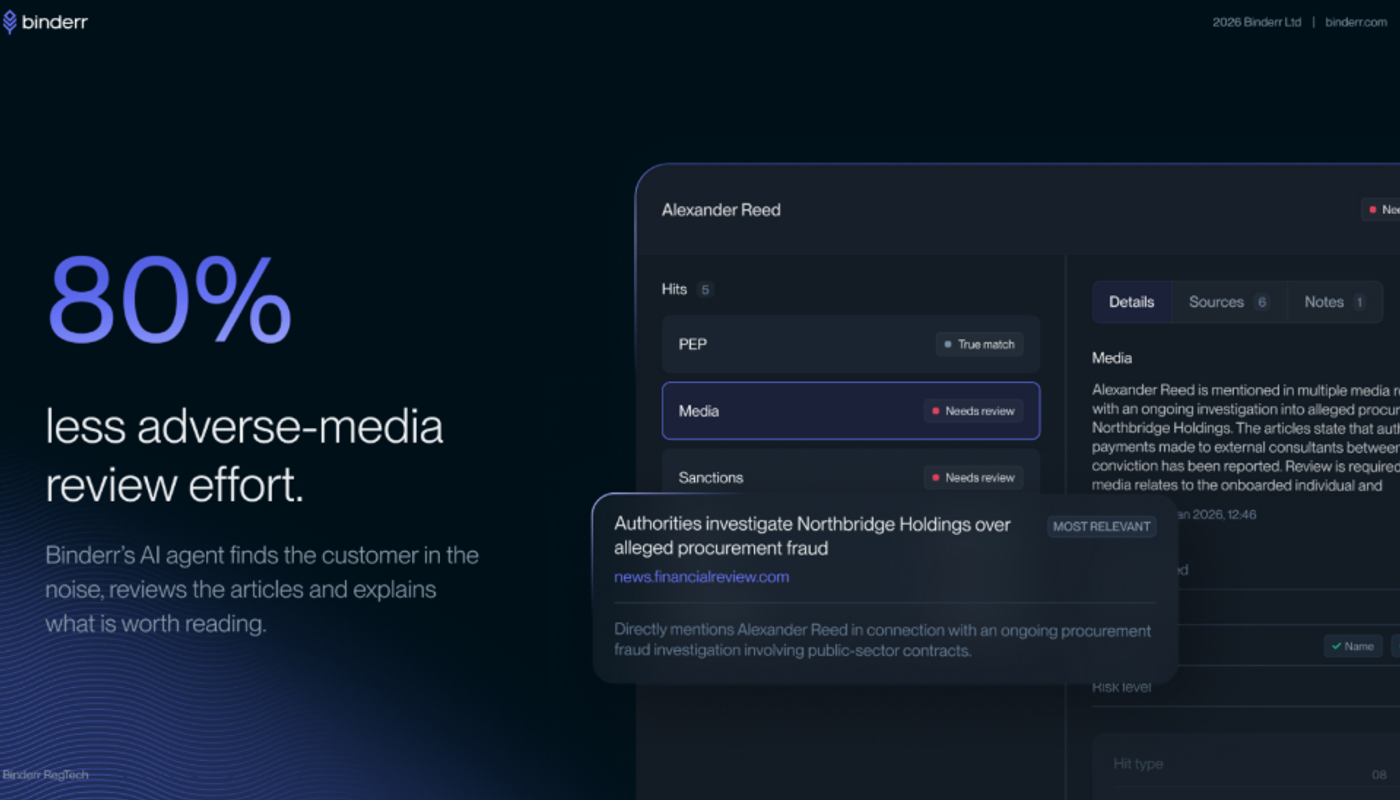
(Binderr helps compliance analysts prioritise relevant adverse media results and review the underlying sources.)
- Configurable and dynamic risk scoring: Users can tailor risk models based on their organisation’s risk appetite, applying weighted factors and thresholds to generate consistent and explainable risk ratings.
- Automated CDD and EDD workflows: Binderr automatically triggers appropriate due diligence processes based on risk levels, including enhanced checks, document requests, and approval workflows for higher-risk cases.
- Continuous monitoring with real-time alerts: The platform tracks changes such as new sanctions matches, adverse media, or ownership updates, ensuring that risk profiles remain current and actionable throughout the customer relationship.
Best For: Best for regulated businesses that need a unified platform to manage customer onboarding, risk assessment, and ongoing compliance monitoring. Ideal for organisations seeking to replace fragmented tools with a scalable, end-to-end KYC, KYB, and AML solution.
Keep Compliance Running Automatically
Copla
Copla’s compliance management software links risks, controls, evidence, vendors, and audit working programs together in one platform. This means a compliance team always knows what's complete, what's missing, and what still needs work. It starts with risk assessment built around the assets and vendors your business actually relies on. Then the platform creates a prioritized compliance plan from there.
Controls written for ISO once map automatically to DORA, NIS2, and SOC 2. So, any evidence you upload just once counts towards every applicable framework. In-house CISOs review risk and control judgment calls. You can launch new frameworks on the platform in less than 4 weeks.
Key Features:
- Risk-driven prioritization: Built around your business risks so effort is allocated to what you actually need.
- Cross-framework control mapping: Map one control to ISO 27000, DORA, NIS2, and SOC 2 at the same time, reusing evidence.
- Real-time compliance tracking: See risk status, missing evidence, open control gaps, owners, due dates, and completion status all on one screen.
- Automated evidence collection: Collect evidence as work is completed and double-check documentation instantly to fulfill regulatory obligations.
- Vendor and document management: Third-party risk, policy creation, reviews, versions, renewal dates all live in the same place as the rest of compliance.
- CISO-reviewed judgment calls: Made by in-house CISOs who validate risk assessments and control decisions through the audit.
Best For: Governance, Risk, and Compliance teams managing multiple frameworks at once and looking for a connected solution. Financial services businesses that want a compliance plan built around their actual risk profile, not a generic checklist.
ComplyAdvantage
ComplyAdvantage is a specialised AML and financial crime intelligence platform designed to help organisations detect and manage financial crime risks in real time. It leverages extensive global data sources and machine learning to identify sanctions exposure, politically exposed persons (PEPs), adverse media, and suspicious activity patterns, enabling more accurate and timely risk assessments.
Unlike tools focused solely on onboarding, ComplyAdvantage provides continuous monitoring throughout the customer lifecycle. This ongoing visibility helps organisations respond quickly to emerging risks, making it especially useful for businesses operating in high-risk sectors or handling large volumes of transactions.
Key Features:
- Comprehensive sanctions and watchlist screening across global regulatory lists, helping organisations quickly identify restricted or high-risk individuals and entities. Includes frequent data updates to ensure screening results reflect the latest regulatory changes and enforcement actions.
- Advanced PEP and relative or close associate identification, enabling deeper insight into politically exposed relationships and indirect risk exposure. Supports enhanced due diligence by mapping complex networks and uncovering hidden affiliations.
- AI-driven adverse media monitoring that scans global news sources to detect negative coverage linked to financial crime, corruption, or reputational risk. Utilize natural language processing to filter relevant articles and reduce false positives.
- Continuous customer screening and monitoring, ensuring that risk profiles remain up to date as new information emerges. Automatically triggers alerts when new matches or risk indicators are identified.
- Transaction and payment monitoring capabilities that detect unusual patterns, suspicious behaviour, and potential money laundering activity. Allows custom rule configuration to align monitoring with specific business risk thresholds.
- Risk intelligence engine with alert prioritisation and case management tools, supported by API-based integration for seamless embedding into existing systems. Enables efficient investigation workflows and faster resolution of compliance alerts.
Best For: Best for banks, payment providers, fintech companies, and crypto businesses that need robust, real-time financial crime intelligence. Ideal for organisations handling large transaction volumes or operating in regulated environments where continuous monitoring is critical.
Sumsub
Sumsub is a comprehensive verification and compliance platform designed to help businesses onboard users efficiently while maintaining strong regulatory compliance and fraud prevention standards. It brings together identity verification, business verification, AML screening, and transaction monitoring into a single system, making it especially useful for organisations operating across multiple jurisdictions.
By consolidating onboarding and risk checks into one workflow, Sumsub helps reduce friction for legitimate users while enabling early detection of high-risk individuals and entities. This integrated approach supports faster decision-making, improves operational efficiency, and strengthens overall compliance processes.
Key Features:
- End-to-end identity verification using document checks, database validation, and automated workflows to confirm user identities accurately, ensuring compliance with regulatory standards and reducing onboarding risks
- Advanced biometric verification with liveness detection to prevent spoofing, deepfakes, and identity fraud, enhancing security during remote identity checks
- Business verification capabilities that validate company data, ownership structures, and registration details, helping organisations assess corporate legitimacy and risk exposure
- Integrated AML screening covering sanctions lists, PEP databases, and adverse media sources, enabling comprehensive financial crime risk assessment
- Fraud detection tools that analyse behavioural patterns, device data, and risk signals to identify suspicious activity, improving early detection of fraudulent behaviour
- Transaction monitoring features that track user activity and flag unusual or high-risk transactions in real time, supporting continuous compliance and risk management
Best For: Best for fintech, crypto, gaming, marketplaces, and digital platforms that need scalable identity verification and fraud prevention across multiple countries.
Ondato
Ondato is a flexible compliance platform designed to help businesses streamline onboarding while maintaining strong regulatory controls. It combines identity verification, business onboarding, AML screening, and risk assessment into a unified system that can be tailored to different industries and risk profiles. This makes it particularly useful for organisations that need adaptable workflows rather than rigid, one-size-fits-all compliance processes.
The platform supports both individual and business verification, allowing companies to assess customers, legal entities, and their ownership structures within a single environment. Ondato also integrates risk scoring and monitoring capabilities, helping compliance teams maintain visibility over customer risk throughout the lifecycle.
Key Features:
- Identity and document verification: Ondato enables secure verification of individuals using document checks and biometric validation, helping businesses confirm identities quickly while reducing fraud risk.
- Business verification and UBO checks: The platform retrieves company data from registries and identifies ultimate beneficial owners, allowing organisations to understand ownership structures and assess associated risks.
- Sanctions, PEP, and watchlist screening: Ondato screens individuals and entities against global sanctions lists, politically exposed persons databases, and watchlists to detect potential compliance risks early.
- Adverse media monitoring: The system scans media sources for negative news related to customers or businesses, helping identify reputational or financial crime risks that may not appear in official databases.
- Customer risk scoring and due diligence: Ondato applies configurable risk scoring models to classify customers and trigger appropriate levels of customer due diligence or enhanced due diligence when needed.
- Ongoing monitoring and transaction oversight: The platform supports continuous monitoring of customer data and business information, along with transaction monitoring capabilities to detect suspicious activity over time.
Best For: Best for fintechs, lenders, gaming companies, telecommunications providers, and regulated firms. Ideal for organisations that need flexible, configurable onboarding workflows with integrated AML and risk assessment capabilities.
Trulioo
Trulioo is a global identity and business verification platform designed to help organisations confidently onboard customers across multiple jurisdictions. It aggregates data from a wide range of authoritative sources, enabling businesses to verify individuals and companies using identity records, documents, company registries, and watchlist data. This makes it particularly valuable for organisations operating internationally, where regulatory requirements and data availability vary significantly by country.
By combining identity verification, business verification, and risk signals into a single platform, Trulioo helps reduce onboarding friction while maintaining compliance with global regulations. Its API-first approach allows businesses to integrate verification processes directly into their existing workflows, supporting scalable and efficient cross-border operations.
Key Features:
- Global identity verification: Access to a vast network of international data sources to verify individuals across multiple countries with high accuracy. Ensures consistent verification standards across different jurisdictions.
- Document and biometric verification: Supports identity-document checks and biometric validation to confirm authenticity and reduce fraud risk. Enhances security by combining multiple verification methods.
- Business verification and ownership checks: Enables verification of companies, including directors and persons of significant control, using official registries. Helps uncover complex ownership structures and hidden risks.
- Watchlist and sanctions screening: Screens individuals and entities against global sanctions lists, PEP databases, and other watchlists. Reduces exposure to regulatory violations and financial crime.
- Workflow orchestration and API integration: Flexible APIs and workflow tools allow businesses to customise onboarding processes and integrate seamlessly with existing systems. Improves operational efficiency and scalability.
- Fraud and identity-risk signals: Provides additional risk indicators and fraud detection insights to support better decision-making during onboarding. Strengthens overall risk assessment and prevention strategies.
Best For: Best for international businesses and digital platforms that need reliable identity and business verification across multiple jurisdictions. Ideal for marketplaces, payment providers, and global fintechs scaling cross-border onboarding.
How Much Does a Compliance Risk Assessment Tool Cost?
The cost of a compliance risk assessment tool depends on the number of users, risk assessments, compliance modules, integrations, monitoring requirements, and level of implementation support. Some platforms offer subscription plans, while other providers prepare custom quotes based on the organisation’s size and requirements.
Binderr offers a free account with free credits, allowing businesses to test its compliance features without a credit card. Paid plans start at €99 for Starter and €349 for Pro, depending on usage and compliance needs. This provides a more predictable starting point than platforms that only disclose pricing after sales calls and product demonstrations.
ComplyAdvantage, Sumsub, Ondato, and Trulioo may use custom, usage-based, or product-based pricing. Final costs can depend on verification volumes, selected modules, monitoring requirements, integrations, implementation, and support.
Compliance Risk Assessment Software Pricing Comparison
Platform | Pricing model | Published starting price | Free access |
|---|---|---|---|
Binderr Compliance | Subscription based on usage and needs | Starter from €99; Pro from €349 | Free account and credits |
Copla | Custom, quote-based after a scoping call | Not publicly available | Demo or consultation |
ComplyAdvantage | Custom and usage-based pricing | Not publicly available | Demo or consultation |
Sumsub | Product and volume-based pricing | Confirm with provider | Demo available |
Ondato | Usage-based and custom pricing | Selected service prices available | Demo available |
Trulioo | Custom volume-based pricing | Not publicly available | Demo or consultation |
Benefits of Automated Compliance Risk Assessment
Unlock smarter, faster decision-making with automated compliance risk assessment tools designed for modern regulatory demands.
From real-time monitoring to consistent risk scoring, these solutions streamline compliance workflows while reducing manual effort and human error.
Reduced manual data entry - Automated compliance risk assessment tools minimise the need for repetitive manual data entry by pulling information directly from trusted data sources and integrating with existing systems. This reduces human error, improves data accuracy, and allows compliance teams to focus on higher-value tasks such as risk analysis and decision-making.
Earlier identification of high-risk relationships - With automated compliance risk assessment software, businesses can detect high-risk customers, entities, or transactions much earlier in the onboarding process. Real-time screening and dynamic risk scoring help flag potential issues such as sanctions exposure, PEP status, or adverse media, enabling faster intervention and stronger risk mitigation.
Better prioritisation of compliance resources - Automation helps compliance teams allocate their time and resources more effectively by highlighting the highest-risk cases first. Instead of treating all customers equally, risk-based workflows ensure that enhanced due diligence and manual reviews are focused where they are most needed, improving overall efficiency.
Automated CDD and EDD escalation - Compliance risk assessment tools can automatically trigger customer due diligence (CDD) or enhanced due diligence (EDD) based on predefined risk thresholds. This ensures that higher-risk relationships receive additional scrutiny, such as source-of-funds checks or senior approval, without relying on manual intervention.
Continuous rather than periodic oversight - Unlike traditional periodic reviews, automated compliance monitoring provides continuous oversight of customer risk profiles. Ongoing monitoring detects changes such as new sanctions listings, ownership updates, or adverse media, allowing businesses to respond quickly to emerging risks.
Stronger documentation - Automated systems create detailed audit trails that capture every step of the compliance process, including risk scores, screening results, and decision-making. This strengthens documentation, supports regulatory reporting, and ensures that businesses are prepared for audits and compliance reviews.
See How Binderr Simplifies Compliance Risk Assessment
- Run KYC, KYB, and AML checks in one platform
- Automatically assign risk scores
- Trigger EDD workflows for high-risk users
- Collect documents dynamically
- Monitor risk continuously
- Maintain full audit trails
How to Choose the Right Compliance Risk Assessment Tool
Find the perfect compliance risk assessment software by evaluating features like risk scoring, automation, monitoring, and integration capabilities tailored to your organisation.
Define What You Need to Assess
Before selecting compliance risk assessment software, clearly define the scope of your risk exposure by identifying whether you need to assess customers, businesses, UBOs, vendors, internal controls, or broader enterprise risks. A well-scoped assessment ensures your compliance risk management strategy aligns with regulatory requirements, AML obligations, and operational priorities, helping you choose a platform that supports accurate risk identification and efficient compliance workflows.
Examine the Risk-Scoring Model
A strong compliance risk scoring model should offer configurable factors, weighted criteria, and flexible thresholds that reflect your organisation’s risk appetite. Look for tools that calculate both inherent and residual risk, provide transparent scoring logic, and allow manual overrides when necessary, ensuring your compliance risk assessment software delivers consistent, explainable, and audit-ready decisions.
Check the Level of Automation
Modern compliance risk assessment tools should automate key processes such as data collection, risk scoring, approvals, escalations, and remediation workflows. Automation reduces manual errors, speeds up onboarding, and enhances operational efficiency, making it easier for compliance teams to manage large volumes of assessments while maintaining regulatory compliance and accurate risk management.
Ensure Real-Time Risk Monitoring and Alerts
Compliance risk is dynamic, so your software must support real-time monitoring and automated alerts to detect changes in customer behaviour, ownership structures, sanctions exposure, or regulatory updates. Continuous compliance monitoring ensures that risk profiles remain current, enabling proactive risk mitigation and helping organisations respond quickly to emerging threats or compliance breaches.
Test the Platform
Before committing to a compliance risk assessment platform, test it through a free trial, sandbox environment, or guided demo using realistic scenarios. This hands-on evaluation helps you assess usability, integration capabilities, risk scoring accuracy, and overall performance, ensuring the tool meets your compliance needs and supports scalable risk management operations.
Try Binderr at No Cost Today
Common Mistakes to Avoid When Selecting Risk Assessment Software
Choosing the right compliance risk assessment tool can make or break your risk management strategy, here are the most common mistakes to avoid when evaluating compliance risk assessment software, automated risk scoring tools, and regulatory risk management platforms
Choosing a broad GRC platform when the real need is customer risk assessment - Many organisations select a full GRC platform when their primary requirement is customer risk assessment software. While GRC tools cover governance, controls, and enterprise risk, they may lack specialised KYC, KYB, and AML capabilities needed to assess customers, UBOs, and financial crime exposure effectively. This mismatch can lead to complex implementations and gaps in compliance risk assessment.
Using fixed scoring models that cannot reflect the organisation’s risk appetite - Relying on rigid, predefined scoring models can limit the effectiveness of compliance risk assessment software. Every organisation has a unique risk appetite based on its industry, geography, and regulatory obligations. Without configurable risk scoring, businesses may misclassify high-risk customers or overlook emerging threats, reducing the accuracy of automated compliance risk assessment.
Failing to test data quality and coverage - Data quality and coverage are critical for accurate compliance risk assessment. If the software relies on incomplete or outdated data sources, such as limited sanctions lists or weak adverse media coverage, risk assessments may be unreliable. Testing data sources, geographic coverage, and match accuracy ensures the compliance risk management software delivers dependable results.
Automating decisions without appropriate human review - While automation improves efficiency, fully automated compliance risk assessment without human oversight can introduce significant risks. Complex cases, false positives, and unusual patterns often require expert judgement. Compliance teams should review high-risk alerts, validate automated decisions, and document overrides to maintain regulatory compliance and accountability.
Treating all industries, customers, and jurisdictions as presenting equal risk - Applying a one-size-fits-all approach to compliance risk assessment ignores the varying levels of risk across industries, customer types, and jurisdictions. For example, customers in high-risk sectors or sanctioned regions require enhanced due diligence. Effective compliance risk assessment software should support risk-based approaches that adjust scoring and monitoring based on these differences.
Binderr: Complete Compliance Risk Assessment Solution
Binderr provides a full end-to-end compliance platform:
- KYC, KYB, and AML in one system
- Dynamic risk scoring and automation
- UBO identification and ownership mapping
- Continuous monitoring and alerts
- CDD and EDD workflows
- Compliance reporting and audit trails
Bottom Line
Choosing the best compliance risk assessment tool depends on your organisation’s regulatory needs, risk exposure, and scale. ComplyAdvantage is well suited for financial crime detection and AML intelligence, while Sumsub excels in identity verification and digital onboarding. Ondato offers flexible KYC and AML workflows, and Trulioo stands out for international verification and global data coverage.
For businesses seeking an all-in-one solution, Binderr provides a comprehensive platform that combines KYC, KYB, AML screening, UBO identification, and dynamic risk scoring. With automated workflows, ongoing monitoring, and transparent pricing starting from €99, it offers a practical and scalable option for managing compliance risk efficiently.

-1-360x240.webp?w=3840&q=75)