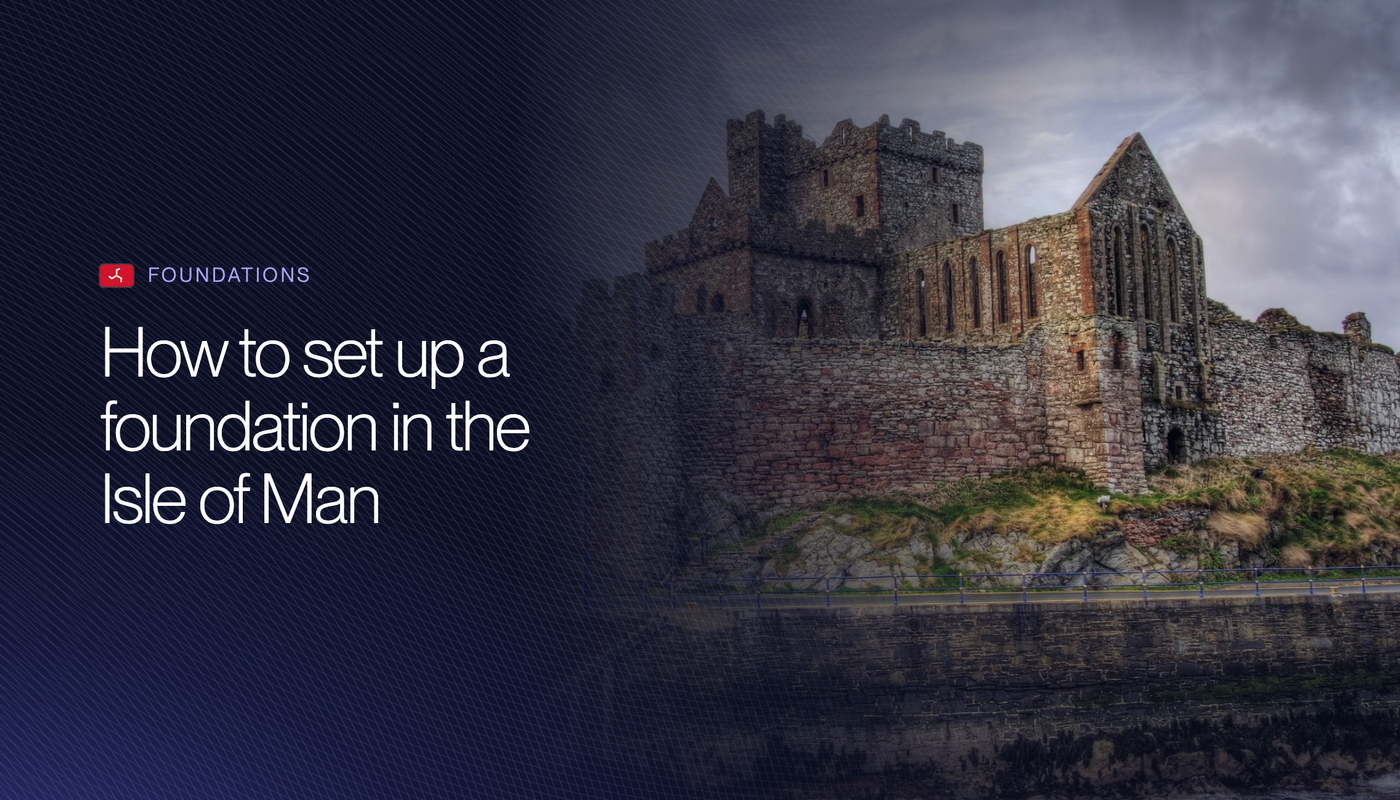
An Isle of Man foundation is a legal person. It owns assets in its own name, needs no trustee, and lets the founder keep a role through its council and its rules. It is taxed at 0% like an island company, there is no capital gains or inheritance tax, and the full rules stay private.
The hard part is the setup. Under the Foundations Act 2011, only a registered agent with a Class 4 licence can file the application, and no foundation can exist without one. The instrument, the rules and the objects must be drafted to work together, and the founder and every council member are checked first.
Setting it up with us is simple. We work with a licensed registered agent on the island and handle the whole setup: the structure, your KYC pack, the instrument and the rules, the filing and the bank file. One team and no email chains. You tell us what the foundation should do, and we get it done.
Isle of Man Company Incorporation
Binderr
Corporate tax
0% for most activities
Time to incorporate
1 Week
Cost
Starting from €1,499
Why Set Up an Isle of Man Foundation
An Isle of Man foundation gives you a single legal person that owns assets, has its own council and follows rules you write. It suits families, founders and charitable projects that want long-term control of assets without a trustee holding legal title. Most of the wider benefits of registering a company in the Isle of Man apply to it too.
A Separate Legal Person
The foundation owns its assets in its own name. Shares, cash, property and investments sit on its balance sheet, not with a trustee or a nominee. It can sign contracts, open accounts and hold shares in companies. Because it is a legal person, it carries on after the founder dies and needs no new trustee to take over the assets.
No Trustee and No Shareholders
A trust needs a trustee to hold the assets for the beneficiaries. A foundation needs neither a trustee nor shareholders. Its council runs it under the foundation's own rules, and nobody owns it. That makes it simple to explain to banks and family members who come from civil law countries, where trusts are less familiar.
Set Up an Isle of Man Foundation
The foundation is simple to set up when the documents are planned together. This is what we handle for you.
- Licensed agent arranged: We work with a Class 4 licensed registered agent, as the Act requires.
- Objects drafted clearly: Objects that meet the legal tests and fit what you want.
- Rules kept private: Sensitive terms go in the rules, not the public instrument.
- Council planned: We help you choose who sits on the council and why.
- One point of contact: One team for the documents, the filing and the bank file.
The Founder Keeps a Role
The founder sets up the foundation and gives it its first assets. The founder can sit on the council and can also be the enforcer, so the person who created it can keep watching how it is run. The rules then set out how the foundation is run and what role the founder keeps.
Private Rules With a Short Public Record
Two documents shape the foundation. The foundation instrument goes on the public Register of Foundations. The rules, which say who benefits and how, stay private. Since 2018, only a redacted copy of the rules is filed with the Registry, and the full rules are held by the registered agent.
0% Tax and No Capital Taxes
The foundation is taxed like an island company, at 0% on most income. The island has no capital gains tax, no inheritance tax, no gift tax and no stamp duty. The founder and the beneficiaries are still taxed under the rules of the country where they live.
How an Isle of Man Private Foundation Works
An Isle of Man private foundation has five parts: the founder who sets it up, the council that runs it, an enforcer where one is needed, optional beneficiaries, and the registered agent that keeps it on the register. Two documents bind them together, the public instrument and the private rules.
The Founder
The founder is the person who establishes the foundation and gives it assets. There is no minimum amount, and the foundation needs no assets at the start. Once assets are transferred, they belong to the foundation, not to the founder. The founder's own powers are the ones the rules give them.
The Council
The council manages the foundation and its assets. It needs at least one member, aged 18 or over, who is not disqualified from acting as a council member or a company director. Each member owes a duty of honesty and good faith and must act with the care of a prudent person. The names and residential addresses of council members go in the foundation instrument.
The Enforcer
An enforcer makes sure the council carries out the foundation's objects. It is required only where the objects include a specified non-charitable purpose. Otherwise it is optional. Apart from the founder and the registered agent, nobody can be both a council member and the enforcer.
The Beneficiaries
Beneficiaries are optional. Where the rules name them, they have no automatic right to a distribution or to information about the foundation. Their rights are the ones the rules give them. This is one of the main differences from a trust, where beneficiaries usually have stronger rights.
The Foundation Instrument and the Rules
The instrument is filed in English and is public. The rules are private and can be in another language, as long as the registered agent holds an English translation.
Types of Foundation in the Isle of Man
Foundations on the island differ by their objects, not by separate laws. One Act covers all of them. The objects decide whether the foundation needs an enforcer, who can benefit and how the council must use the assets.
Private Family Foundation
This is the most common type. It holds family assets, such as shares in a family business or an investment portfolio, for named family members. The rules set out who can receive what and when. It suits founders who want assets kept together across generations.
Charitable Foundation
A foundation can have charitable objects, such as education or medical research. It does not need an enforcer, because the enforcer rule only applies to non-charitable purposes. Our guide to the best jurisdictions for charitable foundations compares the island with other options.
Purpose Foundation
A purpose foundation exists to carry out a specified non-charitable purpose, for example holding the shares of a company or keeping a family property. It must have an enforcer.
Foundation Holding a Company or a Private Trust Company
A foundation often sits at the top of a structure and owns an island company that holds the operating assets. It can also own a private trust company, or act as one, so a family can run its own trusts. Our guide to how to set up a private trust company covers that route, and our guide to how to set up an Isle of Man holding company covers the company below the foundation.
Isle of Man Company Incorporation
Binderr
Corporate tax
0% for most activities
Time to incorporate
1 Week
Cost
Starting from €1,499
Foundation vs Trust vs Company in the Isle of Man
A foundation sits between a trust and a company. Like a company, it is a legal person on a public register. Like a trust, it holds assets for a purpose or for beneficiaries, with nobody owning it. The table shows the main differences on the island.
Factor | Foundation | Trust | Company (2006 Act) |
|---|---|---|---|
Main law | Foundations Act 2011 | Trusts Act 1995 and Trustee Act 2001 | Companies Act 2006 |
Legal person | Yes | No, the trustee holds the assets | Yes |
Who runs it | A council of at least 1 member | A trustee, and 1 is enough | At least 1 director |
Licensed provider needed | Class 4 registered agent | Class 5 licence for a professional trustee | Class 4 registered agent |
Public record | Instrument and council on the register, rules private | No public trust register | Company on the register |
Registry fee | £100, then £380 a year | No registration fee | £100, then £380 a year |
The foundation gives you a legal person and a public record, but keeps its rules private. A trust leaves no public record at all, but a trustee holds legal title to your assets. A company is the right vehicle for trading, which a foundation may only do where it is incidental to its objects.
When a Trust Fits Better
A trust suits families who want no public record and are comfortable with a licensed trustee holding title. Since the Trusts (Amendment) Act 2015, a new Manx trust has no perpetuity limit and one trustee is enough. See how to set up an Isle of Man trust, and our comparison of a private foundation vs trust.
When a Company Fits Better
A company fits when the structure will trade, raise money or be sold one day. Many families use both: the foundation owns the company, and the company runs the business. Our guide to how to set up a company in the Isle of Man covers the company side.
Isle of Man Foundation Requirements
The requirements are short: a Class 4 licensed registered agent, a council of at least one member, a name that includes the word foundation, lawful objects and the filed documents. There is no minimum capital, and the foundation can be formed with no assets.
The Isle of Man Foundations Act 2011
The Act came into force on 1 January 2012. It sets out how a foundation is formed, run, changed and wound up. Amendments in 2018 added the rule that every foundation files a redacted copy of its rules with the Registry.
A Class 4 Licensed Registered Agent
No foundation may exist without a registered agent. The agent must hold a Class 4 licence from the Isle of Man Financial Services Authority and be permitted to act for foundations. It files the application, gives the foundation its business address on the island and holds a copy of the rules. A foundation has one agent at a time, and the High Court can appoint one if needed. Our guide to Isle of Man registered agent requirements explains the licence.
Council, Name and Objects
The council needs at least one member aged 18 or over who is not disqualified. Changes to the council are notified within one month. The name must include the word foundation. The objects must be certain, reasonable, possible and lawful, and the foundation may not trade unless the trading is incidental to its objects.
Beneficial Ownership and Annual Return
Foundations also report their beneficial owners under the Beneficial Ownership Act 2017, through a nominated officer. Each year the foundation files an annual return, which costs £380 on time. Our guide to the Isle of Man Companies Registry search shows what the public register holds.
Read more: Isle of Man annual filing and compliance.

Interpolitan Money
Business account
Time to onboard
1 Week
Currency
EUR, USD, GBP, AED, and 50+
Monthly fee
Custom
Isle of Man Foundation for Non-Residents
A foundation for founders abroad is set up the same way as one for island residents. The founder, the council and the beneficiaries can live abroad. The island link comes from the licensed registered agent, which gives the foundation its business address. With us, the whole setup runs remotely.
No Residence Test for the Council
The Act asks council members to be 18 or over and not disqualified. It does not ask them to live on the island. Many founders sit on the council themselves, and some add a professional council member on the island for continuity. That choice also affects where decisions are made, which matters for tax in some home countries.
Remote KYC and Signing
You send certified copies from home, and we check them before our licensed agent sees them. The instrument and the rules are signed without a trip to the island.
Plan for Your Home Country
The island taxes the foundation at 0%, but your home country decides how it treats you as founder or beneficiary. UK residents, for example, face HMRC's transfer of assets abroad rules. Take advice in your own country before you move assets in. Our guide to how to set up a company as a non-resident covers the wider points.
Set Up an Isle of Man Foundation From Abroad
You do not need to travel to the island. We run the setup with you remotely, from the first call to the filing.
- No trip needed: Documents certified at home and signed where you live.
- Council you choose: Sit on it yourself, or add a professional member on the island.
- File checked before filing: We close the gaps before the agent's review.
- Home country flagged: We point out where your own tax rules need advice.
- Account opened remotely: Our partners open accounts for foundations without a branch visit.
- Clear next steps: You know what to send and when at every stage.
How to Set Up an Isle of Man Foundation
You make three decisions: the purpose, the council and who can benefit. We handle the rest with our licensed registered agent. The agent files the application with the Companies Registry, which processes a standard filing within 48 hours.
Before You Start
Answer three questions first. What the foundation is for, because that decides the objects and whether it needs an enforcer. Who sits on the council, because every member is checked and named on the public register. And which assets go in, because that drives the bank account and any company below the foundation. Read our global guide to the best jurisdictions for private foundations if you are still deciding where to form it.
We Plan the Structure
We map the foundation, its council, any enforcer, the beneficiaries and any company it will own. We decide with you what goes in the public instrument and what stays in the private rules.
We Build the KYC File
Our licensed agent checks the founder, the council members and the enforcer before it files. We tell each person what to send, check every document and close the gaps before submission.
We Draft the Instrument and the Rules
We prepare the foundation instrument in English, with the name, objects and council. We draft the rules with the terms you want private, and a redacted copy for the Registry. Both documents are written to work together.
Our Licensed Agent Files the Application
Our licensed agent files the application, the instrument, the rules information, its own declaration and the Registry fee. The standard service takes 48 hours for £100. The 2 hour service costs £250, and the while you wait service costs £500.
After Registration
The founder transfers the assets, the beneficial owners are reported, and the bank account opens. We build the bank file at the same time as the foundation, so the account follows soon after.
Read more: Isle of Man offshore company formation.
Full-Service Isle of Man Foundation Formation
We handle the whole formation with our licensed registered agent, from the first document to the bank file.
- Registry filing done: Our licensed agent files the application and the documents.
- Instrument and rules drafted: Written together, with a redacted copy for the Registry.
- Enforcer rule checked: We confirm whether your objects need one.
- Ownership reported on time: Beneficial owners filed within the deadlines.
- Bank file at formation: The pack our partners ask for, built at the same time.
Documents Needed for an Isle of Man Foundation
Isle of Man foundation formation needs two groups of documents: the ones filed with the Registry, and the KYC papers our licensed agent needs for every person involved. We prepare the first group and tell each person what to send for the second.
Filed With the Registry
- Application: The application in the prescribed form, filed by the registered agent.
- Foundation instrument: In English, with the name, objects and council members.
- Rules information: Information about the foundation rules, in the Registry's form.
- Redacted rules: A redacted copy of the rules, filed by every foundation since 2018.
- Agent declaration: The registered agent's declaration, filed with the application.
- Fee: £100 for the 48 hour service, or more for a faster one.
For the Founder, Council and Enforcer
Each person sends a certified passport, a recent proof of address, a CV and evidence of source of funds and source of wealth, plus a bank or professional reference. Where a company or a trust is involved, it sends its constitutional documents and details of its own beneficial owners. A lawyer, notary or accountant in your country certifies the copies.
Cost of Setting Up a Foundation in the Isle of Man
The cost has two parts: the Registry fees, which are fixed, and the work of the registered agent and the advisers, which depends on the structure. Our fee for a foundation is quoted with your setup. Our "from €1,499" price covers a standard company only, and foundations are quoted separately.
Cost item | When it is paid | Typical amount | What it covers |
|---|---|---|---|
Foundation setup with Binderr | Once, before filing | Quoted with your setup | Advice, KYC pack, instrument, rules and the filing through our licensed agent |
Annual return to the Companies Registry | Every year | £380 on time, £480 or £630 if late | Keeps the foundation on the register |
Registered agent | Every year | About £2,400 a year on one island fee scale | The licensed agent the Act requires |
Professional council member | Every year, only if you use one | From £3,330 a year on one published island scale | A professional on the council |
Underlying company | Once, only if the foundation owns one | From €1,499 for a standard company | A 2006 Act company below the foundation |
Business account with our partners | Every month, from opening | About €30 to €100 a month on published plans | The foundation's account |
The yearly costs matter more than the setup. As a planning estimate built from these figures, the annual return and the registered agent alone come to close to £3,000 a year, before any council member or account. That is why a foundation suits a meaningful pool of assets, not a small one. Our guide to how much an Isle of Man company costs breaks down the company costs.
Registry Fees for Isle of Man Foundations
Registry item | Fee |
|---|---|
Establishment, 48 hour service | £100 |
Establishment, 2 hour service | £250 |
Establishment, while you wait | £500 |
Annual return, on time | £380 |
Annual return, 1 month and 1 day to 3 months late | £480 |
Annual return, more than 3 months late | £630 |
Change to the foundation instrument | £0 on time, £100 or £250 late |
Continuance in from another jurisdiction | £100 |
Continuance out to another jurisdiction | £550 |
Winding up | £0 |
These are the government's own fees and they are small. The real cost sits in the agent's yearly fee and in any professional council member. A foundation that moves to the island from another jurisdiction pays £100 to continue in, and leaving later costs £550.
What Drives the Yearly Cost
The yearly cost depends on who sits on the council and what the foundation owns. A founder who sits on the council alone pays mainly the annual return, the agent and the account. A professional council member, a paid enforcer or a company below the foundation each add a yearly fee. We set out every yearly cost for your profile in the quote, before you sign.
Isle of Man Company Incorporation
Binderr
Corporate tax
0% for most activities
Time to incorporate
1 Week
Cost
Starting from €1,499
How Long Isle of Man Foundation Formation Takes
The Registry part takes 48 hours on the standard service, 2 hours on the express service, or the same day while you wait. Most of the time goes before filing: agreeing the objects, drafting the rules and completing the KYC checks.
What Sets the Pace
Delays come from source of wealth evidence that does not match, council members who send documents late and rules that change after drafting. We fix these before filing, not after.
After the Certificate
Once registered, the foundation can take its assets and open its account. Shares move into its name with a transfer, and the island charges no stamp duty on it. The bank file is ready at the same time, so the account usually follows within days with our partners. Council changes after that must be notified within one month.
One Clear Quote for Your Isle of Man Foundation
Foundations are quoted with your setup. You see the setup fee and every yearly cost before you sign.
- Setup quoted up front: One fee for the documents, the KYC pack and the filing.
- Yearly costs listed: Annual return, agent fee and any council member shown first.
- Company option priced: A company below the foundation from €1,499.
- Registry fee options: 48 hours, 2 hours or while you wait, as you need.
- No surprises later: Late fees and changes explained before they apply.
Isle of Man Foundation Tax
Foundations in the Isle of Man are taxed like island companies, at 0% on most income. There is no capital gains tax, no inheritance tax, no gift tax and no stamp duty. The tax result for the family depends on where the founder and the beneficiaries live.
0% Like an Island Company
The government confirmed in May 2012 how foundations are taxed, shortly after the Act came into force. Foundations follow the company rules, so the standard 0% rate applies to most income. No capital or wealth taxes apply.
No Capital Gains, Inheritance or Gift Tax
The island has no capital gains tax, inheritance tax, gift tax or stamp duty. Assets can move into the foundation, grow inside it and pass to the next generation without island tax on the transfer or the gain.
Your Home Country Still Taxes You
The founder and the beneficiaries remain taxed in their own countries. Some countries may tax the founder on the foundation's income, and others tax distributions when they are paid. UK residents face HMRC's transfer of assets abroad rules. Check your own position before assets go in.
Read more: Isle of Man company tax and the zero rate rules.
Banking for Isle of Man Foundations
A foundation needs an account to receive assets, hold cash and pay distributions. Most island banks take foundations only through a licensed provider and review them for several weeks. We work with regulated payment partners built for complex structures, who open the account in days once the file is complete. Our guide to opening a bank account for a foundation explains what they check.
Isle of Man Banks for Foundations
Isle of Man Bank and NatWest International charge £12.50 a month per business account on tariffs correct as of January 2025. Both open business current accounts only where all owners and directors live in the Channel Islands, the Isle of Man or Gibraltar, with a single layer of ownership and no nominees. Lloyds runs Island Business Banking for businesses registered and operating in the islands, and its guide to bank charges allows an enhanced due diligence fee of up to £10,000 a year per legal entity. Lloyds International Private Banking asks for £250,000 or more to deposit. HSBC's price list of 30 September 2026 sets £8 or £10 a month for its island business accounts. See our guide to the best banks for Isle of Man companies.
Our Partner Route for Foundations
We work with a regulated payment partner that specialises in complex structures, including trusts, foundations and SPVs. We build the file from the formation documents: the instrument, the council resolution, the KYC for the founder and council, and the source of wealth. Then we open the account with you, remotely, on published plans of about €30 to €100 a month. Our guide to bank accounts for Isle of Man trusts and foundations covers the details.
Factor | Isle of Man banks | Our partners |
|---|---|---|
Who they accept | Mostly island residents, structures through a licensed provider | Trusts, foundations and other complex structures |
How you apply | Through a licensed provider, or directly if you qualify | Remotely, with a file we build |
Monthly cost | £8 to £12.50 a month on standard tariffs | About €30 to €100 a month on published plans |
Enhanced checks | Up to £10,000 a year per entity at Lloyds | None published |
Time to open | Several weeks | Days after the file is complete |
For a foundation run from abroad, the island banks' eligibility rules usually decide the matter before fees do. Families with wider needs can read our guide to banking for family offices, and trustees our guide to banking for trusts.
Interpolitan Money
Business account
Time to onboard
1 Week
Currency
EUR, USD, GBP, AED, and 50+
Monthly fee
Custom
Isle of Man vs Jersey, Guernsey and Malta Foundations
Jersey, Guernsey and Malta all have foundation laws, and each sets its own key requirement. The Isle of Man and Jersey keep the full rules private, the three Crown Dependencies have 0% standard company tax, and Malta is the only EU member.
Factor | Isle of Man | Jersey | Guernsey | Malta |
|---|---|---|---|---|
Foundation law | Foundations Act 2011 | Foundations (Jersey) Law 2009 | Foundations (Guernsey) Law, 2012 | Second Schedule to the Civil Code |
Key requirement | A Class 4 licensed registered agent | A qualified member on the council | A full fiduciary licence holder applies | Beneficial owners registered with the Registrar for Legal Persons |
Standard company tax | 0% | 0% | 0% | 35% headline, about 5% effective |
EU member | No | No | No | Yes |
Our company price | From €1,499 | From €1,499 | From €1,899 | From €1,299 |
On the Isle of Man the council can be the founder alone, because the licensed provider acts as registered agent rather than sitting on the council as Jersey requires. Jersey and Guernsey are close alternatives for families whose trusts or funds already sit there. Malta suits families that want an EU base. Foundations are quoted with your setup in every jurisdiction, and the company prices above are for a standard company.
Isle of Man vs Jersey
The Foundations (Jersey) Law 2009 came into force on 17 July 2009. A Jersey foundation's council must include a qualified member registered to carry on trust company business. Its charter and abridged regulations go on the public register, and the full regulations stay private. See how to set up a Jersey foundation.
Jersey Company Incorporation
Binderr
Corporate tax
0% standard / 10% financial services
Time to incorporate
1 Week
Cost
Starting from €1,499
Isle of Man vs Guernsey
A Guernsey foundation is governed by the Foundations (Guernsey) Law, 2012. Only a corporate service provider with a full fiduciary licence from the Guernsey Financial Services Commission can apply to register it, and every councillor, guardian and resident agent must be registered with the Guernsey Registry first. See how to set up a Guernsey foundation.
Guernsey Company Incorporation
Binderr
Corporate tax
0% standard / 10% regulated activities
Capital gains and inheritance tax
0%
Time to incorporate
1 Week
Cost
Starting from €1,899
Isle of Man vs Malta
Malta's foundations sit under the Second Schedule to the Civil Code, and the Registrar for Legal Persons keeps the register of their beneficial owners. Malta is in the EU, with a 35% headline company tax rate that falls to about 5% after shareholder refunds. Malta also suits EU holding structures, so see how to set up a Malta holding company.

Malta Company Incorporation
GCS Malta
Effective tax
~5% for non-resident
Time to Incorporate
1 Week
Cost
Starting from €1,299
Who an Isle of Man Foundation Is Wrong For
A foundation is the wrong choice when the structure must trade, when nothing can be public, or when the assets are too small to carry the yearly costs. These are the main cases.
It does not suit a trading business. A foundation may only trade where it is incidental to its objects. If you want to run a business, set up a company, and let the foundation own it if you want the foundation on top.
It does not suit anyone who needs full secrecy. The council members' names and residential addresses are on the public register with the instrument. If that is a problem, use a professional council member or consider a trust.
It does not suit small sums. As a planning estimate, the annual return and the registered agent alone come to close to £3,000 a year, before any council member. For a few thousand euros of assets, that cost outweighs the benefit.
It does not suit groups that need an EU entity. The island is outside the EU. A Maltese structure gives an EU base.
Read more: Isle of Man company formation for non-residents.
Common Mistakes When Setting Up an Isle of Man Foundation
Most problems with a foundation start in the documents or in the first year. Each one has a cost, and each one is easy to avoid.
Putting Private Terms in the Public Instrument
The foundation instrument is public, while the rules are private. Founders who put the beneficiaries, the amounts or their own powers in the instrument make them visible to anyone who inspects the register, which costs £12. Fixing it later means a change to the instrument, which is free on time but costs £100 or £250 when filed late. Keep the instrument to the name, the objects and the council, and put every private term in the rules.
Leaving the Enforcer Rule to Chance
A foundation with a specified non-charitable purpose must have an enforcer. Founders who mix family benefits with a purpose, such as keeping a family property, can trigger the rule without noticing. A foundation without a required enforcer does not meet the Act, and fixing it means new appointments and changes to the documents. Decide the objects first, then check whether an enforcer is needed before filing. We check this at the planning stage, before any document is drafted, so the instrument and the rules are right the first time.
Missing the Annual Return or a Council Change
The annual return costs £380 on time, £480 when 1 month and 1 day to 3 months late, and £630 after that. Council changes must be notified within one month. Foundations have little day to day activity, so families forget these dates. Three months late, the annual return already costs £250 more than on time. Your registered agent tracks the dates, so keep its yearly fee paid and tell it about every change to the council.
Using the Foundation to Trade
A foundation may only trade where it is incidental to its objects. Founders who run sales, invoices and staff through the foundation put its status at risk. The fix is simple and cheap: let the foundation own a company, from €1,499 with us, and run the business inside the company. Keep the foundation's own account for holding assets and paying distributions, and run business payments through the company's account.
Talk to Us About Your Isle of Man Foundation
Not sure a foundation is the right structure? Book a short call and we map it with you before anything is filed.
- €30 advisory call: Credited against your setup if you go ahead within 30 days.
- Foundation or trust: We compare both against what you want to achieve.
- Objects and enforcer: We check the objects and whether an enforcer is needed.
- Private terms protected: We show what goes in the instrument and what stays in the rules.
- Yearly budget: Every running cost listed for your profile.
- Banking route mapped: The account that fits a foundation with your council.
Bottom Line
An Isle of Man foundation gives you a legal person that owns assets in its own name, with no trustee and no shareholders. It is taxed at 0% like an island company, the island has no capital gains or inheritance tax, and the full rules stay private.
The work is in the setup: a Class 4 licensed registered agent to file, objects that meet the Act, an instrument and rules that work together, a council of at least one member, and a bank account for a structure run from abroad. The Registry fee is £100 and the annual return £380, but the agent and any council member are the real yearly cost.
We set up the foundation with our licensed registered agent, quote it with your setup and open the account with our partners. If the foundation will own a company, that company starts from €1,499.
What is an Isle of Man foundation?
What does the Isle of Man Foundations Act 2011 require?
How do I set up a foundation in the Isle of Man?
How much does it cost to set up a foundation in the Isle of Man?
Can a non-resident set up an Isle of Man foundation?
What are the requirements for an Isle of Man foundation?
What types of foundation are there in the Isle of Man?
Is an Isle of Man private foundation public?
How is an Isle of Man foundation taxed?
What is the difference between an Isle of Man foundation and a trust?
Can an Isle of Man foundation run a business?
How long does Isle of Man foundation formation take?
Can an Isle of Man foundation open a bank account?
Sources
The facts and figures in this article come from these official sources, read in October 2026.
- Isle of Man Government, Companies Registry: Foundations
- Isle of Man Government, Companies Registry fees
- Isle of Man Government, The tax treatment of foundations (23 May 2012)
- Isle of Man Government, Beneficial Ownership
- Isle of Man Government, Corporate Tax Rates
- Isle of Man Government, Withholding Tax
- Isle of Man Government, 2006 Act companies
- PwC Isle of Man, Tax Matters 2025/26
- HMRC, International Manual INTM600000: transfer of assets abroad
- Isle of Man Bank, Business, Corporate and Commercial Account Charges (IOM 30165)
- Isle of Man Bank, Business bank account eligibility
- NatWest International, Business, Corporate and Commercial Account Charges (NWI 25033)
- Lloyds Bank, Island Business Banking charges guide (OB693, from 19 June 2026)
- Lloyds Bank Corporate Markets, Your guide to bank charges (OB535, from 19 June 2026)
- HSBC, Business Price List for the Channel Islands and Isle of Man (30 September 2026)
- Lloyds Bank, International Private Banking
- Foundations (Jersey) Law 2009, Jersey Legal Information Board
- Foundations (Guernsey) Law, 2012, consolidated text, Guernsey Financial Services Commission
- Guernsey Registry, Foundations
- Malta Financial Services Authority, Civil Code (Second Schedule) (Register of Beneficial Owners, Foundations) Regulations 2017
- PwC Worldwide Tax Summaries, Jersey corporate taxes
- States of Guernsey, Company tax
- PwC Worldwide Tax Summaries, Malta corporate taxes