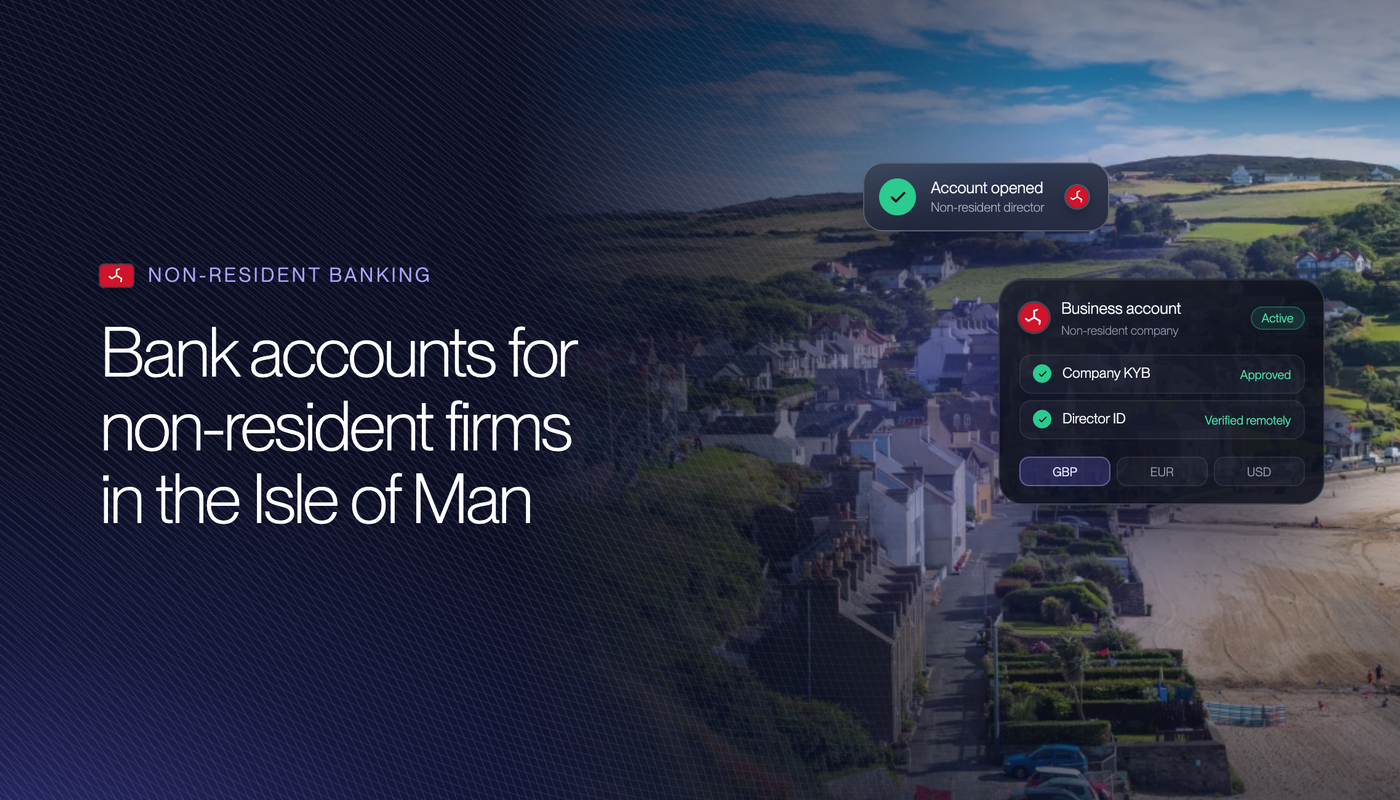
An Isle of Man bank account for non-resident companies gives you a sterling base on a self-governing island where most companies pay 0% tax and no tax is withheld on dividends. Island company law is open to owners abroad: a 2006 Act company can run with one director who lives anywhere.
The banks are the hard part. NatWest International wants every owner, director and shareholder to live in the Channel Islands, the Isle of Man or Gibraltar. Lloyds serves businesses registered and operating in the islands, and its charges allow an enhanced due diligence fee of up to £10,000 a year per entity.
This is where we come in. Our licensed banking partners open multi-currency accounts for companies owned from abroad in days, fully online, with no minimum balance. We handle the work: the KYC file, the source of wealth evidence, the certified copies and the introduction. Need the company too? We form it. One team, and we get it done.
Our top-rated, licensed banking providers open accounts for Isle of Man companies with owners abroad in days, with no island address and no branch visit.

Equals Money
Business Bank Account
Time to onboard
2 Days
Account opening fee
Free
Monthly fee
€30

3S Money
Cross-border payments
Time to onboard
4 Days
Account opening fee
Free
Monthly fee
Starting from € 100
Why Isle of Man Bank Accounts Are Hard for Non-Residents
Isle of Man law lets a company be owned and run entirely from abroad, but the island's banks set their own rules, and those rules favour people who live in the islands. For a company with owners abroad, the local route means residency tests, an island link, deeper checks on wealth and extra fees. Each of these has a fix.
Island Banks Serve People Who Live in the Islands
Under the Companies Act 2006, an Isle of Man company needs only one director, a corporate body can hold that seat, and there is no rule on where the owners live. The banks are stricter than the law. NatWest International, which now takes the new business customers that Isle of Man Bank sends on, asks that every owner, director and shareholder lives in the Channel Islands, the Isle of Man or Gibraltar. Isle of Man Bank itself opens business current accounts only for existing customers adding another entity. A founder in Dubai, Lagos or Toronto fails both tests before anyone reads a single document. At an island bank, owners abroad are judged first on where they live, not on what the company does.
The Bank Wants a Real Island Link
Residency is not the only test. Isle of Man Bank and NatWest International also want an Isle of Man registered address or tax registration, and a single layer of ownership with no nominee shareholders. Lloyds offers its Island Business Banking account to businesses registered and operating in Jersey, Guernsey or the Isle of Man, with turnover up to £25 million. HSBC writes its business price list for customers in the Channel Islands and the Isle of Man. A company registered in Douglas but managed, sold and paid entirely abroad sits outside each of these groups.
A foreign company with no island registration is further away still. The banks build their business accounts around island entities, so a UK, UAE or Singapore company usually does not fit any standard account. Groups with a holding company on top face their own version of this problem, covered in our guide to bank accounts for Isle of Man holding companies.
Open a Business Bank Account in the Isle of Man
Living abroad does not stop your Isle of Man company from banking. This is what we handle for you.
- No island residency test: Our partners accept owners and directors who live abroad.
- KYC file built for you: We list what to send and check every page before submission.
- Source of wealth made clear: We turn your history into the evidence a reviewer expects.
- Online from start to finish: No trip to Douglas and no branch appointment.
- Multi-currency from day one: Sterling, euros, dollars and more in one account.
- No idle minimum: Your working capital stays in the business.
Deeper Checks on Owners Abroad
Every bank on the island applies Isle of Man anti-money laundering rules, and a file with owners abroad gets the closer look. The bank verifies each director, owner and signatory, maps the ownership through every layer to the beneficial owners, and asks where the company's money will come from. For owners abroad it also wants source of wealth: how the main owners built the money behind the business, shown with sale contracts, dividend statements or tax returns. A clear, documented story passes. A gap, an unexplained transfer or a name spelled two ways stops the review.
The Enhanced Due Diligence Fee
Some banks charge for that extra work. Lloyds' guide to bank charges, effective from 19 June 2026, allows an enhanced due diligence fee of up to £10,000 a year per legal entity. Layered ownership, owners in higher-risk countries and links to politically exposed persons are the usual reasons a file goes into enhanced checks. The fee is a yearly charge, and paying it does not shorten the review. Our partners publish no such charge, which is one reason the partner route costs less for a structure owned from abroad.
Sectors the Island Banks Decline
High street banks on the island also screen by activity. Isle of Man Bank and NatWest International limit cash takings to 20% of turnover. Crypto, online gaming, e-money and money services firms often find the high street banks closed to them, even though the island licenses many of these businesses itself. They need specialist banking, set out in our guide to banking for Isle of Man gaming and e-money companies.
A Refusal Follows the File
A decline can make the next application harder. Application forms often ask whether the company or its owners have been refused elsewhere, and a bank that sees an earlier refusal reads the next file more carefully. Sending the same papers to three banks in a row can cost months, and the company has no way to get paid in the meantime. Choose the route that fits your profile before you apply.
What to Do After a Refusal
Find the rule you missed first. If it was residency or the island link, the answer will not change until your structure does, so stop applying to the same group of banks. If it was a gap in the file, fix it before the next application. Founders abroad usually get the fastest result from a partner account, so the company can trade while they decide whether a local bank is worth another try.
Read more: why banks reject business account applications and our guide to a business bank account for non-residents.
Which Isle of Man Banks Take Non-Resident Companies
Few of them do on their standard accounts. Everyday business banking on the island is run mainly by the local arms of large UK groups, and each one sets a residency, trading or customer test that a company owned from abroad rarely meets. These banks are slow to onboard, costly on every cross-border payment and quick to refuse a file that does not fit.
Bank | Who it takes | What blocks owners abroad | Monthly fee |
|---|---|---|---|
Isle of Man Bank | Existing business customers adding another entity | New customers are sent to NatWest International | £12.50, plus £0.35 per automated payment |
NatWest International | Island businesses whose owners, directors and shareholders all live in the Channel Islands, the Isle of Man or Gibraltar | Owners abroad, nominee shareholders, more than one layer of ownership | £12.50 |
Lloyds (Island Business Banking) | Businesses registered and operating in the islands, turnover up to £25m | A company managed and traded from abroad | £8.50, first 100 electronic payments free |
HSBC | Small Business and Business customers in the Channel Islands and the Isle of Man | Companies outside its island customer base | £8 to £10 |
Conister Bank | Companies, partnerships, trusts and charities with £5,000 or more to save | Any company that needs a current account to trade | No current account, savings only |
Read the third column first. Every standard tariff on the island is built for a business with people or trade in the islands, so an Isle of Man business account for non-residents is rarely on offer at the high street. The cheapest fees, HSBC at £8 and Lloyds at £8.50, go to island traders. Conister Bank, part of Manx Financial Group, is a home for reserves rather than a trading account, as our guide to business savings accounts in the Isle of Man explains. For a bank by bank view, see the best banks for Isle of Man companies.
Fees on Every Payment Across a Border
A company owned from abroad pays most of its bills across borders, and that is where island tariffs are highest. Isle of Man Bank's business charges leaflet, correct as of January 2025, sets £15 for an electronic SWIFT payment, £25 for a manual one and £10 more if the recipient must receive the full amount. It takes £7 from each incoming currency payment unless the sender pays all charges. HSBC charges £17 for an international payment sent online and £40 by post. Lloyds charges 25p per £100 sent abroad, with a minimum of £13 and a maximum of £40.
Wide Currency Margins
Island banks do not print the margin they add when they convert currency, and a spread of 1% to 3% over the interbank rate is common in the market. A company that bills in euros or dollars and reports in sterling pays that margin on almost every invoice. Holding the currency instead costs extra: HSBC charges £96, £120 or £180 a year for each international business account.
Relationship Pricing for Complex Files
Standard island tariffs carry no minimum balance, but they are not the tariffs a structure owned from abroad ends up on. HSBC prices its corporate account, for turnover above £40 million, by agreement. The island's private and international banks that do take international structures usually work through a licensed corporate service provider and price each client as a relationship. The real cost of the local route is often clear only after the account opens.
Slow Onboarding Across Time Zones
No island bank publishes an opening time. For an owner abroad, every request for a certified copy, a signed form or an extra statement means a notary, a courier or a time difference, and each round adds days. Several weeks is common for a new customer, and a layered or nominee structure can wait longer, if it is eligible at all. Our wider guide to business bank accounts in the Isle of Man covers the island market for resident owners.
Read more: Isle of Man Bank, Lloyds International and Conister business accounts and the Isle of Man offshore banking guide.
Equals Money
Business Bank Account
Time to onboard
2 Days
Account opening fee
Free
Monthly fee
€30
A Faster and Cheaper Way to Open an Isle of Man Business Account
The better route for most companies owned from abroad is to open an Isle of Man business account with one of our regulated partners. They are built for international companies, they do not require anyone to live on the island, and they open accounts in days, fully online, with no minimum balance.
The account covers what a trading company needs: it receives customer payments, pays suppliers and staff, and holds sterling, euros, dollars and other currencies in one place. Published plans run at about €30 to €100 a month, international payments cost a fraction of island SWIFT fees, and the conversion rate is shown before you confirm. It suits Isle of Man companies with owners or directors abroad, holding and trading companies with real activity, and businesses that invoice in more than one currency.
It works in three steps. We check that the company, its owners and its activity fit the partner's criteria. We build the KYC file with you, including the source of wealth evidence and the certified copies, and submit it once. The partner then runs its own checks, usually within 2 to 4 days of a complete file.
Feature | Isle of Man banks | Our partners |
|---|---|---|
Time to open | Several weeks for a new customer | Usually 2 to 4 days from a complete file |
Owners and directors abroad | Usually declined on standard accounts | Accepted |
Island link needed | Island residency, registered address or island trading | Not required |
Minimum balance | None on standard tariffs, relationship based elsewhere | None |
Monthly cost | £8 to £12.50 a month on standard tariffs | About €30 to €100 a month |
Currencies | Sterling, other currencies at extra cost | Sterling, euros, dollars and more in one account |
International payments out | £13 to £40 each | €5 to €25 each |
FX margin | 1% to 3%, not printed on tariffs | 0.25% to 1.0%, shown before you confirm |
Enhanced due diligence fee | Up to £10,000 a year at Lloyds | None published |
The island banks are cheaper only on the monthly fee. Every other row favours the partner route for a company run from abroad, and the gap grows with each payment that crosses a border.
Opening a Business Account in the Isle of Man From Abroad
With a partner, the whole process is fully remote. Identity checks run online, documents are uploaded rather than posted, and signatories approve payments from wherever they live. If one of your owners does live in the islands and the company trades there, you can run a local bank application in parallel while the partner account keeps the company trading. Our guide on how to open a business bank account remotely covers the process in more depth.
How Client Money Is Safeguarded
Our partners are regulated payment firms, not banks, and they do not lend out client money. They safeguard it, which means customer funds are kept apart from the firm's own money, usually in segregated accounts at major banks. Read what an EMI account is for how this works, and our comparison of a business bank account and an EMI account for the trade-offs. For a company that trades in several currencies, our partners' multi-currency business accounts in the Isle of Man are usually a better fit than a set of single-currency bank accounts.
Equals Money
Business Bank Account
Time to onboard
2 Days
Account opening fee
Free
Monthly fee
€30
3S Money
Cross-border payments
Time to onboard
4 Days
Account opening fee
Free
Monthly fee
Starting from € 100
Documents Needed for an Isle of Man Business Account for Non-Residents
Island banks and our partners ask for the same three groups of papers for an Isle of Man business bank account: the company's documents, identity and address evidence for each person, and proof of where the money comes from. Owners abroad add one more task. They have to get copies certified and translated where they live, in a form the reviewer accepts.
Company Documents
Expect the certificate of incorporation, the memorandum and articles, a recent certificate of good standing, the registers of directors and members, an ownership chart that reaches every beneficial owner and a board resolution that opens the account and names the signatories. A 2006 Act company adds the details of its licensed registered agent. If another company holds the shares, the same set is needed for that company too, and for a foreign parent those papers come from its own registry.
Documents for Each Owner Living Abroad
Each director, owner and signatory gives a valid passport, a proof of address dated within the last three months and a tax residence self-certification for CRS and FATCA. Some reviewers also ask for a short CV. Make sure the address on the proof matches the country you declare for tax. An owner who lives in one country but files tax in another should explain why in a short note, before the reviewer asks.
Source of Wealth for Owners Abroad
This is the part of a non-resident file that most often decides the outcome. The reviewer wants to see how the main owners built the money behind the business, whether from a business sale, salary, dividends, an inheritance or investments. Back it with documents such as sale agreements, payslips, dividend vouchers, tax returns or bank statements. Add source of funds for the company itself: where its first deposit and its expected income will come from.
Certification and Translation From Abroad
Copies for people the reviewer does not meet are usually certified by a lawyer, notary or accountant, who confirms the copy is true and the photo matches the person. Documents in another language need a certified English translation. Start this early. A certifier abroad may not know what an island reviewer expects, and a copy certified in the wrong form sends the file back to the start.
Read more: Isle of Man bank account requirements and our checklist of documents needed to open a business bank account.
Prepare Your Isle of Man Bank Account File
A complete file is what gets an account opened quickly. We build it with you, wherever you live.
- Checklist sent first: A document list matched to your company, owners and sector.
- Certification guidance: We tell you who can certify and in what form.
- Ownership chart drawn up: Every layer traced to the people at the top.
- Gaps closed early: Fixed before submission, not across three rounds of bank questions.
- Translations checked: Certified English versions wherever the original is not in English.
- Single point of contact: One person runs your file from start to finish.
- Partner review in days: Usually 2 to 4 days once the file is complete.
Isle of Man Bank Account Costs for Non-Resident Companies
A company owned from abroad pays more for an Isle of Man business bank account at an island bank than the monthly fee suggests. Island tariffs start at about £8 a month, but cross-border payments, currency conversion, extra currency accounts and enhanced checks make up most of the bill. Our partners' published plans run at about €30 to €100 a month, with far lower payment and FX costs.
Charge | Typical range at an Isle of Man bank | With our partners |
|---|---|---|
Account opening | No fee for eligible island businesses, relationship based on complex files | Free or a low one-off fee |
Monthly account fee | £8 to £12.50 a month on standard island tariffs | €30 to €100 a month on a published plan |
Minimum balance | None on standard tariffs, relationship based at private banks | None |
International online banking | £6 a month per customer | Included on the plan |
Extra currency accounts | £96 to £180 a year per account | Included in one multi-currency account |
Local payments in | Free to £0.35 each | Free on most plans |
Local payments out | Free to £1 each | €0.20 to €4 per payment |
Same-day sterling (CHAPS) | £25 to £30 per payment | Sent as a local payment, priced as above |
International payments in | £6 to £7 per currency payment | €5 or less per payment |
International payments out | £13 to £40 per payment | €5 to €25 per payment |
FX margin | 1.0% to 3.0% over the interbank rate | 0.25% to 1.0% over the interbank rate |
Cash deposits | £0.95 per £100 up to 1.5% plus £1.50 per credit | Not a cash product |
Bank reports and references | £14.98 to £25 or more per request | Statements and confirmations online |
Enhanced due diligence | Up to £10,000 a year per entity at Lloyds | None published |
The local column comes from published island tariffs: Isle of Man Bank's business charges leaflet, HSBC's business price list of 30 September 2026 and Lloyds' charges guides effective from 19 June 2026. The FX line is a market range, because island banks do not print their margin. The partner column comes from our partners' published plans. Treat both columns as planning ranges. The final price on either route is confirmed in writing before the account opens.
The big costs sit outside the monthly fee. A company that converts £400,000 a year at a 1% to 3% bank margin pays £4,000 to £12,000 for currency alone, against £1,000 to £4,000 at 0.25% to 1.0%. Twelve SWIFT payments a month at £15 add £2,160 a year at Isle of Man Bank, before the £10 charge for sending the full amount. Add an enhanced due diligence fee of up to £10,000 a year and the gap gets wider still for a non-resident file.
To be fair to the banks, Lloyds at £8.50 a month with 100 electronic payments included beats our partners on the monthly fee, and a small island business paying local suppliers in sterling may spend very little there. Those accounts are built for island traders, though. Once the owners live abroad and money crosses borders, the partner route costs less.
Read more: our guide to business bank account fees and how much an Isle of Man company costs.
Equals Money
Business Bank Account
Time to onboard
2 Days
Account opening fee
Free
Monthly fee
€30
3S Money
Cross-border payments
Time to onboard
4 Days
Account opening fee
Free
Monthly fee
Starting from € 100
How Long an Isle of Man Bank Account Takes From Abroad
No island bank publishes an opening time for an Isle of Man business bank account, and a new customer with owners abroad usually waits several weeks, if the bank takes the file at all. Our partners usually open within 2 to 4 days of a complete file. The difference comes from eligibility, certification and how many rounds of questions the file needs.
Stage | Isle of Man bank | Our partners |
|---|---|---|
Checking eligibility | Residency, island link and ownership tests before you apply | Same day, with our help |
Preparing and certifying the file | 1 to 2 weeks, longer when certified abroad | 1 to 3 days, with our help |
Review and follow-up questions | 2 to 6 weeks, often longer | Within the onboarding window |
Account open and ready to use | Several weeks in total | Usually 2 to 4 days |
For an owner abroad, the second row is where most of the time goes. A file that is certified correctly the first time moves at the speed of the review. One that is not loses a week or more on every correction.
What Slows a Non-Resident File
Delays usually come from copies certified in the wrong form, a proof of address older than three months, ownership through trusts or nominees, a thin source of wealth story and time zones that turn each question into a two-day exchange. A file that fails a residency test does not move at all, however long you wait.
How to Speed It Up
Send one complete file, certified the right way, and answer follow-up questions the same day. If the company needs to receive money now, open a partner account first so trading never waits for a bank. A bank that reviews the company later then sees an active, well-run business.
3S Money
Cross-border payments
Time to onboard
4 Days
Account opening fee
Free
Monthly fee
Starting from € 100
What Happens After the Account Is Open
Approval starts an ongoing relationship. Banks and partners review customers over time, report accounts under international tax rules and expect to hear about changes. For a company owned from abroad, keeping the company itself in good standing on the island matters just as much as the account.
Periodic Reviews
Expect a file refresh every few years, sooner for higher-risk profiles: updated passports, proofs of address, recent accounts and a current ownership chart. Owners abroad should keep certified copies current, so a review does not restart the certification process from scratch.
Report Changes Before They Happen
Tell the account provider before you add an owner or director, start a new activity or change the size of your payments. On the company side, the legal owners must give details of an ownership change to the company's nominated officer within 21 days, and the officer then has 21 days to update the island's database. The nominated officer must be an island resident or a licensed corporate service provider, which is one more reason owners abroad rely on a local agent.
Deposit Protection for Companies
The Isle of Man Depositors' Compensation Scheme covers companies up to £20,000 per entity per covered bank, against £50,000 for individuals. The Financial Services Authority kept the company limit at £20,000 in its March 2024 consultation response. Client accounts, other banks and connected parties are excluded. That limit is small next to most company balances, so spread large reserves across more than one institution.
Keeping the Company in Good Standing
A 2006 Act company must keep a licensed registered agent, file its £380 annual return within one month of its made-up date and keep its beneficial ownership details current. A company that falls far enough behind can be struck off, and a struck-off company cannot keep its account. Our guide to Isle of Man company annual filing and compliance sets out the yearly calendar.
Why the Company Comes Before the Account
No bank or partner opens an Isle of Man bank account for a company that does not exist yet. The account file is built on the certificate of incorporation, the constitution, the registers and the ownership details, so the order is company first, account second.
We form standard Isle of Man companies from €1,499, usually within a week of a complete file, working with a licensed registered agent, and the agent and registered office are in place from day one. The KYC file we build for the company is the same one the account needs, so nothing is prepared twice. Owners abroad can read more in Isle of Man company formation for non-residents.
Read more: how to set up a company in the Isle of Man and setting up an Isle of Man company with a bank account.

Isle of Man Company Incorporation
Binderr
Corporate tax
0% for most activities
Time to incorporate
1 Week
Cost
Starting from €1,499
Common Isle of Man Bank Account Mistakes for Non-Residents
Most delays and refusals for owners abroad follow a few patterns. Each one costs time or money, and each one is easy to avoid with the right plan before you apply.
Applying Where You Cannot Qualify
Founders abroad often apply to the best-known island bank without reading its eligibility page. Where every owner, director and shareholder must live in the Channel Islands, the Isle of Man or Gibraltar, no document can fix the file. The cost is several weeks of waiting and a refusal that later forms may ask about. Read the rules first, and if the residency or island trading test rules you out, go straight to a partner account. If you want to open a business bank account in the Isle of Man quickly, start where you already qualify.
Treating Source of Wealth as a Formality
A one-line note saying the money came from savings is rarely enough. The reviewer sends questions back, each round adds days, and across time zones that can mean weeks. In the worst case the file is declined even though the owner has nothing to hide. Write a short, dated account of how the money was built and attach the evidence: sale agreements, dividend vouchers, tax returns or statements. A documented story usually passes on the first review.
Certifying Documents in the Wrong Form
A plain photocopy, a certifier who leaves out their name and profession, or a proof of address older than three months all send a file back. For an owner abroad, each correction means another notary appointment and often a courier, which can cost a week or more each time. Ask for the exact certification wording before anyone signs, and check every copy against the checklist before the file goes in.
Choosing on the Monthly Fee Alone
An £8.50 tariff looks cheaper than a €30 plan, and for an island trader paying local bills it is. For a company owned from abroad, the bill comes from the other lines. A 1% to 3% FX margin on £400,000 a year is £4,000 to £12,000, and twelve SWIFT payments a month at £15 add £2,160. Model a normal month of payments in every currency before you decide, then compare the totals.
Keeping Every Pound at One Bank
Island deposit protection covers a company up to £20,000 per covered bank. A company that keeps its whole balance at one institution carries all of that risk in one place. Separate operating money from reserves, and spread large balances across more than one provider. If you plan to set up more structures later, our guide on how to set up a company as a non-resident explains how owners abroad usually organise banking across a group.
Plan Your Isle of Man Business Account for Non-Residents
Not sure which route fits your Isle of Man business account? Tell us about the company, the owners and the money, and we will tell you what to expect.
- Honest first read: We tell you whether an island bank is worth trying for your profile.
- Structure reviewed: Holding companies, trusts and nominee layers checked up front.
- Company and account together: We can form the company and open the account as one job.
- Costs in writing: The partner's plan and our scope, set out before you start.
- Quick turnaround: Accounts usually open within 2 to 4 days of a complete file.
Bottom Line
Non-resident companies looking for an Isle of Man bank account face a clear gap between company law and bank policy. The law lets owners and directors live anywhere. The island's high street banks mostly want island residents, island trading or existing customers, and they charge heavily for cross-border payments, currency and enhanced checks, with an enhanced due diligence fee of up to £10,000 a year at Lloyds.
The faster and cheaper way is to open an Isle of Man business account with our regulated partners: usually 2 to 4 days from a complete file, fully online, no minimum balance and about €30 to €100 a month. Build the file properly once, with documented source of wealth and correctly certified copies, and the account is the easy part. If you need the company too, we form it from €1,499 and open the account with you.
Can a company with owners abroad get an Isle of Man non-resident bank account?
How to open a business bank account in the Isle of Man from abroad?
Which Isle of Man banks accept non-resident owners?
How much does a non-resident business bank account in the Isle of Man cost?
Do I need to live on the island to open an Isle of Man business account?
What documents do non-resident owners need for an Isle of Man bank account?
How long does an Isle of Man bank account take for a company owned from abroad?
What is the enhanced due diligence fee at Isle of Man banks?
How much of my company's money is protected in an Isle of Man bank?
Can a foreign company open a bank account in the Isle of Man?
Is an Isle of Man company tax resident if the owners live abroad?
Does an Isle of Man company need a resident director to open a bank account?
What happens if an Isle of Man bank refuses my company?
Sources
The figures in this article come from these official sources and published charge schedules, read in October 2026.
- Isle of Man Bank, Business, Corporate and Commercial Account Charges (IOM 30165, August 2025)
- Isle of Man Bank, Business bank account eligibility
- NatWest International, Business bank account eligibility
- NatWest International, Business, Corporate and Commercial Account Charges (NWI 25033, August 2025)
- Lloyds Bank, Island Business Banking account
- Lloyds Bank, Business Banking Charges Guide (OB693, from 19 June 2026)
- Lloyds Bank, Your guide to bank charges (OB535_LBCM, from 19 June 2026)
- HSBC, Business Price List for customers in the Channel Islands and Isle of Man (30 September 2026)
- Conister Bank, Corporate savings accounts
- Isle of Man Financial Services Authority, Depositors' Compensation Scheme
- Isle of Man Financial Services Authority, DCS consultation response CR24-01 (12 March 2024)
- Isle of Man Government, 2006 Act companies
- Isle of Man Government, 1931 Act companies
- Isle of Man Government, Beneficial ownership
- Isle of Man Government, File an annual return
- Isle of Man Government, Corporate tax rates
- Isle of Man Government, Withholding tax
- PwC Worldwide Tax Summaries, Isle of Man corporate residence (reviewed 24 September 2026)