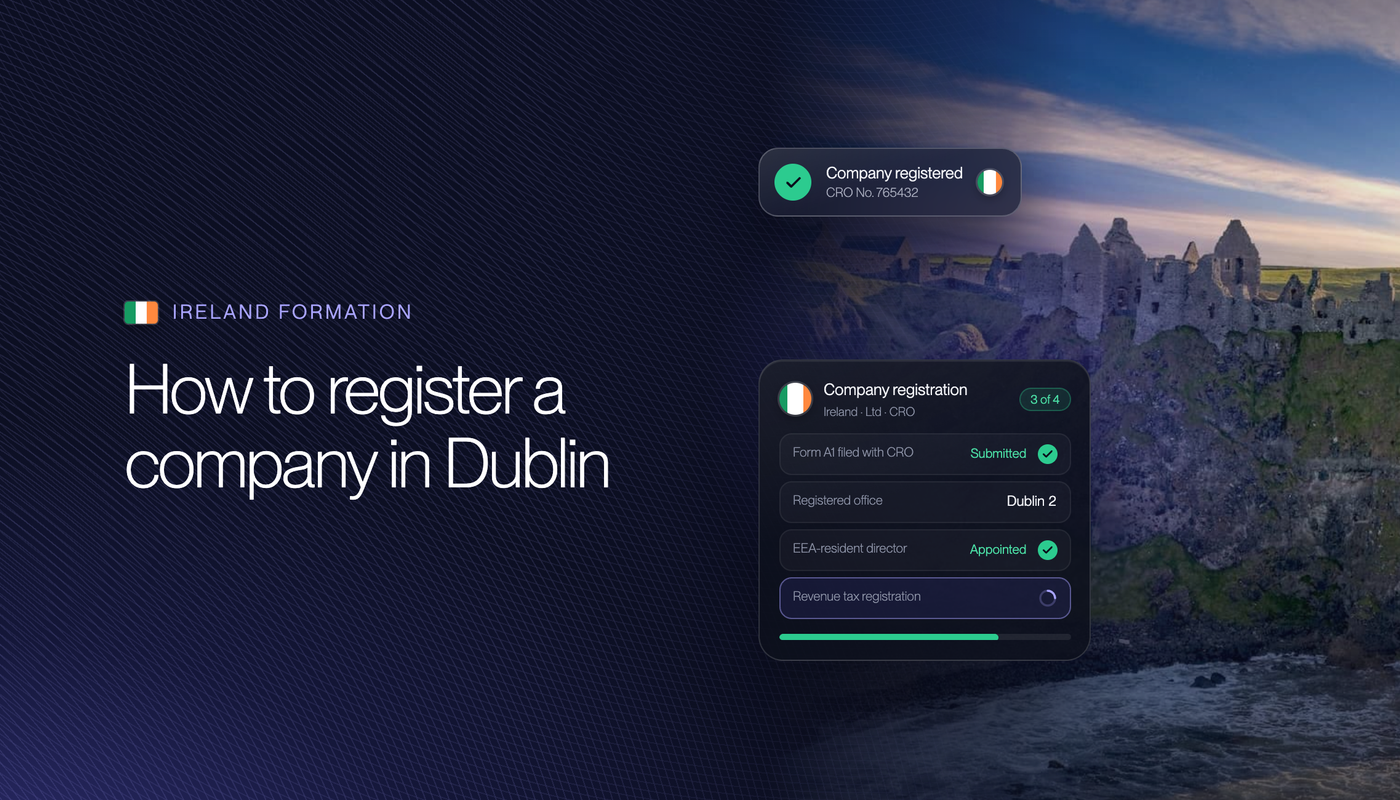
For company registration, Dublin is a strong choice for international founders. The Companies Registration Office is in the city, trading profits are taxed at 12.5%, and your company sits inside the EU with English as its working language. A private limited company needs one director and no minimum share capital.
The hard part is the detail around the filing. One director must live in the European Economic Area, or the company needs a €25,000 Section 137 bond. Every director needs a PPS number or a CRO identity number first. And a Dublin office brings its own costs, from rent to commercial rates.
This is where we come in. We form the company ourselves and run every step: the name, the constitution, the CRO filing, your Dublin registered office and secretary, the ownership register and the tax registration. One team, one clear price, and your company is ready in about a week.
Ireland Company Incorporation
Binderr
Corporate tax
12.5% trading / 25% non-trading income
Time to Incorporate
1 Week
Cost
€1,899
Why Set Up a Company in Dublin
Founders set up a company in Dublin for a 12.5% tax rate on trading profits, a base inside the EU single market and a large English-speaking workforce. The registry works online, international groups already run their EU operations from the city, and four Local Enterprise Offices fund new firms.
12.5% Tax on Trading Profits in Dublin
Revenue taxes trading income at 12.5% and non-trading income such as rent, interest and investment returns at 25%. A Dublin company that really sells goods or services pays the lower rate. The 15% global minimum tax only reaches groups with turnover of €750 million or more. A new company can also claim start-up relief for its first five years: full relief where the corporation tax due is €40,000 or less, and partial relief up to €60,000, limited to the employer PRSI it pays.
An EU Base for Tech and Finance Groups
Dublin holds the largest share of Ireland's international business. The Department of Enterprise's Annual Employment Survey 2025 counted 138,928 full-time jobs at foreign-owned client companies in the Dublin region, 45.3% of all such jobs in Ireland. Many groups enter the EU by forming a Dublin company as a subsidiary of their parent company.
Set Up a Company in Dublin
A Dublin company is very doable when every step happens in the right order. This is what you get with us.
- 12.5% on trading profit: The Irish rate for a Dublin company that really trades.
- 100% foreign ownership: Shareholders can be any nationality and live anywhere.
- Inside the EU market: Sell across the single market from a euro company.
- Online registry: The CRO aims to issue the certificate in 5 working days on its fast scheme.
- English-speaking staff: Hire from a large workforce used to international firms.
- From €1,899, about a week: We form your Dublin company with a complete file in about a week.
Fast Online Company Registration in Dublin
The CRO is based at Bloom House in Dublin 1, but you never need to visit. Its public office has been closed since 12 March 2020, and Form A1 is filed online only, through the CRO's CORE system. The CRO keeps one register for the whole State. In 2025 it registered 26,533 new companies, and over 95% of all documents reached it electronically.
A Large English-Speaking Workforce in Dublin
Census 2022 counted 1,458,154 people in County Dublin, and 698,931 of them were at work, up 14% on 2016. Non-Irish citizens made up 17% of the county's population. Business runs in English. IDA Ireland's client companies employed 312,468 people across Ireland at the end of 2025, so many candidates already have experience in international firms.
Grants for New Dublin Companies
Dublin has four Local Enterprise Offices, one for each council: Dublin City, Fingal, South Dublin and Dún Laoghaire-Rathdown. LEO Dublin City's Priming Grant covers 50% of the investment up to €50,000 for businesses in their first 18 months, if they create at least one full-time paid job and already have paying customers. Larger plans go to Enterprise Ireland, whose Pre-Seed Start Fund invests €50,000 or €100,000 in early-stage start-ups.
Read more: the benefits of setting up a company in Ireland.
Types of Companies You Can Register in Dublin
You can register a company in Dublin as one of four main types under the Companies Act 2014, or register a branch of a foreign company. Most founders use the private company limited by shares, or LTD, for Dublin company formation. A DAC, a CLG or a PLC fits a narrower purpose. The rules are the same as anywhere else in Ireland.
Private Company Limited by Shares (LTD)
The LTD is the default for trading and holding companies in Dublin. It needs one director, plus a separate company secretary when there is only one director. It can have between 1 and 149 members and has no minimum share capital, so 100 shares of €1 each is a common start. Its constitution has no objects clause, so the company can carry on any lawful business. It is the wrong choice for a charity or a company selling shares to the public. Our guide on how to set up a limited company in Ireland covers it in depth.
Designated Activity Company (DAC)
A DAC states its objects in its constitution and needs at least two directors. Joint ventures, special purpose vehicles and companies holding a single licence use it when a lender or regulator wants the purpose written down. Choose an LTD if you want one director and the freedom to change what the company does.
Company Limited by Guarantee (CLG)
A CLG has no share capital, and its members promise to pay a set amount if it is wound up. It needs at least two directors. Charities, clubs and membership bodies use it, but it cannot take investors or pay dividends, so it is wrong for a business run for profit.
Public Limited Company (PLC)
A PLC needs at least €25,000 of allotted share capital, with a quarter paid up before it trades, and at least two directors. It is built for raising money from the public. A new founder company almost never needs one.
Branch or Subsidiary of a Foreign Company
A foreign company can register a branch in Dublin with the CRO for €50 online, within 30 days of establishing it. A branch suits a foreign company testing the market, but it is not a separate legal person, so the parent carries its debts. Most groups choose a subsidiary instead, a normal Irish LTD owned by the parent, because banks and customers find a separate company easier to deal with.
Ireland Company Incorporation
Binderr
Corporate tax
12.5% trading / 25% non-trading income
Time to Incorporate
1 Week
Cost
€1,899
Dublin Company Formation for Non-Residents
Dublin company formation for non-residents is common and runs fully remotely. Shareholders can live anywhere and be any nationality, and one person can own every share. Two points need planning from abroad: the EEA director rule and the identity numbers. Tax residence needs a plan too, because it can depend on where the board takes its decisions.
The EEA Director Rule and the Section 137 Bond
Under section 137 of the Companies Act 2014, at least one director must live in a member state of the European Economic Area. A director in Lisbon or Berlin meets the rule as well as one in Dublin, but since Brexit a director in the UK does not. Without an EEA director, the company holds a bond worth €25,000 for at least two years. It is not refundable, and published broker prices for a two-year bond are about €2,000. We arrange it as part of the setup. The non-resident director rules for Irish companies set out the detail.
Identity Numbers for Directors Abroad
Every director named on Form A1 must give a PPS number. A director without one files Form VIF to get an Identified Person Number from the CRO. Since 30 April 2026, the CRO only accepts VIF forms witnessed in person, with the witness and the director in the same room, and a form signed outside Ireland goes before a notary public. We plan the witnessing and check the form before it goes in.
No Need to Travel to Dublin
You can set up a company in Dublin without visiting. Documents are certified in your own country, the constitution is signed there, and the CRO issues the certificate electronically. The registered office and company secretary come with our service, so the company has its Dublin address from day one.
Where Your Dublin Company Is Tax Resident
A company incorporated in Ireland is Irish tax resident unless a tax treaty says otherwise. Your home country may still claim it if the directors really decide things there, and its controlled foreign company rules can tax the profits early. Board meetings held in Dublin, with directors who take real decisions, keep the position clear.
Read more: how to set up a company as a non-resident.
Set Up a Dublin Company From Abroad
Owners abroad can set up a company in Dublin without travelling. We run every step remotely.
- No visit to Dublin: Documents certified at home and signed where you live.
- Any nationality welcome: Shareholders can live in any country and own every share.
- EEA rule covered: The €25,000 bond arranged where no director lives in the EEA.
- VIF done right: In-person witnessing planned, so the CRO accepts it first time.
- Dublin address ready: Registered office and company secretary in place at formation.
- Board planned early: We agree where decisions are made before anything is filed.
Industries That Use Dublin Companies
Company formation in Dublin is most common in four groups: technology and software, financial services and fintech, holding companies, and service businesses that sell across the EU. Each uses the same company law. Some need a licence or tax planning before they trade, so the sector shapes how we set up a company in Dublin for you.
Technology and Software
Software, SaaS and digital service companies often choose Dublin for its EU address, the 12.5% rate on trading profit and staff who already work for international groups. Ireland's R&D tax credit is 35% of qualifying spend, and the Knowledge Development Box taxes qualifying IP profits at an effective 10%. Our guide to tech and startup company formation in Ireland covers the sector.
Financial Services and Fintech
The Central Bank of Ireland is based in Dublin and authorises payment, e-money, insurance and fund firms. These companies need a licence before they trade, so we form the company with the licence application in mind. Read about fintech company formation in Ireland.
Holding Companies and Group Structures
Since 1 January 2025, an Irish company can receive foreign dividends free of Irish corporation tax under a participation exemption, if it holds at least 5% of the subsidiary for 12 months and the subsidiary is resident in the EU, the EEA or a treaty country. Ireland has 78 signed tax treaties. See Ireland holding company formation and how to set up a holding company.
Consulting, E-Commerce and Services
Consultancies, agencies and online sellers use a Dublin company to invoice EU customers in euro. An owner-managed service company should plan for the close company surcharge: 15% on half of its undistributed trading income, removed by a dividend paid within 18 months of the period end.
Ireland Company Incorporation
Binderr
Corporate tax
12.5% trading / 25% non-trading income
Time to Incorporate
1 Week
Cost
€1,899
How to Register a Company in Dublin
To register a company in Dublin, you choose the company type and name, appoint the officers, meet the EEA director rule, and file Form A1 and the constitution with the CRO online. Then you register the owners and the tax numbers. We run every step for you, and a complete file is usually registered in about a week.
Before You Start
Settle three points first. Check whether the business needs a licence before it trades, because a regulated activity changes the order of every step. Decide whether you need only a Dublin registered office or also a place to work, because a lease brings rent and commercial rates. Confirm where each director lives, because that decides the EEA rule and the identity numbers.
We Check and Reserve the Company Name
The CRO refuses a name that is the same as, or too like, one on the register, and words such as bank need approval. We check the register and reserve the name on CORE where a launch date depends on it. A reservation costs €25 for 28 days. See how an Irish company name availability check works.
We Appoint the Directors and the Secretary
Each director must be over 18 and sign a consent to act. Under section 129 of the Companies Act 2014, a sole director cannot also be the secretary, so we provide a corporate secretary at formation. We also get each director's PPS number or Identified Person Number in place before filing.
We Set Up Your Dublin Registered Office
The registered office must be a physical address in Ireland where CRO letters, Revenue notices and legal papers can be served, and a PO box is not accepted. It does not have to be in Dublin, but most founders who register a company in Dublin want one there. Ours is included at formation.
We Prepare the Constitution and Form A1
Form A1 carries the name, the registered office, the directors, the secretary and the shareholders. Every name, date of birth and address must match the identity documents exactly. A missing middle name is enough for the CRO to send the file back, so we check every page.
We File With the CRO Online
For company incorporation in Dublin, we submit Form A1 and the constitution through CORE. The CRO fee is €50, and it sits inside our price. Read how the Ireland company registration process works, or how to register a company in Ireland online.
We Handle the Filings After Registration
Once the certificate issues, we file the beneficial owners with the Register of Beneficial Ownership and register the company for tax with Revenue on Form TR2. One application covers corporation tax, VAT and employer PAYE. The account application goes in the same week, built from the same KYC pack.
Full-Service Company Registration in Dublin
Company registration in Dublin runs through one team with us. This is the work we take off your plate.
- Name cleared first: Checked against the register before any document is drafted.
- Secretary supplied: A sole director cannot also be the secretary, so we provide one.
- Filed on CORE: One complete file, so no rounds of CRO queries.
- Owners on the RBO: Beneficial owners filed well inside the five-month limit.
- Tax numbers opened: Corporation tax, VAT and PAYE registered with Revenue.
- Deadlines on our calendar: Revenue, RBO and annual return dates set at formation.
Documents Needed for Company Registration in Dublin
Company registration in Dublin needs few documents at the CRO itself: Form A1, the constitution and each officer's details. Most of the pack is for the identity checks we run before filing, and the bank repeats them later. A complete pack at the start is the biggest time saver.
For Every Director, Shareholder and Secretary
- Passport: A valid passport, copied and certified by a lawyer, notary or accountant.
- Proof of address: A utility bill or bank statement in your name from the last 3 months.
- PPS number or Form VIF: An Irish PPS number, or Form VIF witnessed in person.
- RBO identity number: A beneficial owner with no PPS number uses an Identified Person Number.
- Consent to act: Signed by every director and by the secretary.
- Source of funds: Proof of where the money for the shares and the setup comes from.
For the Company Itself
To incorporate a company in Dublin, we need the proposed name and a backup, the share structure and a plain description of the business: what it sells, to whom, in which countries and how money moves. That description goes into the tax registration and, almost word for word, into the bank application.
For a Parent Company or a Trust
If a company holds the shares, we need its certificate of incorporation, its constitution, its register of directors and an ownership chart up to the individuals at the top. A trust brings the trustees, settlor and beneficiaries into scope. Our guide to the ultimate beneficial owner explains how control is traced through each layer.
Certified Copies and Translations
Copies are certified by a professional who confirms the person matches the photo, and anything not in English or Irish needs a certified translation. Our page on Irish company formation requirements lists the rule behind each document.
Read more: documents needed to open a business bank account.
Cost of Company Registration in Dublin in 2026
Company registration in Dublin with us starts from €1,899, paid once, for a standard private company limited by shares, holding and trading companies included. It includes the structure advice, your KYC pack, the constitution, Form A1, the €50 CRO fee, the registered office and company secretary at formation, and the first beneficial ownership filing, all confirmed in writing before you pay. Trusts, foundations, funds, regulated and high-risk structures are quoted separately.
The cost of company registration in Dublin is paid once, but running the company is not. The table adds the first 12 months.
Cost item | When it is paid | Typical amount | What it covers |
|---|---|---|---|
Company incorporation with Binderr, all of the above included | Once, before filing | From €1,899 | Advice, KYC pack, constitution, Form A1, the CRO fee, office and secretary at formation |
CRO annual return, Form B1 | The first one is made up to 6 months after incorporation and filed within 56 days | €20 filed online | The yearly return that keeps the company on the register |
Registered office and company secretary renewal | Every year from the first anniversary | Quoted with your setup | The Irish address for notices, and the separate officer a sole director needs |
Bookkeeping, financial statements and the CT1 return | Every year, with the CT1 due by the 23rd day of the ninth month after the year end | About €1,200 to €3,000 for a simple company, as a planning range | The accounts and the corporation tax return |
Statutory audit | Only above the small company limits, or after audit exemption is lost | Quoted with your setup | An audit of the accounts filed with the annual return |
Section 137 bond | Once for two years, only if no director lives in the EEA | About €2,000 on published broker prices | The €25,000 bond that stands in for an EEA-resident director |
VAT and payroll returns | From the month you pass a threshold or hire | Usually inside the accounting fee for a small company | VAT returns and PAYE reporting on Revenue Online Service |
Business account with our banking partners | Monthly, once the account is open | About €30 to €100 a month on a published plan | A multi-currency account with real IBANs |
Realistic first-year total | Year one | About €3,500 to €7,500 for a simple Irish company, before any audit, bond or licence cost | Our price, the annual return, year-one accounting and an account |
The €50 CRO fee is already inside our price. The annual return costs €20 only when it is on time: from the first late day it costs €120, then €3 a day up to €1,200. Rent and commercial rates on a Dublin office sit outside this table.
First-Year Cost by Company Profile
Who owns the company and what it does moves the first-year cost more than anything else.
Company profile | Realistic first year | What drives the cost |
|---|---|---|
Simple LTD with a non-resident owner and an EEA director in place | About €4,000 to €7,500 | Identity work on owners abroad, plus a bought-in office and secretary |
Irish-resident startup run by its own director | About €3,500 to €6,000 | The director signs locally, so only the secretary and the accounts are bought in |
Holding company with no trading activity | About €3,500 to €6,500 | Light bookkeeping, plus advice on the participation exemption and treaties |
Trading company with real banking and VAT | About €5,000 to €9,000 | VAT returns, payroll and a multi-currency account all year |
Company with a non-EEA director and the Section 137 bond | About €5,500 to €9,500 | The two-year bond at about €2,000 on top |
Regulated or high-risk company | Quoted separately | Licence, capital, substance and specialist banking, priced case by case |
These are planning ranges, and your written quote is what counts. Read more: the cost of starting a company in Ireland and company formation costs by country.
Ireland Company Incorporation
Binderr
Corporate tax
12.5% trading / 25% non-trading income
Time to Incorporate
1 Week
Cost
€1,899
How Long Dublin Company Registration Takes
Dublin company registration takes about a week with a complete file. The CRO aims to issue the certificate within five working days on the Fé Phráinn scheme, or ten on the ordinary online scheme. The rest of the week goes on identity checks, the constitution and the signatures. Tax registration follows in the week the certificate issues, and our banking partners can open the account a few days later.
What Adds Days
Five things usually add time to company registration in Dublin: a director who needs an Identified Person Number, ownership through several companies or a trust, documents that need certified translation, a name that clashes with one on the register, and an activity that needs a licence first. A VIF form witnessed online is now rejected and must be signed again in person.
How We Keep It to About a Week
We send one document list on day 1 and check every page before filing. The name check, the VIF and the bond run at the same time, not one after another. A complete file is not sent back with queries, which keeps your Dublin company registration close to the five working day target. Our guide on how to set up a company in Ireland walks through all 12 steps.
Dublin Company Formation From €1,899
One starting price covers a standard Dublin company, and you see the first-year budget before you pay.
- From €1,899: Our starting price for a standard private limited company.
- CRO fee inside: The €50 filing, the constitution and Form A1 are included.
- Office and secretary at formation: Your Dublin address and secretary from day one.
- First-year budget: Plan on about €3,500 to €7,500 for a simple company.
- Quoted in writing: Scope and price confirmed before you pay anything.
- No late fees: The first annual return filed on time, so the €120 charge never starts.
Tax and Compliance After Company Registration in Dublin
After company registration in Dublin, the company follows the same national rules as every Irish company. It registers with Revenue, tells Revenue within 30 days that it has started trading, files its owners with the RBO within 5 months and files an annual return each year. Hiring adds payroll, pension and permit rules.
Corporation Tax and VAT
Trading profits are taxed at 12.5% and non-trading income at 25%, and the CT1 return and balance are due by the 23rd day of the ninth month after the period ends. A business established in Ireland registers for VAT once turnover passes €42,500 for services or €85,000 for goods in a calendar year. One not established in Ireland registers from its first taxable supply here. The standard rate is 23%. For a UK group, see Ireland vs UK corporation tax.
Tell Revenue When You Start Trading
Section 882 of the Taxes Consolidation Act 1997 gives every new company 30 days from the start of trading to send Revenue a statement of its particulars. Missing it can cost the company €4,000 and the secretary €3,000, and Revenue can ask the Registrar to begin striking the company off. We track that date from formation.
Beneficial Ownership and the Annual Return
The company files its beneficial owners, anyone who owns or controls more than 25%, with the RBO within 5 months of incorporation. The fine for failing to comply can reach €500,000 on conviction on indictment. The first annual return, Form B1, is made up to the date 6 months after incorporation and filed within 56 days, with no accounts attached.
Hiring Staff for a Dublin Company
Register as an employer with Revenue before the first payday, a director's salary included. The national minimum wage is €14.15 an hour in 2026, and Budget 2027 raises it to €14.94 from 1 January 2027. Since 1 January 2026, staff aged 23 to 60 who earn €20,000 or more and have no pension through payroll are auto-enrolled, with the employer paying 1.5% of salary in years 1 to 3. A non-EEA hire needs an employment permit: since 1 March 2026 the minimum salary is €36,605 for a General Employment Permit and €40,904 for a Critical Skills Employment Permit. Plan these costs into your cash flow before the first hire.
Ireland Company Incorporation
Binderr
Corporate tax
12.5% trading / 25% non-trading income
Time to Incorporate
1 Week
Cost
€1,899
Dublin Office, Virtual Office and Commercial Rates
After Dublin company formation, most companies start with a registered office address and no premises. Ours is included at formation, and the renewal is quoted with your setup. A desk or a lease comes later, when you hire. Once the company occupies a commercial property, the council charges commercial rates every year.
Registered Office or Virtual Office
A registered office is the company's legal address for official post. A virtual office adds mail handling and sometimes a phone line or meeting rooms. Rates fall on the occupier of a commercial property, so an address service alone does not make your company the ratepayer. Our page on company formation services in Ireland explains what the office and secretary services include.
Coworking and Leased Offices in Dublin
Coworking desks and serviced offices suit a small team on a short contract. A lease is a bigger step. CBRE's Dublin office report for Q2 2026 put prime headline rent at €67.50 per square foot a year, up from €65.00, and its Q3 update of 13 October 2026 reported prime rents holding. Prime means the best buildings in the best locations, so most space rents for less.
Commercial Rates Across the Four Dublin Councils
Rates are the property's rateable valuation, set by Tailte Éireann, multiplied by the council's annual rate on valuation (ARV). Each of Dublin's four councils sets its own ARV. These are the 2026 figures in Tailte Éireann's published list.
Council | 2026 ARV | Rates on a €10,000 valuation | Example areas |
|---|---|---|---|
Dublin City Council | 0.2890 | €2,890 | City centre and Docklands |
South Dublin County Council | 0.2800 | €2,800 | Tallaght, Clondalkin and Lucan |
Dún Laoghaire-Rathdown County Council | 0.2140 | €2,140 | Dún Laoghaire, Dundrum and Sandyford |
Fingal County Council | 0.1868 | €1,868 | Swords, Blanchardstown and Dublin Airport |
The same valuation costs about 35% less in Fingal than in Dublin City, so the council can matter as much as the rent. Dublin City Council's 2026 rates were due in full on 1 January 2026, with payment plans agreed with your rate collector. When you take or leave a property, the law gives you 10 working days to tell the council.
Business Banking for Dublin Companies
A Dublin company holds euro from day one, which makes banking simpler than for a company outside the EU. The account still needs planning alongside company registration in Dublin. Dublin's high street banks review new companies carefully and want to see the directors in person, while our banking partners open multi-currency accounts in days, fully remotely.
Dublin's High Street Banks
AIB, Bank of Ireland and PTSB are the three high street banks for everyday business banking. AIB's online route is for companies registered and trading in Ireland. For a company, AIB emails next steps within five business days, the directors who sign prove their identity in a branch, and a final check can take up to 10 business days. Its schedule effective 1 July 2026 charges €4.50 a quarter and 1.75% on foreign currency card purchases. Refusals are rarely explained, so the file has to be right first time. See business bank accounts in Ireland for new companies.
Faster Accounts Through Our Banking Partners
We work with regulated payment partners that open multi-currency business accounts for Dublin companies in days, remotely, with no minimum balance. They are payment and e-money institutions, not banks, and they safeguard client money rather than lend it out. We prepare the file from the same KYC pack as your company and make the introduction. Read what an EMI account is, or see business bank accounts in Ireland for non-residents.
Factor | Dublin high street banks | Our banking partners |
|---|---|---|
Time to open | Next steps within 5 business days at AIB, then a branch check and a final review of up to 10 business days | Usually 2 to 4 days from a complete file |
Identity check | In a branch for the directors who sign | Online, from anywhere |
Account fee | AIB: €4.50 a quarter | About €30 to €100 a month on a published plan |
Currencies | A separate account for each currency | Several currencies in one account, with real IBANs |
Foreign card spending | AIB: 1.75% on non-euro purchases | FX about 0.25% to 1.0% over the interbank rate |
On the fee alone, a Dublin bank is cheaper. The partner route wins once money crosses a border or the company needs its account this month. Some companies use both: a local account for euro and a multi-currency business account for the rest.

Equals Money
Business Bank Account
Time to onboard
2 Days
Account opening fee
Free
Monthly fee
€30

3S Money
Cross-border payments
Time to onboard
4 Days
Account opening fee
Free
Monthly fee
Starting from € 100
Dublin vs London, Cyprus and Malta
Founders who look at Dublin usually weigh it against London for a fast, low-cost company, and against Cyprus or Malta for an EU holding base. All four are formed in about a week with us. The choice turns on EU access, the tax on your type of income and the price.
Factor | Dublin (Ireland) | London (UK) | Cyprus | Malta |
|---|---|---|---|---|
Company tax | 12.5% trading, 25% non-trading | 19% small profits rate, 25% main rate | 15% flat from 2026 | 35% headline, about 5% effective after the 6/7ths refund |
VAT | 23% | 20% | 19% | 18% |
EU member | Yes | No | Yes | Yes |
Known for | EU trading, tech and holding companies | Fast, low-cost formation and a company form banks know | EU holding companies with a wide treaty network | Holding structures and the shareholder refund |
Our price | From €1,899 | From €350, including the £100 Companies House fee | From €1,200 | From €1,299 |
Time with us | About 1 week | About 1 week | About 1 week | About 1 week |
Dublin costs the most of the four to start, and it gives the clearest low rate for a company that really trades inside the EU. London is cheaper but sits outside the EU. Cyprus and Malta suit holding structures more than operating companies with staff.
Dublin vs London
A London company is a UK company, formed through Companies House from €350 with us, with no director residency rule. It trades with the EU as a third country, so EU customers and contracts often push founders to Dublin. Choose London on cost and the UK market, and Dublin when the company must sit inside the EU. See company formation in London or our UK company registration guide.

UK Company Incorporation
Binderr
Corporate tax
19% (small profits) / 25% (main rate)
Time to Incorporate
1 Week
Cost
€350 (no pre-payment)
Dublin vs Cyprus
Cyprus moved to a 15% flat rate in 2026, above Ireland's 12.5% trading rate but below its 25% rate on passive income. A company that earns mostly dividends, interest or royalties often fits Cyprus better, while a company with staff and customers fits Dublin. Read about holding company formation in Cyprus.

Cyprus Company Incorporation
Binderr
Corporate tax
15% flat
Time to Incorporate
1 Week
Cost
€1,200 one-off
Dublin vs Malta
Malta charges 35% on company profits, then refunds six sevenths of the tax to shareholders after a dividend, which brings the effective rate to about 5%. The low rate only arrives once profits are paid out, so Malta suits holding structures, while Dublin suits an operating company with a team. See our guide to Malta company formation.

Malta Company Incorporation
GCS Malta
Effective tax
~5% for non-resident
Time to Incorporate
1 Week
Cost
Starting from €1,299
Who a Dublin Company Is Wrong For
Company formation in Dublin is the wrong choice for a dormant company, for a founder outside the EEA who will neither appoint an EEA director nor buy the bond, for a business with only passive income, and for a regulated business that has not settled its licence. In each case, another structure or another order of steps saves money.
A dormant Dublin company still needs a registered office, a secretary, an annual return and a tax return every year. Passive income such as rent and interest is taxed at 25%, not 12.5%, and undistributed investment income in an owner-managed company can attract a further 20% surcharge. If the lowest headline rate is the main goal, look at the lowest corporate tax rates in Europe first.
A payments, lending, insurance or fund business needs Central Bank of Ireland authorisation before it trades, so map the licence route before you incorporate a company in Dublin. And if you only need an EU address with no team, skip the lease: a registered office keeps rent and rates off your costs.
Common Mistakes When Setting Up a Company in Dublin
Most problems in Dublin company formation come from small choices at the start, not from the law: an identity form witnessed the wrong way, a missed Revenue date, a lease signed without checking the rates or a late first return. These are the mistakes we see most often, and each one is easy to avoid.
Getting Form VIF Witnessed Online
Some directors abroad still expect to sign Form VIF on a video link. Since 30 April 2026, the CRO rejects any VIF form witnessed online, and Form A1 cannot go in until every director has an Identified Person Number. One rejected form puts the whole company on hold while the director signs again in person. Plan the witnessing first: arrange a notary appointment for each director abroad at the start, and send us the form to check before it goes to the CRO. Use the current version of the form too, because the CRO rejects older versions.
Missing the 30-Day Revenue Statement
Founders focus on the CRO and forget Revenue. Section 882 gives a new company 30 days from the start of trading to send Revenue its particulars. Missing it can cost €4,000 for the company and €3,000 for the secretary, and it can lead to strike-off. The statement is made on Revenue's Form 11F CRO. Put the date in the calendar on the day you sign your first customer, or let us track it from formation.
Signing a Dublin Lease Before Checking the Rates
A founder picks an office on rent alone and meets the rates bill in January. On the same €10,000 rateable valuation, rates in 2026 are €2,890 in Dublin City and €1,868 in Fingal. The occupier must also tell the council within 10 working days of moving in, or face a fine. Check the rateable valuation with Tailte Éireann and the council's ARV before you sign. The same valuation costs about 26% less in Dún Laoghaire-Rathdown and about 35% less in Fingal than in Dublin City.
Filing the First Annual Return Late
The first annual return needs no accounts, so new companies forget it. It is made up to the date 6 months after incorporation and due within 56 days. Late, it costs €120 from the first day, then €3 a day up to €1,200, and a company that files late more than once in five years loses audit exemption for two years. These late fees are not tax deductible either. Set the date at formation, or leave it on our calendar.
Company Formation in Dublin for Complex Setups
Some Dublin setups need planning before any form is filed. Tell us what you need and we get back to you with a plan.
- Licence needed first: Payments, funds, insurance or lending, with the Central Bank route mapped.
- Holding chains and trusts: Several layers, or a trust above the company, documented once.
- Non-EEA directors: The bond and the section 140 route costed side by side.
- Group restructures: EU contracts or IP moved into a Dublin company properly.
- Home-country tax checked: We check if your own country could also claim the company.
Bottom Line
Dublin gives a trading company a 12.5% rate, full access to the EU market, an online registry that aims to issue the certificate in five working days and a large English-speaking workforce. The law, the fees and the deadlines are the same as anywhere in Ireland. Dublin also brings local factors: four Local Enterprise Offices with start-up grants, prime office rents of €67.50 per square foot a year, and commercial rates that differ by council.
Four things need to be right when you register a company in Dublin: the EEA director position, an identity number for every director, a registered office that works and the Revenue and RBO deadlines in the first months. We handle all four through our Ireland company incorporation service, and Dublin company formation with us starts from €1,899, ready in about a week, with the first-year budget shown before you pay. For the national picture, start with our Ireland company formation guide.
Plan the first year as one budget: about €3,500 to €7,500 for a simple company, before any audit, bond or licence cost, plus rent and rates if you take premises. Choose the council area with the rates in mind, and keep the Revenue, RBO and annual return dates in one calendar from the day the certificate arrives.
How do I register a company in Dublin?
How much does company registration in Dublin cost?
How long does Dublin company registration take?
Can a non-resident set up a company in Dublin?
Can I incorporate a company in Dublin without an EEA director?
Do I need a Dublin address to register a company?
Where is the Companies Registration Office in Dublin?
How much are commercial rates in Dublin in 2026?
What grants can a new company in Dublin get?
Is company formation in Dublin different from the rest of Ireland?
What tax does a Dublin company pay?
Can a Dublin company open a bank account remotely?
What do I need to hire staff in Dublin?
Sources
- Companies Registration Office, Company fees (2026)
- Companies Registration Office, Company registration methods, Fé Phráinn and ordinary online A1 (2026)
- Companies Registration Office, Contact us and public office status (2026)
- Companies Registration Office, Annual Report 2025 (June 2026)
- Companies Registration Office, VIF form amendment and update (30 April 2026)
- Companies Registration Office, European Economic Area resident director, Leaflet 17
- Revenue, Tax relief for new start-up companies (2026)
- Revenue, VAT thresholds (6 May 2026)
- Tailte Éireann, Local Authority Annual Rates on Valuation in 2026 (February 2026)
- Dublin City Council, Commercial Property Rates and Annual Rate on Valuation 2026
- Local Enterprise Office Dublin City, Business Start Up Grant (Priming) (2026)
- Local Enterprise Office, What grants are available from the LEO (2026)
- Enterprise Ireland, Pre-Seed Start Fund (2026)
- Department of Enterprise, Tourism and Employment, Annual Employment Survey 2025 (February 2026)
- Department of Enterprise, Tourism and Employment, Roadmap for employment permit salary thresholds (2 December 2025)
- IDA Ireland, Annual Report 2025 (2026)
- Central Statistics Office, Census of Population 2022 Summary Results Dublin (30 May 2023)
- Citizens Information, Auto-enrolment (30 June 2026)
- Grant Thornton Ireland, Budget 2027 payroll summary (October 2026)
- CBRE, Dublin Office Market Q2 2026
- CBRE, Dublin Office Market Q3 2026 (13 October 2026)
- AIB, Business Fees and Charges (effective 1 July 2026)
- AIB, Centralised account opening FAQs (2026)