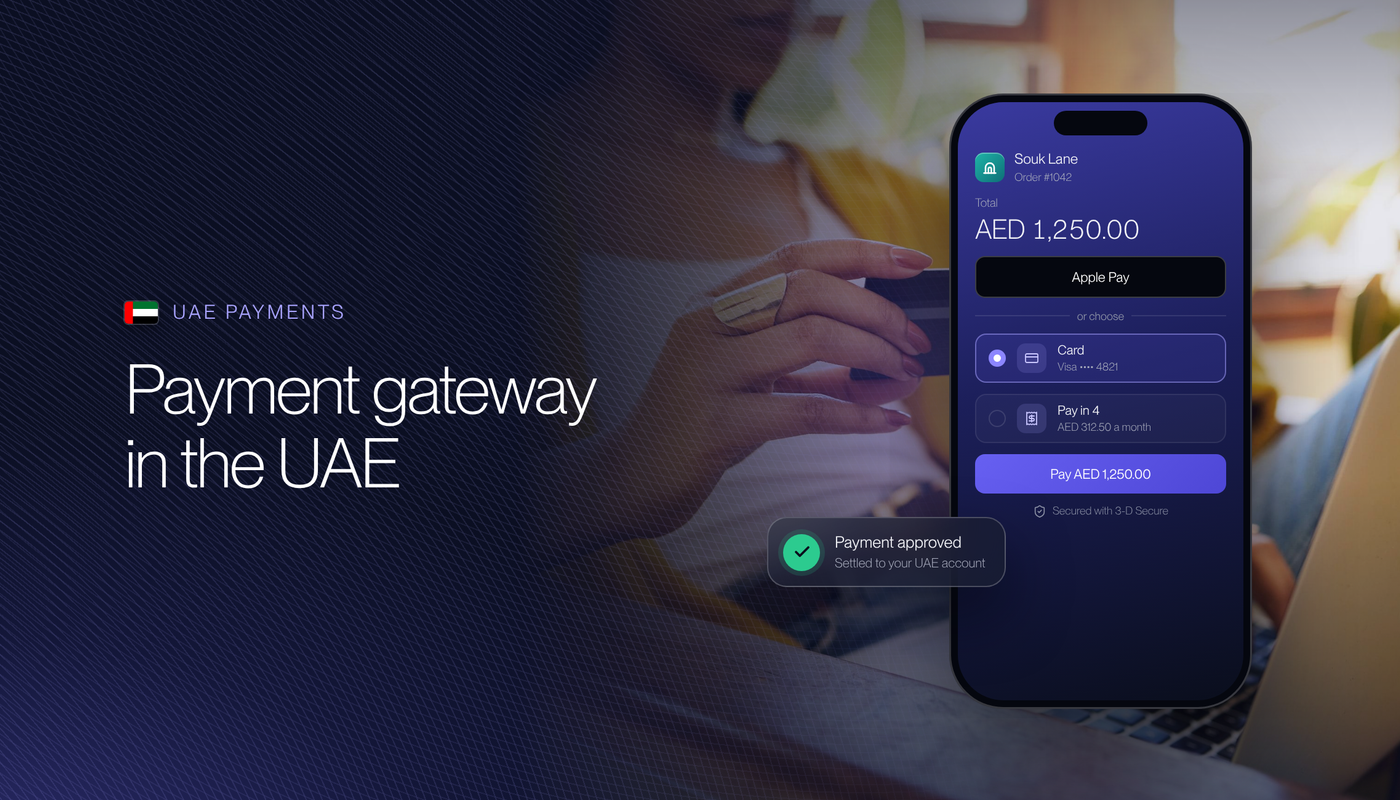
The right payment gateway UAE shoppers trust lets your company take Visa, Mastercard, Apple Pay and Google Pay on its website and in its app, with sales settled in dirhams. Online card payments are routine across the Emirates, and since October 2023 the Central Bank's Aani platform also moves money between accounts instantly, 24 hours a day.
The hard part is the approval and the real price. Local acquirers want a UAE trade licence that covers your activity, a UAE bank account and a finished website before they say yes. A published rate of 2.9% plus AED 1 per payment grows with international cards, currency conversion and VAT on the fees, and some payouts take five business days.
This is where we come in. We match you with a regulated payment partner that takes your business model and handle the application with you: the website check, the KYC pack, the business profile and every underwriting question. Apply once, get a fast approval and start taking payments in days.

What Is a Payment Gateway in the UAE
A payment gateway in the UAE is the service that takes the card or wallet details at checkout, sends them for approval and returns the result to your website within seconds. The money then moves through an acquirer, which settles it to your business account, usually in AED. Your customer sees one screen. Behind it sit four parties.
The gateway is the technical layer: the hosted payment page, the plugin for your store and the fraud checks. The acquirer is the regulated party that holds the merchant relationship and carries the risk if customers dispute payments. The card schemes, Visa and Mastercard, set the rules, and your bank receives the payout. Our guide on what a payment gateway is and how it works covers each role in more depth.
How a UAE Payment Gateway System Works
The system runs the same steps for every order. The customer enters card details or taps Apple Pay. The gateway encrypts the data and passes it to the acquirer. The acquirer asks the card scheme and the issuing bank to approve it. The answer comes back, the order is confirmed, and the funds are batched for settlement to your account on the provider's payout schedule.
The part that matters for your cash flow is the last step. Settlement can be next day, two days or five business days, and faster payouts usually cost more. For a deeper look at card flows, read how an online credit card payment gateway works.
Gateway, Acquirer and Merchant Account
Across the Emirates, these three are often sold as one package, so the words get mixed up. A merchant account is the agreement with the acquirer that lets you accept cards. The gateway is the software that connects your checkout to it. Banks, licensed payment companies and international processors can all play one or more of these roles, and each one runs its own approval.
Aani and Card Payments
Aani is the UAE's instant payments platform, launched on 16 October 2023 by Al Etihad Payments, a subsidiary of the Central Bank of the UAE. It lets people send money using a phone number, request payments and pay merchants by scanning a QR code, 24 hours a day. For most online stores, cards and wallets still carry the bulk of sales, and Aani works best as an extra option for local customers paying from a UAE bank account.
Get Fast Approval for Your UAE Payment Gateway
The best payment gateway UAE businesses can get is the one that approves them on the first try. We build the file with you and match you to a partner that takes your model.
- Fast approval: Your application goes in complete, so it is not sent back for missing items.
- KYC pack done for you: We tell you what is needed and prepare the full file.
- Website checked first: Policies, pricing and contact details reviewed before submission.
- Regulated partners: Licensed payment partners with card scheme access.
- Cards and wallets: Visa, Mastercard, Apple Pay and Google Pay at checkout.
- One application: You apply once and we handle the follow-up questions.
UAE Payment Gateway Fees in 2026
UAE payment gateway fees in 2026 start at about 2.4% to 2.9% plus up to AED 1 per payment for UAE cards on published plans, and run to about 3.2% to 3.9% plus AED 1 for international cards. Larger providers do not publish rates and quote by volume. The table shows what the providers that publish prices charged at the time of writing in November 2026.
Provider | UAE cards | International cards | Other published terms |
|---|---|---|---|
Stripe UAE | 2.9% + AED 1 | 3.9% + AED 1 (adds 1%) | Extra 1% when the charge currency is converted; AED 2 minimum charge |
Mamo Growth | 2.9% + AED 1 | 3.4% + AED 1 | AED 0 a month; payout in 5 business days, same day for 0.75% more |
Mamo Premium | 2.7% + AED 0.80 | 3.2% + AED 0.80 | AED 99 a month; same day payout for 0.5% more |
Nomod | 2.37% + AED 0.80 to 2.67% + AED 0.80 on payment links | 2.87% + AED 1 to 3.07% + AED 1 on its terminal rates | Rate depends on payout speed: 5 days, 2 days or next day |
Telr, Network International, PayTabs, Checkout.com | Quoted by volume | Quoted by volume | Monthly plan or setup fees depend on the contract |
These published plans are flat rates. You pay the same percentage on a cheap local debit card as on a premium foreign credit card, and the provider keeps the difference. Mamo and Nomod quote their fees excluding 5% VAT. Telr does publish tiered plans, but its pricing page currently mixes Saudi riyal and dirham figures, so get its UAE rates in writing before you compare.
What a Month of Sales Really Costs
Take an online store selling AED 100,000 a month at an average order of AED 250: 280 payments on UAE cards worth AED 70,000 and 120 payments on international cards worth AED 30,000.
Fee line | Stripe UAE | Mamo Growth | Mamo Premium |
|---|---|---|---|
UAE cards, AED 70,000 | AED 2,310 | AED 2,310 | AED 2,114 |
International cards, AED 30,000 | AED 1,290 | AED 1,140 | AED 1,056 |
Monthly plan fee | None stated | AED 0 | AED 99 |
Total before VAT | AED 3,600 (3.6%) | AED 3,450 (3.45%) | AED 3,269 (3.27%) |
The gap between these plans is about AED 330 a month on this store, or roughly AED 4,000 a year. The bigger swing comes from the card mix. Every extra point of international sales adds cost, which is why stores that sell abroad should read our guide to the best international payment gateway before they sign.
The Cheapest Payment Gateway in UAE Depends on Your Volume
On cost, the best payment gateway UAE stores can choose changes with your volume. On Mamo's published plans, Premium saves 0.2% and AED 0.20 per payment against Growth, which covers its AED 99 monthly fee at about AED 35,000 a month in sales at a AED 250 average order. Below that, the plan with no monthly fee is cheaper. Above it, the paid plan wins, and the saving grows with every order.
Past roughly AED 300,000 a month, ask for a quoted rate instead of a published one. Acquirers price by volume and risk, and a business with a clean history and a low refund rate can negotiate. The cheapest payment gateway in UAE markets for a small store is rarely the cheapest one at scale. Our guide on the best payment gateway for small businesses covers the early stage in detail.
Is There a Free Payment Gateway in the UAE
No provider offers a free payment gateway in UAE markets in the sense of zero cost. What some offer is AED 0 a month, with the cost moved into the per-payment fee. That suits a new store with low or uneven sales. Once volume is steady, a plan with a monthly fee and a lower rate usually costs less in total, as the example above shows.
How to Judge the Best Payment Gateway UAE Merchants Can Use
The best payment gateway UAE merchants can use is the one that approves your business model, settles in the currency you need on a schedule your cash flow can carry, and keeps its total cost low at your real card mix. The headline rate is only one of five things to check, and it is rarely the deciding one.
Settlement Speed and Currency
Ask when the money reaches your account and in which currency. Five business days is common on entry plans, and next day or same day payout usually costs extra. If you sell in USD or EUR and pay suppliers in the same currency, a provider that settles in AED forces two conversions. Check whether the provider can pay out in the currency you sell in, and to an account in your company's name.
Local and International Cards
Most published plans add about 0.5% to 1% for cards issued outside the UAE, and Stripe adds another 1% when the charge currency is converted. A store selling mainly to UAE residents can ignore much of this. A store selling to the GCC, Europe or Asia should model its real mix before choosing, because the extra charge on foreign cards can outweigh any difference in the base rate.
Checkout Methods Your Customers Expect
UAE shoppers expect Apple Pay and Google Pay, and many expect a buy now pay later option at checkout. Stripe lists Visa, Mastercard, Apple Pay, Google Pay and Link for UAE accounts, and Telr's pricing page lists Apple Pay and Tabby on its plans. Every method you add should come through the same gateway, so reporting and refunds stay in one place.
Reserves and Payout Holds
A provider can hold part of your payouts as a reserve, or pause them, if it sees a risk it did not expect. This happens most often a few weeks after go-live, when real sales start. A complete application at the start is the best protection. Our guide on how to get the best payment gateway provider lists the questions to ask about reserves before you sign.
Integration and Plugins
Check that the gateway has a tested plugin for your platform, whether that is Shopify, WooCommerce, Magento or a custom build. A hosted payment page keeps card data off your servers and reduces your PCI DSS work. An API matters if you build your own checkout, run subscriptions or split payments between sellers. If you sell on Shopify, check the Shopify payment gateway in the UAE options before you build anything custom, and make sure any online payment gateway in the UAE you consider has a tested plugin.
Apply Once for a UAE Payment Gateway
Approval depends on the file, not luck. We prepare it with you and send it to a regulated partner that accepts your model.
- Your model accepted: We match you with a partner that takes your sector and structure.
- Multi-currency payouts: Get paid in the currencies you sell in.
- Non-resident friendly: Companies registered outside the UAE can apply.
- Underwriting answered: We handle the questions so approval does not stall.
- Hosted checkout: Card data stays off your servers.
CBUAE Rules for Payment Gateway Providers in UAE
Payment gateway providers in UAE markets that acquire or aggregate payments need a licence from the Central Bank of the UAE under the Retail Payment Services and Card Schemes Regulation, in force since 15 July 2021. Banks licensed by the Central Bank are exempt but must notify it. For you as a merchant, the rule means checking that your provider is licensed or works through a licensed acquirer.
The regulation lists nine retail payment services, including merchant acquiring and payment aggregation, and sets four licence categories. Capital depends on the average monthly value of payments the provider handles, and the Central Bank can ask for more. Existing providers had a one-year transition period to get licensed. Since then, any firm that offers these services to UAE merchants without a licence or an exemption is operating outside the rules.
What Payment Gateway Providers in UAE Check About You
Payment gateway providers in UAE markets check the same core items. They want to see that the company exists and holds a valid trade licence for what it sells, who owns and runs it, what the website sells and at what price, and how refunds and deliveries work. They also look at your expected monthly volume, average order and refund rate, because these drive their risk.
Trade Licence and Activity
The activity on your licence must match what you sell online. A general trading licence does not always cover e-commerce, and a mismatch is a common reason for a delay. If you sell online from Dubai, our guide on the e-commerce licence in Dubai explains the options, and the guide on the UAE trade licence covers the wider rules.
VAT and Corporate Tax on Card Revenue
Card fees from UAE providers carry 5% VAT, and published rates often exclude it, so add it to any comparison. Your sales income counts toward UAE corporate tax, charged at 9% on taxable income above AED 375,000 under Cabinet Decision No. 116 of 2022, with 0% below that line. A clean gateway report makes both filings easier, because every payment, fee and refund is already itemised.
Payment Gateway in Dubai and the Other Emirates
A payment gateway in Dubai works the same way as one in Abu Dhabi, Sharjah or any other emirate. Providers treat the UAE as one market, settle in AED and apply the same Central Bank rules. What changes from emirate to emirate is your trade licence, which decides what you can sell, and in a free zone, who you can sell to.
Dubai Payment Gateway for Mainland and Free Zone Companies
A Dubai payment gateway approves mainland and free zone companies alike, as long as the licence covers the activity. A mainland company in Dubai can sell to customers anywhere in the UAE. A free zone company can sell online too, but its licence and activity list need checking before you apply, because the gateway will read them closely.
Providers also check that the company name on the licence, the bank account and the website match. A trading name on the site that differs from the licensed name needs a short explanation in the application. If you plan to sell under a brand, put the legal company name in the website footer and the terms.
Is the Dubai Pay Payment Gateway Open to Businesses
The DubaiPay (Dubai Pay) payment gateway is the Dubai government's platform for paying government service fees, not a merchant gateway for private businesses. On 28 October 2025, Dubai Finance announced that it accepts Apple Pay, Google Pay, Samsung Pay, Alipay, RuPay, UnionPay and other wallets for government payments. To take payments from your own customers, you still need a commercial payment gateway.
Set Up Your Payment Gateway in Dubai
Your gateway goes live faster when the licence, the bank account and the website tell the same story. We line them up before you apply.
- Licence checked: We confirm your activity covers what you sell online.
- Name match: Licence, bank account and website reviewed together.
- Mainland or free zone: Both are accepted when the file is complete.
- AED and other currencies: Settlement set up around how you sell.
- Apple Pay and Google Pay: Wallets switched on with the gateway.
- One contact: One team from application to first payout.
Best Payment Gateway UAE Options by Business Type
The best payment gateway UAE sellers can get is different for a Shopify store, a SaaS company and a consultancy that bills by invoice. Each model needs different features and carries a different risk for the acquirer. Start from your model, then look at the providers that serve it well.
Online Payment Gateway in the UAE for Ecommerce Stores
An online payment gateway in the UAE for an ecommerce store needs a hosted checkout, Apple Pay and Google Pay, fast refunds and a plugin for your platform. Stores selling physical goods should also show delivery times and a return policy, because providers check both. Our guide on the best ecommerce payment gateway goes through the features in detail.
Shopify Payment Gateway in the UAE
Shopify lists the UAE among its Shopify Payments countries, but eligibility depends on your plan and business type. When Shopify Payments is not available to you, you connect a third-party Shopify payment gateway in the UAE instead, and Shopify may add its own transaction fee on top of the gateway's rate. Check both fees before you choose, because together they set your real cost per order.
SaaS and Subscription Businesses
Subscription businesses need card storage, automatic retries on failed renewals and clear cancellation terms. The gateway must support recurring billing in your currency. Read our guides on the best subscription payment gateway and on payment gateways for SaaS for the details.
Service Businesses and Invoicing
Consultancies, agencies and clinics often do not need a full store. Payment links sent by email or WhatsApp, or an invoice with a pay button, are enough. Some providers price links differently from website checkouts, as Nomod's published rates show, so ask for the rate on the method you will actually use.
Travel businesses fall into their own group, because payment comes long before the trip. Our guide on payment gateways for travel agencies explains how providers treat that risk.
Companies Registered Outside the UAE
Most local acquirers want a UAE trade licence and a UAE bank account. A company registered in the UK, the EU or elsewhere that sells to UAE customers can still take payments through an international acquirer, which settles in USD, EUR or GBP. UAE cards then count as foreign cards for pricing, so the rate is higher, but you can start selling without setting up a UAE company first.
Higher Risk Sectors
Gaming, crypto, nutraceuticals and similar sectors are declined by most standard providers. They need a specialist route, covered in our guides on the best high risk payment gateway and on how a crypto payment gateway for merchants works.
How to Get Approved for a Merchant Account in UAE
A merchant account in UAE markets is approved when the provider can see who you are, what you sell, how you deliver and what could go wrong. Most declines come from gaps in the file, not from the business itself. Prepare the documents below before you apply and expect a decision within days once nothing is missing.
Documents Merchant Account Providers in UAE Ask For
Providers ask for the same core documents. Have these ready:
- Trade licence: Valid, with an activity that covers what you sell.
- Company documents: Memorandum of association and the shareholder register.
- Owner identity: Passports and Emirates IDs or proof of address for owners and directors.
- Bank account: A UAE business account in the company's name for AED settlement.
- Website: Live, with prices, terms, refund, delivery and privacy policies and contact details.
- Business profile: Expected monthly volume, average order and main customer countries.
- Processing history: Recent statements if you already take cards elsewhere.
The bank account often takes longer than the gateway, so start it early. Our guides on how to open a business bank account in Dubai and on a multi-currency business bank account in the UAE explain the steps.
Why Applications Get Declined
The common reasons are an activity on the licence that does not match the website, missing refund or delivery policies, prices not shown, a website still under construction, an owner who cannot be verified, or a forecast that does not fit the business. Each one is fixable before you submit. A decline is harder to fix after, because the next provider will ask about it.
Do You Need a UAE Company First
For a local acquirer, yes. Most want a UAE company with a trade licence and a UAE bank account. If you do not have one yet, our guide on business setup in Dubai explains the first step. Founders based abroad can read our guide on opening a business bank account in the UAE as a non-resident before they apply.
Open a Merchant Account in the UAE
Approval starts with a complete file. We prepare it with you and submit it to a regulated partner that accepts your business.
- Document list for your case: Only what your provider will ask for, nothing extra.
- Avoid a rejection: Gaps closed before submission, not after a decline.
- Website ready for review: Policies and pricing checked against acquirer rules.
- Clear forecast: Volume and refund figures that match your model.
- Payments live in days: Fast approval once the file is complete.
Common Mistakes With a UAE Payment Gateway
Most problems with a UAE payment gateway come from choosing on the headline rate, applying before the website is ready, or ignoring the payout terms. Each one costs time or money that a little preparation saves.
Choosing on the Headline Rate
A store that picks the lowest UAE card rate but sells 40% to foreign customers can pay more in total than on a plan with a higher base rate and a smaller foreign card surcharge. On AED 100,000 a month, a 1% difference on the international share alone is worth AED 400. Model your real card mix before you choose, using the worked example above as a template. The best payment gateway UAE stores can choose is the one with the lowest total cost, not the lowest base rate.
Applying With an Unfinished Website
Providers review the website as part of underwriting. Missing refund terms, no prices or a placeholder page lead to a decline or a request for changes, which adds a week or more. Finish the site first, including the legal company name in the footer, then apply. One complete application is faster than two incomplete ones.
Ignoring the Payout Schedule
A five-day payout means the money from Monday's sales arrives the following week. For a store paying suppliers upfront, that gap needs working capital. Faster payout costs 0.5% to 0.75% more on Mamo's published plans, which on AED 100,000 a month is AED 500 to AED 750. Decide whether speed or price matters more before you sign.
Leaving the Bank Account to Last
Most local acquirers settle only to a UAE bank account in the company's name. Founders who apply for the gateway first often wait weeks for the account, with the gateway approved but unable to pay out. Open the account in parallel with the gateway application, or choose a provider that can settle to a multi-currency account you already have.
Talk to Us About Your Payment Gateway UAE Setup
Not sure which route fits your business? Tell us how you sell and where your customers are, and we match you with the right partner.
- Advice on your card mix: Local or international route, based on your real sales.
- Company and account: We can form the UAE company and set up the bank account too.
- Regulated partners: Licensed providers with card scheme access.
- Clear terms: Fees, payouts and reserves explained before you sign.
- We handle everything: Application, documents and follow-up in one place.
Bottom Line
A UAE payment gateway costs about 2.4% to 3.9% plus up to AED 1 per payment on published plans, before 5% VAT on the fees. The best payment gateway UAE companies can choose depends on card mix, payout needs and business model more than on the headline rate. Prepare the licence, bank account and website before you apply, and approval follows quickly.
Your situation | What to do | Why |
|---|---|---|
New UAE store, low or uneven sales | Start on a plan with no monthly fee | Fixed fees cost more than they save at low volume |
Steady sales above about AED 35,000 a month | Move to a lower rate plan with a monthly fee | The lower rate covers the fee and then saves money |
Large share of foreign customers | Compare the foreign card surcharge, not the base rate | It decides most of your total cost |
Company registered outside the UAE | Use an international acquirer | Local acquirers usually need a UAE licence and account |
Sales above about AED 300,000 a month | Ask for a quoted rate | Volume pricing beats published plans |
Higher risk sector | Go to a specialist provider | Standard providers decline most of these models |
Whichever route you take, the company and the account come first. If you are still at that stage, read company formation in the UAE and our guide to company formation costs by country.
What is the best payment gateway UAE businesses can use in 2026?
How much does a UAE payment gateway cost?
Is there a free payment gateway in UAE?
Which is the cheapest payment gateway in UAE?
Can I use a payment gateway in Dubai with a free zone company?
Does Shopify Payments work in the UAE?
Do I need a UAE company to get a UAE payment gateway?
What documents do merchant account providers in UAE need?
How long does it take to get a merchant account in UAE?
Are payment gateway providers in UAE regulated?
Is the Dubai Pay payment gateway available to businesses?
Can I accept Aani payments on my website?
Do I pay VAT on payment gateway fees in the UAE?
Sources
- Stripe Support, UAE Promotional Pricing FAQs (standard pricing from 9 January 2023)
- Stripe Support, payment methods and products available in the UAE
- Mamo, pricing plans (accessed November 2026)
- Nomod, standard plans (accessed November 2026)
- Telr, pricing page (accessed November 2026)
- Shopify Help Center, supported countries for Shopify Payments
- Central Bank of the UAE Rulebook, Retail Payment Services and Card Schemes Regulation
- Pinsent Masons, UAE introduces licensing regime for payment service providers
- Central Bank of the UAE, Al Etihad Payments launches Aani (16 October 2023)
- Dubai Media Office, Dubai Finance enables global digital wallets on DubaiPay (28 October 2025)
- UAE Ministry of Finance, Cabinet Decision No. 116 of 2022 on the taxable income threshold